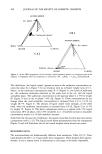
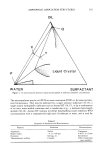
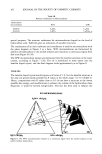
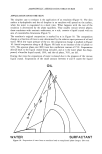
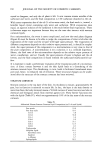
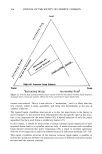
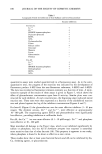
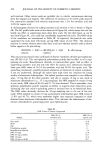
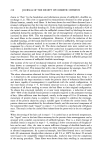
166 JOURNAL OF THE SOCIETY OF COSMETIC CHEMISTS crystal to disappear, and only the oil phase is left. It now contains inverse micelies of the surfactant and water, and the final composition is 14% surfactant dissolved in the oil. With some evaporation also of the oil (« oil-to-water ratio), the final result is, instead, a lameliar liquid crystal containing only water and surfactant. With evaporation rates equal, an aqueous solution of the surfactant is the result before final evaporation. These in-between stages are important because they are the ones that interact with stratum corneum lipids. For a microemulsion, the event is more complicated, and now the total phase diagram (Figure 8) must be known to be able to judge the compositions of what is left after the evaporation of the water and the oil part with high vapor pressure. The evaporation of different components depends on their relative vapor pressure and, it should be empha- sized, the vapor pressure of the components in a microemulsion is very close to that of the pure components. A microemulsion is not a solution it is a colloidal dispersion. Hence, the final state of the microemulsion depends on the relative vapor pressure of water, cosurfactant, and oil. Usually the vapor pressure of water is highest and the oil lowest, and the final composition is found towards the surfactant/cosurfactant/oil sur- face. It is essential to make a preliminary evaluation of the evaporation path of a microemul- sion. A direct contact between it and the skin lipids leads to a disordering of the stratum corneum layer. The disordering, in turn, leads to facilitated transdermal trans- port and, hence, to enhanced risk of irritation. These structural changes can be under- stood after the structure of the stratum corneum has been reviewed. STRATUM CORNEUM Stratum corneum is the top layer of the skin. Its thickness is minute, approximately 30 [•m, but its function is essential to retain life. In fact, the layer is the main barrier to water loss from the body (removal means a 50-fold increase of water loss rate) and also to chemical and biological attack from external agents (22). These barrier functions rest with the lipids (Table IV), which are approximately 10% of the dry mass of the stratum corneum. Table IV Abdominal Human Stratum Corneum Lipid Composition (wt% of total liDds) Free steroIs 14.0 Free fatty acids 19.3 C14:0 3.8 C16:0 36.8 C16:1 3.6 C18:0 9.9 C18:1 33.1 C18:2 12.5 C20:0 0.3 Triglycerides 25.2 Nonpolar lipids 16.3 Sterol/wax esters 6.1 Squalene 6.5 n-Alkanes 3.7 Sphingolipids 18.1

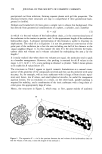
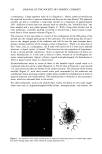
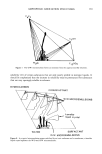
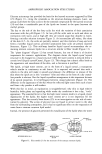
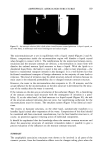
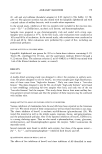
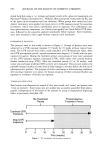
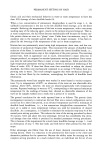
AMPHIPHILIC ASSOCIATION STRUCTURES 167 Electron microscopy has provided the basis for the layered structure suggested by Elias (23) (Figure 11), citing the ceramides as the structure-forming elements. Later, our group could show the fatty acids to be the essential compounds for the layered structure (24) and that a considerable part of the lipids are located in the space between the methyl groups. The key to the role of the free fatty acids lies with the variation of their association structures with the pH (Figure 12). At low pH the acids exist as such and show no interaction with water, and at high pH they are ionized soaps that dissolve in water, forming a miceliar solution (compare Figure 2). At intermediate pH values, like those of the skin (4.5-6), the acids are partially ionized, and this mixture of soap and acid forms a lameliar liquid crystal, provided unsaturated fatty acids are present (Layered Structure, Figure 12). This acid/soap lameliar liquid crystal accommodates the re- maining stratum corneum lipids into a structure similar to Elias' model (Figure 11). The "phase diagram" (Figure 12) has several features, but one of them is of decisive importance for cosmetic applications. The diagram shows the liquid crystal layered structure to be changed to a crystal structure when the water content is reduced below a certain level (Liquid crystal/Crystal, Figure 12). This change has a drastic effect both on the appearance and smoothness of the skin, and a discussion is justified. The lipids, at high water content, are in the form of a liquid crystal, a transparent vehicle similar in consistency to soft butter. It is expected and natural that such a vehicle in the skin will make it smooth and pleasant the difference in texture of the skin when the lipids are in this "ointment" form and when in the form of a dry crystal- line powder is obvious. But the liquid crystalline arrangement is also important because of its optical properties. It is birefringent between crossed polarizers (Figure 13). The difference in the appearance of the skin when the reflected light comes from such a layer and from a dry powder is self-evident. With this fact in mind, an explanation is straightforward: why skin in high relative humidity looks glossy and appealing while under dry conditions it has a dry, "scaly" appearance. The essential factor is that the high water content results in a liquid crystal organization of the lipids the higher water content per se is not important for the appearance. This has recently been shown (25) in an investigation on the role of mois- turizer by glycerol. The action of glycerol was not found to attract water to the skin from the surrounding atmosphere, and it had no significant effect on the evaporation of water from a stratum corneum lipid model. Instead, the presence of glycerol prevented the crystallization of the lipids when the water Cholesterol Ceramide 61ucosyl- OIFFERENTIAIEO CELLS INIERCELLULAR LAYERED STRUCTURE REGION Figure 11. Elias model (23) for the structure of the stratum corneum lipids.
Purchased for the exclusive use of nofirst nolast (unknown)
From: SCC Media Library & Resource Center (library.scconline.org)