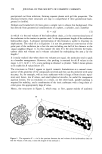
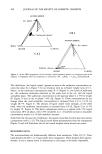
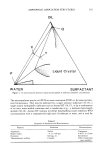
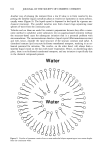
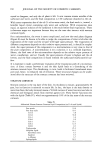
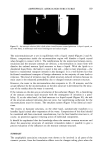
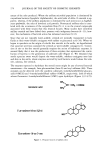
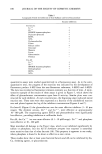
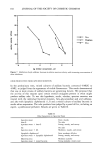
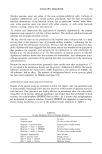
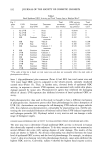
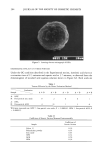
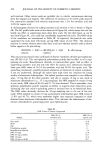
156 JOURNAL OF THE SOCIETY OF COSMETIC CHEMISTS precipitated out from solutions, forming separate phases with gel-like properties. The relations between these structures are easy to comprehend if their geometrical back- ground is clarified. Ninham and Israelachvili (4) have given a simple rule to obtain this background. One has directly from geometrical considerations of a sphere, a cylinder, and a lamellae R = v/a/ [ 1] in which v is the real volume of the hydrocarbon chain, a is the cross-sectional area of the surfactant in the structure in question, and l is the approximate length of the surfactant hydrocarbon chain. A physical interpretation of this formula is useful to illustrate its implications. The value of a in Equation 1 is not the geometrical cross-section of the polar part of the surfactant per se but the area including one half of the distance to the closest neighbor (Figure 1). In this manner the ratio R is the ratio between the hydro- carbon chain real volume and a volume calculated by multiplying the area a by the length 1. It is easily realized that when these two volumes are equal, the molecules tend to pack in a lameliar arrangement. However, this packing is retained for all R values in the range 1-0.5. At R = 0.5, a new packing is obtained: a cylinder. Table I shows spheres to be stable for R values below 1/3. The structures in Table I appear in typical cosmetic formulations as a natural conse- quence of the geometry of the compounds involved and they can be predicted with some accuracy. So, for example, will an ionic surfactant with its large a (from electric repul- sion) and, hence, low R values, and small spherical micelies, be useful for transparent aqueous lotions. For an emulsion or a cream, on the other hand, parallel packing is required for stability, and a combination of the ionic surfactant with a long-chain al- cohol gives the appropriately large R value. Hence, the structures in Figure 2, which may, at first, appear mainly of academic Figure 1. The expression R = v/al is the quotient between the real volume of the hydrocarbon chain (v) and the volume of the area a times the length of the molecule 1.

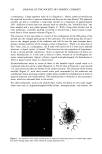
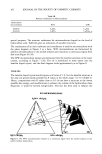
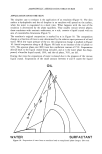
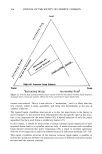
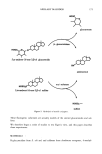
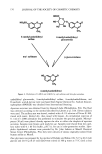
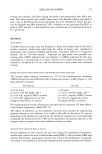
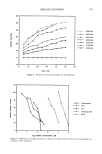
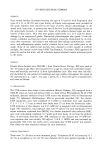
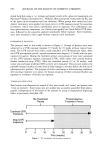
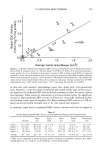
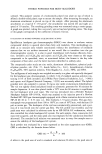
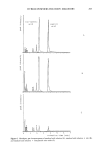
AMPHIPHILIC ASSOCIATION STRUCTURES 157 Table I Relation Between R and Amphiphilic Association Structures R % ¬-« «-1 1 Structure Spherical Cylinder Lamella Inverse cylinder Aqueous or micelie Micelie interest are, in fact, essential to understanding both microemulsions, emulsions, and foams. In addition, the almost identical system of water, soap, and long-chain carbox- ylic acid is decisively relevant to the structure of the stratum corneum lipids. These latter hold the key to the effect of humidity on skin properties and are the essence of cosmetic science. Hence, a closer examination of them is well worthwhile. Adding a long- or medium-chain to an ionic surfactant in an aqueous solution results in three structures forming consecutively. At first, the ionic surfactant forms spherical micelies in the aqueous solution (Figure 2, bottom left). This structure is expected because the polar groups of an ionic surfactant give repulsive forces between them and, as INVERSE MICELLES Long chain Alcohol LAMELLAR LIQUID CRYSTAL water Ionic Surfactant SPHERICAL MICELLES Figure 2. In a system of water, ionic surfactant, and long-chain alcohol three phases are important cosmet- ically. The aqueous solution (lower left) contains spherical micelies, the lameliar liquid crystal is located in the middle, and the alcohol solution (top) contains inverse micelies.
Purchased for the exclusive use of nofirst nolast (unknown)
From: SCC Media Library & Resource Center (library.scconline.org)