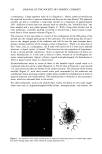
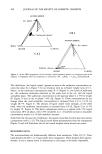
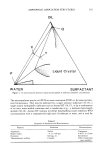
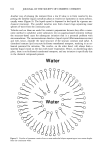
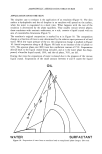
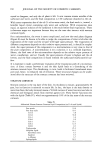
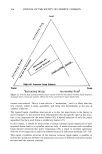
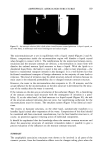
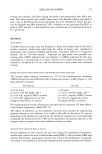
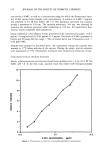
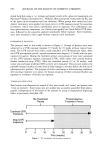
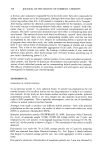
158 JOURNAL OF THE SOCIETY OF COSMETIC CHEMISTS a consequence, a huge apparent value of a in Equation 1. Hence, spherical micelles are the expected structures in aqueous solutions and they are the ones formed. The spherical micelies are able to solubilize a long-chain alcohol to a maximum of approximately 10%. Addition of more than that amount leads to turbidity the "solubility limit" has been reached and a new phase appears (Figure 2). With a long-chain alcohol and an ionic surfactant, a lameliar packing is actually so favored that a liquid crystal is sepa- rated from a dilute aqueous solution (Figure 2). The structure of this new phase is a result of the combination of the OH group of the alcohol and the charged polar group of the surfactant. The alcohol group has no repul- sion to the charged groups of the surfactant and will fit into the space between them, giving a strong reduction of the average a value in Equation 1. There is no reduction in the v value, and, as a consequence, the R value will exceed the 0.5 limit and a lameliar structure, a liquid crystal, is formed. This structure has two properties of importance. It has a viscous gel-like consistency, which is important for stabilization of many cos- metic formulations. It is also easy to detect in these, because of its birefringence be- tween crossed polarizers. Figure 3 shows a typical microphotograph of a formulation in which a liquid crystal exists in a hand lotion. Alcohol/surfactant ratios in excess of those in the lameliar liquid crystal result in a continued reduction of the a value (Equation 1). The R value in Equation 1 now exceeds 1.0, and inverse micelies are formed in the alcohol solution. The structure of the inverse micelies (Figure 2), with their central water pool surrounded by the surfactant and cosurfactant chains pointing outward, makes them suitable for solubilization of water or aqueous solutions into hydrocarbons. This solubilization is obtained in the microemul- sions, which are discussed later in the article. For other surfactants, such as the double-chain variety (lecithins) or even some single- chain ones such as oligoethyleneglycol-alkyl-ethers, monoglycerides, and similar, the Figure 3. An emulsion with liquid crystals gives an expected microscope picture in normal light (right) but shows shining halos when viewed between crossed polarizers (left).

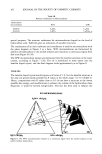
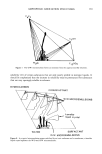
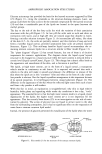
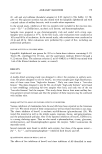
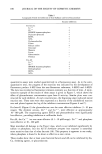
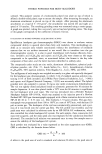
AMPHIPHILIC ASSOCIATION STRUCTURES 159 polar group is small and the lameIlar liquid crystal is formed directly from the aqueous solution. The aqueous solubility is now extremely small ( 1%), and the lameliar liquid crystal is in equilibrium with a very dilute aqueous solution. This fact is used to prepare creamy dispersions of the liquid crystal and also to prepare vesicular solutions. In the following sections, emulsions, microemulsions, and vesicles are briefly described, emphasizing situations when surfactant association structures are important for special properties of the system. EMULSIONS Emulsions were originally considered as dispersions of one liquid in another in the form of large droplets (micron size) (5). The stability of such an emulsion is decided by the surface properties of the droplets and the colloid stability of the thin liquid films formed when droplets fiocculate (6). However, a large number of cosmetic emulsions (3) contain more than two liquids they may, in addition, contain another liquid, a solid substance or a lameliar liquid crystal. The first and last cases are of interest for this article because they illustrate the decisive influence that surfactant association structures can have on emulsion properties. THREE LIQUIDS Emulsions containing three liquids stabilized by the common ethylene oxide adducts are characterized by a very small average droplet size in spite of only a minute energy required for the emulsification process (7,8). The emulsification of an O/W system takes place at elevated temperatures (HLB-temperature, =60 C ø) where the third liquid (the surfactant phase) appears (Figure 4A). The interfacial tension between the three liquids is at minimum at the HLB-temperature and emulsification is facilitated. After emulsification, the system is cooled fast to room temperature. The surfactant phase region has now been moved to the water corner, and the emulsion becomes a traditional one of two liquid phases (Figure 4B). The "move" of the surfactant phase means a rather tumultuous process in the system, the surfactant phase being split into two phases and its components transferred to the oil and water liquids. These interfacial transfers fur- ther divide the droplets into smaller ones. TWO LIQUIDS PLUS A LIQUID CRYSTAL When the third phase is a liquid crystal (Figure 5) (9,10), two properties are interesting from the formulation point of view. At first it should be observed that the vehicle that stabilizes the emulsion (liquid crystal, Figure 5) is now composed not only of the sur- factant: the water and the hydrocarbon are also included into it. As a matter of fact, in the figure, they are the major components. In the example the liquid crystal has a composition of water 59.4%, oil 24.4%, with the surfactant present only to 16.2% (by weight). Hence, the stabilizing body consists of 83.8% of water and oil. This vehicle exists in the emulsion together with the oil phase and aqueous phase and can be sepa- rated from them by centrifugation. Instead of the common two layers, when a simple emulsion is separated, now three layers are found: oil, water, and liquid crystal.
Purchased for the exclusive use of nofirst nolast (unknown)
From: SCC Media Library & Resource Center (library.scconline.org)