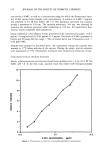
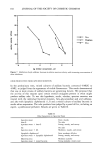
210 JOURNAL OF THE SOCIETY OF COSMETIC CHEMISTS chains to "flow" by the breakdown and reformation process of sulfhydril-disulfide in- terchange (1,2). This view is supported by measurements obtained on other groups of fibrous keratins, namely wool fibers. It has been shown for wool fibers distorted into a strained configuration that the time rate of protein chain rearrangement is dependent on the reduction of the disulfide bonding (3). If the disulfide bonding is reduced to 42% of the initial content of the fiber with the sulfhydril content fixed by blocking the excess sulfhydrils formed by methylation, the time rate of rearrangement of protein chains is increased by about 40%. This was measured by the relaxation of mechanical forces in the wool fibers in the strained configuration. However, if with the reduction of the disulfide bonding, all the bonds cleaved were converted to sulfhydrils, the large increase in the sulfhydrils present resulted in an increase of the time rate of protein chain rear- rangement by a factor of nearly 20. The above mechanical tests were carried out for wool fibers in distilled water. If the tests were carried out in aqueous solutions over the hydrogen ion concentration range from pH 3.7 to pH 9.7 (2), an increase in the rate of mechanical relaxation and hence of protein chain rearrangement of 1000 for this pH range was obtained. This rate results from the increase of ionized sulfhydril groups and hence from an increase of sulfhydril disulfide interchange. The increase of the rate of mechanical relaxation with increase of temperature also has been shown to correspond to a single reaction process of energy of activation (3) of around 80 kj/g mol. This means that with a rise of temperature for example, from 25øC to 75øC, the rate of mechanical relaxation increases by a factor of 100. The above observations obtained for wool fibers may be considered in relation to steps 1-4 observed in the normal permanent waving procedure for human hair. Steps 1-3 are essentially the steps necessary to make the protein chain of ot-keratin fibers mobile and hence capable of rearrangement to equilibrium with the curled configuration. In the time frame of steps 1-3, the keratin structure acts as a liquid, with a complete relaxation of all forces tending to return the hair fibers to their original configuration. To obtain this structural mobility at or near room temperature, a reduction of some 20%-40% of the disulfide bonds present is normally required in the permanent waving of hair. After sufficient time has elapsed, usually in the range of 10 to 30 minutes, the movement of protein chains is complete. Step 4 is applied to stabilize the rearrange- ment of the protein chains by using a suitable agent to reform the cystine bonds. The protein chains are immobilized by the reformed bonds, and the structural component of the ot-keratin fiber made "liquid" in steps 1-3 is reversed to a mechanically stiff glassy state. The result is that the curled fibers release from the perm-rods in the set configura- tion. When the setting of the hair curl in steps 1-3 is carried out at an elevated temperature, the "liquid" state in the hair fibers necessary for the protein chain rearrangement can be attained with a smaller concentration of sulfhydril groups. That is, a lower cleavage of disulfide bonds is required in steps 1-3, meaning a lower concentration of thioglycol- late can be used. Also, the time to attain sufficient cleavage of disulfide bonds and a complete relaxation of the protein chains into their rearranged state occurs more quickly at elevated temperatures. As a practical example, hair fibers formed into a curl treated with 4% ammonium thioglycollate solution at pH 9.4 at 100øC for about 20 seconds were found to be completely relaxed mechanically, ready for step 4 for the completion of the setting procedure. These fibers were shown from their swelling in concentrated

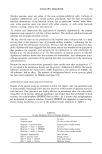
PERMANENT SETTING OF HAIR 211 formic acid and their mechanical behavior in water at room temperature to have less than 10% cleavage of their disulfide bonds (4). When a low concentration of ammonium thioglycollate is used for steps 1-3, the sulfhydril concentration is low due to the low disulfide bond cleavage, as in the above example. Reducing the temperature of the hair to room temperature, with a concurrent washing away of the reducing agent, results in the protein structure being set. That is, at room temperature, the hair fibers become mechanically stiff because the former mo- bile protein chains are now in a "glassy" state. Under these circumstances, step 4, the oxidation step in the example quoted above, was no longer necessary. It has been re- placed by the lowering of the temperature of the curl to room temperature. Human hair was permanently waved using high temperature, short time, and low con- centration of ammonium thioglycollate. This minimized the amount of disulfide bond reduction of the fibers. It removed the need to reform the cleaved disulfide bonds, i.e., eliminated the neutralization step at the completion of the perm process. The resulting permed hair, both in appearance and in touch, demonstrated a major reduction in changes produced, as compared to standard permanent waving procedures. Force-exten- sion tests for individual hair fibers in water at room temperature, before and after this high temperature permanent waving technique, showed a mechanical weakening of the fibers of under 10%. If these hair fibers were then reoxidized to reform the cleaved disulfides, the fibers were mechanically weakened to an average 17% below their pre- perming tests in water. This result strongly suggests that more mechanical damage is done to the hair fibers by the oxidation, outweighing the benefit of disu!fide bond reformation. The permanently waved hair samples were washed in water heated to various tempera- tures. Up to temperatures of 60øC, no relaxation of the wave set was observable after washing. Above 60øC, however, the wave set relaxed progressively with temperature increase. Repeated washings in water at 45øC, corresponding to the expected maximum temperature for the washing of human hair, showed no observable relaxation of the wave set for samples washed once a week over a period of 12 months. The general conclusion for the work reported here is as follows: The protein chain rearrangement necessary to restructure the hair fiber into a waved configuration can be carried out for a short time period, at an elevated temperature and with a minimum of disulfide bond breakdown, i.e., a low ammonium thioglycollate concentration. The wave set is stable at room temperature without any need for reoxidation of cleaved disulfides. As a consequence, it is feasible to eliminate the oxidation step (step 4) of the normal perm setting procedure. This reduces the time of the setting procedure by about 30 minutes. Over and above this time advantage, the hair has considerably less chem- ical damage than that which is produced by standard permanent waving procedures. This is because of the requirement for a much lower disulfide cleavage in steps 1-3 and an elimination of step 4. The hair looks and feels better when permed by this tech- nique. Other advantages also follow from the use of lower chemical concentrations in the waving lotions. There is a reduction in the potential for skin burns to the client and dermatitis problems for the operatives. Because the ability exists for carrying out the complete setting procedure in a much reduced time, an individual test for set of one
Purchased for the exclusive use of nofirst nolast (unknown)
From: SCC Media Library & Resource Center (library.scconline.org)