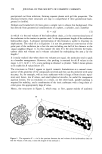
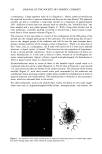
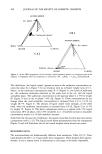
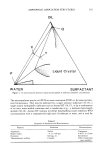
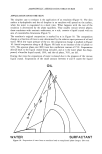
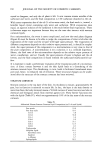
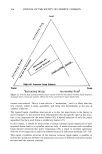
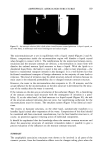
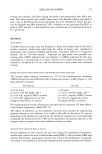
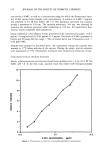
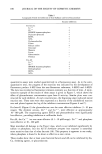
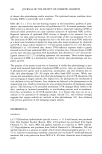
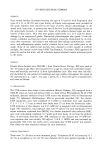
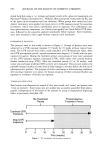
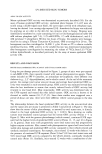
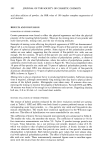
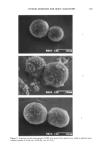
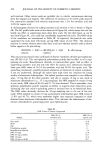
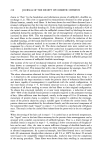
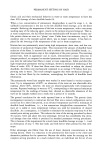
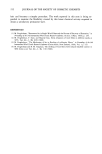
160 JOURNAL OF THE SOCIETY OF COSMETIC CHEMISTS Water HYDROCARBON Oil (B) " SurfactanphaseOil•HYDRxphase•" •_ WATER (A) Aqueous phase WATER Cx (EO) y Figure 4. At the HLB temperature (A) the isotropic liquid (surfactant phase) is a conspicuous part of the diagram. It disappears when the temperature is reduced by 30øC. Cx(EO)y = CxH2x +•[(CH2)20]yOH The third layer, the liquid crystal, appears as soon as the surfactant concentration ex- ceeds the value X in Figure 5 for an emulsion with an oil/water weight ratio of 1:1. Hence, in the surfactant concentration range X-Y (Figure 5), two kinds of stabilizers act: the surfactant molecules dissolved in the water and in the oil, and the liquid crystalline phase. The surfactant concentration in the aqueous phase is 2.5% by weight (P, Figure 5) and in the oil phase 5.8% (Q, Figure 5). These concentrations do not change when the total emulsifier concentration is increased from 4.0 to 13.5% by weight (X-Y, Figure 5). The amount of liquid crystal varies strongly, on the other hand, when the surfactant concentration is increased from 4.0 (X, Figure 5) to 13.5% by weight (Y, Figure 5). The latter composition results in a system with 72% liquid crystal plus 28% oil phase, with 5.8% emulsifier in it. A fourfold increase in emulsifier concentration results in a 24-fold stabilizer increase! Aside from the obvious role of stabilizer, the liquid crystal has recently also been used as a preparatory tool (11,12). The liquid crystal forms spontaneously from the components (Figure 5) and will distribute the oil into small droplets when stirred into water. MICROEMULSIONS The microemulsions are fundamentally different from emulsions, Table II (13). Their small droplets (0.0015-0.15 •m) make them transparent. These droplets form sponta- neously to stir a system down to dimensions in this range is obviously impossible.

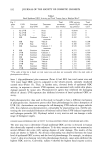
AMPHIPHILIC ASSOCIATION STRUCTURES 161 OIL Q Y P ß 0 :-:":'.i. ' Liquid Crystal WATER SURFACTANT Figure 5. In many emulsion systems a liquid crystal appears at moderate emulsifier concentrations. The microemulsions may be oil (W/O) or water continuous (O/W) or, for some systems, even bicontinuous. They may be stabilized by a single nonionic surfactant (14, 15), a single anionic hydrophobic surfactant such as Aerosol OT (16, 17), or by a combination of an ionic water-soluble surfactant and a cosurfactant (e.g., a medium-chain-length alcohol) (18, 19). Aerosol OT (sodium di-(2ethyl hexyl)sulfosuccinate) stabilizes W/O microemulsions with a comparatively high ratio of surfactant to water, and is used for Table II Properties of Emulsions and Microemulsions Property Emulsions Microemulsions Appearance Turbid Transparent Droplet radius --0.15-100 IJtm 0.0015-0.15 IJtm Formation Stirring, etc. Spontaneous Thermodynamic stability Unstable Stable (exceptional cases unstable)
Purchased for the exclusive use of nofirst nolast (unknown)
From: SCC Media Library & Resource Center (library.scconline.org)