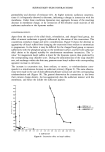
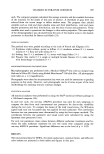
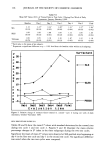
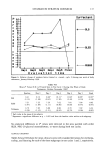
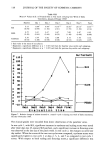
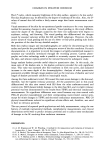
SURFACTANT-SKIN INTERACTIONS 83 S •.5' 0 p 3.0- 2.5- 2.0- ß RUN •. ß RUN 2 iO 20 30 40 50 50 70 80 90 tO0 ttO c-valus Figure 13. C-values vs soap chamber scores of anionics from two separate runs done by the same test laboratory. Table II List of Soap Chamber Indices and "C-Values" Surfactant "C-value" Soap chamber score Pluriol PE6400 4.10 0.30 SLES/Pluriol 3:1 5.48 0.70 Triton-X 102 8.90 0.45 Pluriol PE6400/SLES 1:1 12.21 0.50 C16/18 alcohol (EO15) 643.27 0.40 C16/18 alcohol (EO20) 1953.52 0.20 mary irritation and delipidization. Both are important factors in real-use situations. Liposome damage may occur by two mechanisms, namely: disruption of the phospho- lipid layers by charge interaction (predominant for anionics) and dissolution of the phospholipid layers by solubilization (predominant for nonionics). These mechanisms could be considered analogous to skin irritation and delipidization (detersivity). Soap chamber data do not measure detersivity and there is up to now no reliable in vivo model for it. Lack of correlation of the "c-values" and soap chamber scores for some surfactant systems may not indicate an inherent flaw in the liposome method. The in vivo indices have long been known to give erratic results (3,4,24) and, apart from the subjectivity of the assessments, not all irritation may be measurable by the same criteria. Surfactants that destroy liposomes at low concentration, but only after an initial lag time, may initially bind to the outer surface of the liposomes. A multiphase interaction may occur in this case, whereby the binding step may have a neutral, a shielding, or an irritating character.

84 JOURNAL OF THE SOCIETY OF COSMETIC CHEMISTS CONCLUSION The purpose of this work is to define a reliable, reproducible, and quantitative in vitro system to test surfactant mildness. The liposome assay does not involve growing cells or isolating materials and components from tissue. Liposomes can be prepared at short notice, they are a totally defined system, and they are remarkably reproducible in their mode of response. Liposomes contain basic membrane lipid components. The assay is run under standardized conditions of physiological pH and osmolality so that the only variable tested is the surfactant. Based on the available data, there is reason to believe that the liposome technique ranks the mildness of anionic surfactants, comparable to established in vivo techniques. Be- cause of the relative ease and speed of the liposome method, it becomes possible to screen a large number of potential surfactant blends, especially anionics. The best candidates can then be selected for formulation into products, and their characteristics can even- tually be confirmed by in vivo methods if this should be necessary for their commercial acceptance. With the recommendations of the Center for Alternatives to Animal Testing of The Johns Hopkins University School of Hygiene and Public Health in mind, the liposome assay may well provide one out of a battery of screening tools to evaluate the irritancy of surfactants and surfactant blends and thereby reduce the need for animal testing. ACKNOWLEDGMENTS The authors wish to thank summer intern Mary F. Messerlie for enthusiastic assistance, Dr. R. R. Wickett and J. J. Runkel for writing the computer program to record and manipulate the fluorescence readings, and Linda A. Boldus for secretarial help. REFERENCES (1) P. J. Frosh and A.M. Kligman, A new method of assessing irritancy of soaps, J. Am. Acad. Dermat., 1, 35-41 (1979). (2) J. H. Draize, G. Woodard, and H. O. Calvery, Methods for the study of irritation and toxicity of substances applied topically to the skin and mucous membranes, J. Pharmacol. Exp. Ther., 82, 377 (1944). (3) J. F. Griffith, The low volume eye irritation test, Soap/Cosmetics/Chemical Specialties, 32-36, 58•53 (April 1987). (4) A.M. Goldberg and J. M. Frazier, Alternatives to animals in toxicity testing, Scientific American, 261(2), 24-30 (1989). (5) H. Salem, Alternative approaches to animal testing in toxicological evaluations, Army Research, Development and Acquisition Magazine, 24-26 (Jan .-Feb. 1987). (6) A.D. Bangham, Membrane models with phospholipids, Prog. Biophys. Mol. Biol., 18, 29 (1968). (7) J. Wilshut, "Preparation and Properties of Phgospholipid Vesicles," in Liposome Methodology in Phar- macology and Cell Biology, L. D. Leserman and J. Barber, Eds. INSERM Symposia Series, Vol. 107, 1982, pp. 9-24. (8) M. K. Bahl, ESCA studies on skin lipid removal by solvents and surfactants, J. Soc. Cosmet. Chem., 36, 287-296 (1985). (9) G. Lang and J. Spengler, Surfactants in cosmetic formulations: Skin irritancy and physical properties, XIVth I.F.S.C.C. Congress, Barcelona, 1986. (10) M. B. Finkey, Evaluation of subjective irritation induced by soap materials,J. Soc. Cosmet. Chem., 82, 153-161 (1987).
Purchased for the exclusive use of nofirst nolast (unknown)
From: SCC Media Library & Resource Center (library.scconline.org)