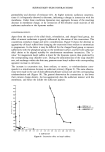
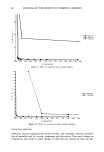
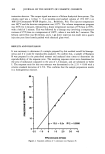
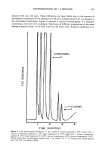
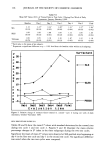
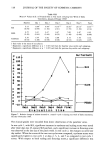
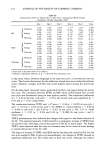
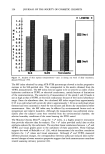
100 JOURNAL OF THE SOCIETY OF COSMETIC CHEMISTS ionization detector. The output signal was sent to a Nelson Analytical data system. The column used was a 12-foot x Vs-in stainless steel packed column of 15% OV-1 on 100/120 Chromasorb WHP (Supelco, Inc., Bellefonte, PA). The injector temperature was 185øC and the detector temperature was 325øC. The column temperature program was: 85øC for 2 minutes, followed by a linear temperature increase of 5øC/min to 95øC, with a hold of 1 minute. This was followed by a cleanup step involving a temperature increase of 25øC/min to a temperature of 300øC, where it was held for 5 minutes. The helium carrier flow was 40 ml/min, and a 1-•1 direct injection was made into a quartz injection port liner loosely packed with silanized glass wool. RESULTS AND DISCUSSION It was necessary to determine if a sample prepared by this method would be homoge- neous and if it could be reproducibly analyzed. To confirm this, a sample of Shampoo B was prepared in the prescribed manner and analyzed nine times to determine the reproducibility of the response ratio. The resulting response ratios were determined as the area of isobutanol compared to the area of 1,4-dioxane, and are tabulated in Table I. The response ratio for this test mixture was determined to be 2.55 - 0.06 with a relative standard deviation of 2.5%. This confirms that the sample preparation results in a homogeneous mixture. -20 - 1 0 y= 13.8+ 0.9x R^2 =0.9996 ß I ' I ' I ' I 0 10 20 30 40 PPM DIOXANE SPIKED Figure 2. Standard addition of 1,4-dioxane into Shampoo B.

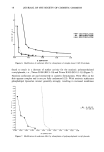
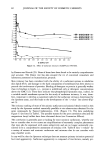
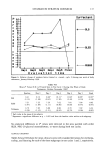
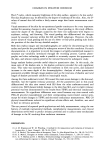
DETERMINATION OF 1,4-DIOXANE 101 Studies were performed to determine the linear range and recovery of the method. 1,4-dioxane standards were prepared at levels between 1 and 250 ppm and analyzed. The results are graphically presented as FID response vs ppm 1,4-dioxane in Figure 1. The area/concentration curve showed a correlation coefficient of 0.9998, indicating linearity over the concentration range examined. Since we were unable to obtain a 1,4-dioxane-free shampoo that contained ethoxylated surfactants, standard addition experiments were performed on two different shampoos to determine the linearity and recovery of the system. One of the shampoos (Shampoo B) contained ethoxylated compounds, while a second shampoo (Shampoo K) contained no ethoxylated surfactants. A spiking solution of 250 ppm 1,4-dioxane in water was prepared and different volumes were spiked into samples of both shampoos. These samples were then prepared and analyzed according to the procedure outlined previ- ously. The resultant data is graphically displayed in Figures 2 and 3. Shampoo B had a linear response over the spiking range of 0 to 40 ppm, with a correlation coefficient of 0.9996, and providing an intercept of 13.8 ppm 1,4-dioxane. This result compares favorably with an independent analysis of the same sample, which determined the level of 1,4-dioxane in Shampoo B to be 13.0 ppm. As shown in Figure 3, analysis of Shampoo K, the ethoxylate-free shampoo, was linear over the spiking concentration range of 7 to 225 ppm 1,4-dioxane, with a correlation coefficient of 0.9999 and an intercept of 1.5 ppm. This also compares favorably with an independent analysis that determined the level of 1,4-dioxane in Shampoo K to be 1.3 ppm. The recovery of the 20O 100 o -50 ß . 0.9999 I ' I ' ! 50 150 250 PPM DIOXANE SPIKED Figure 3. Standard addition of 1,4-dioxane into Shampoo C.
Purchased for the exclusive use of nofirst nolast (unknown)
From: SCC Media Library & Resource Center (library.scconline.org)