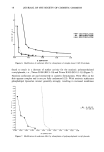
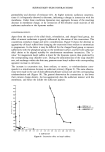
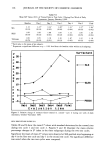
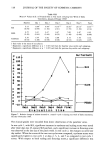
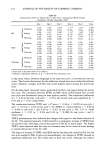
92 JOURNAL OF THE SOCIETY OF COSMETIC CHEMISTS Finally, the leaching of soluble protein and pigment from bleached hair into the cationic polymer solutions was examined. Detrimental effects of artifacts arising from these constituents were minimized by soaking bleached hair thoroughly. This was demon- strated by noting that the endpoint of the buffer-indicator blank remained unchanged from a blank that also contained the thoroughly rinsed, bleached hair. Previous colloid titration work to quantify cationic adsorption onto a negatively charged substrate was performed by reference to a calibration curve (5,10-12). In the present study, the equivalent weight of the polymer was a constant value within the concen- tration range of interest. This allowed accurate and reproducible determination of the amount of cationic polymer in solution. Several different concentrations of Polyquaternium-10 ranging from 0.05 to 0.20% w/v were evaluated. Aliquots of these solutions were titrated and the equivalent weight of Polyquaternium-10 was found from the slopes of the individual regression lines. Lin- earity of response between KPVS and Polyquaternium-10 was evident within the con- centration range studied (Figure 2). The equivalent weight of Polyquaternium-10 was found to be 877.7 + 19.1 g/equiv by application of Equations 1 and 2 and the averaged slope (2.2 ml/mg) of the regression lines (Figure 2). This result correlated very closely with the 875 g/equiv value calculated independently from direct and standard substit- uent analysis of the polymer that is, analysis for hydroxyethyl molar substitution (MS) by the Zeisel method and determination of nitrogen content (Kjeldahl method) yielded values of 2.24 and 1.45 percent, respectively. Assuming that the cationic moiety is the (2-hydroxypropyl)trimethylammonium chloride (CH2CHOHCH2N + (CH3)3C 1 -) res- idue, a nitrogen level of 1.45 percent yields a degree of substitution (DS) of 0.36. These MS and DS values yield a molecular weight (MW) of 315 grams per polymeric repeat (monomer) unit from which an equivalent weight of 875 g/equiv, i.e., MW/DS, is obtained. The close agreement between these two independent analyses suggests a one-to-one stoichiometric relationship in charge neutralization between the KPVS ti- trant and Polyquaternium-10. Difficulties in determining the equivalent weight of Polyquaternium-10 are worth mentioning. The use of a sodium citrate buffer (pH 6.0) to prepare the polymer solution gave variable results, especially when Polyquaternium-10 solutions were examined over a period of several days. This variability was attributed to ion exchange between the relatively large citrate ion and the chloride of the Polyquaternium-10. However, the formation of soluble complexes of Polyquaternium-10 with the tribasic citric acid may also be a source of stoichiometric variability. When the solvent system was changed to phosphate buffer, the equivalent weight of the cationic polymer remained constant when examined for up to five days after preparation. In order to calculate the equivalent weight of Polyquaternium-10 accurately, the rela- tionship between the cationic polymer and KPVS must remain constant. However, the relationship between KPVS titrant and Polyquaternium-10 deviated from linearity when the amount of Polyquaternium-10 present exceeded 400 •xg. A similar problem was noted by Onabe, who also used colloid titration analysis (12). The deviation was attributed to an excess in cationic charge on the cationic polymer-KPVS colloidal product at high levels of cationic polymer. Residual cationic charge hindered selective adsorption of KPVS on the 0-Toluidine blue indicator and changed the titration end-

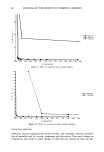
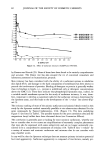
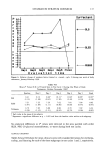
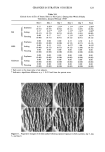
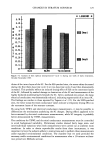
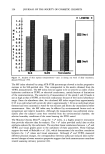
CATIONIC POLYMER ADSORPTION 93 point. Accordingly, Polyquaternium-10 levels were always kept within the linear range determined for the present work. Polyquaternium-10 treatment solutions were analyzed by removing aliquot volumes whose size depended on cationic concentration that is, for 0.10% cationic solutions, 300 Ixl was analyzed. The Polyquaternium-10 level was kept constant at 300 Ixg for all analyses, regardless of the concentrations of other components. The amount of Polyquaternium-10 present in solution as determined by colloid titration was compared to the amount determined gravimetrically and found to be within 2.7 + 0.6%. Initial determinations for Polyquaternium-10 levels gave inordinately high er- rors, which were attributed to variability in the indicator blank. To obtain consistent results, the amount of 0-Toluidine blue indicator had to be kept constant. The indicator blank was apparent in the titration endpoint, accounting for the non-zero intercept value (Figure 2). The amount of KPVS needed to titrate 1.00 ml of indicator was determined from the intercept of the regression line of the plot of KPVS titrant vs Polyquaternium- 10 (Figure 2). The intercept is the amount of KPVS needed to reach the endpoint when no cationic polymer is present, and corresponds to an indicator blank of 0.261 -+ 0.010 mi. The amount of Polyquaternium-10 adsorbed by the hair is dependent on the degree of hair damage caused by bleaching. Hair that was bleached under mild conditions (30 minutes at 32øC) exhibited an average uptake of 2.6 -+ 0.1 mg/g. This amount is much lower than that found for hair bleached under harsh conditions (four hours at 40øC). Uptake for the more severely damaged hair was 9.2 -+ 0.3 mg/g. Both determinations were performed using treatment solutions that were 0.1% in Polyquaternium-10 con- centration. These values generally agree with adsorptions reported previously for this cationic HEC (8), where uptake was measured directly by liquid scintillation of bleached hair tresses treated with radioactively tagged cationic polymer. Polyquaternium-10 uptake was examined as a function of polymer treatment time (Figure 3). Increasing the treatment time resulted in increasing adsorption of Poly- quaternium-10 by hair, with the more damaged hair again showing higher polymer levels. Extrapolation of the present colloid titration data to the longer times evaluated previously (8) showed similar results. The continued increase of Polyquaternium-10 uptake by the harshly bleached hair demonstrated the more porous nature of this hair (14): Polyquaternium-10 is adsorbed beyond the hair surface and into the fiber. In earlier work (8), bleached hair showed an uptake of up to 6% of the fiber weight with a lower molecular weight version of Polyquaternium-10. The large uptake was attrib- uted to diffusion of the cationic into the hair fiber when hair was treated with polymer solution for up to one week. The high and continuing uptake of the Polyquaternium-10 used in this experiment, while less than the 6% uptake of the lower molecular weight Polyquaternium-10, also indicates some degree of diffusion into the hair fiber. The effect of Polyquaternium-10 concentration on polymer uptake by hair was also examined with different lots of both mildly and harshly bleached hair than was used to generate the adsorption isotherms of Figure 3. Cationic adsorption was greater from a 0.20% solution in comparison to a 0.05% solution for both hair types (Figure 4). Adsorption by the mildly bleached hair from a 0.20% solution was 3.5 + 0.2 rag/g the corresponding adsorption from a 0.05% solution measured 2.8 -+ 0.1 mg/g. Poly-
Purchased for the exclusive use of nofirst nolast (unknown)
From: SCC Media Library & Resource Center (library.scconline.org)