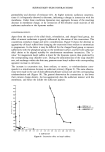
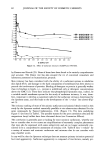
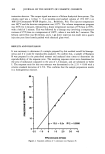
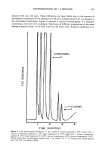
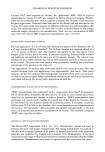
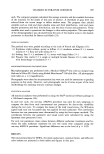
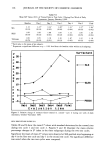
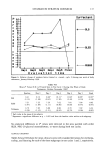
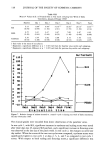
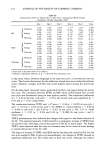
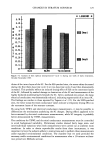
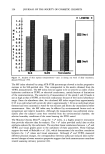
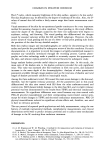
94 JOURNAL OF THE SOCIETY OF COSMETIC CHEMISTS -!- 12 z o I- lO o 8 o 6 :• 4 z m 2 o i i 30 45 90 120 0 o. TREATMENT TIME (MINUTES) 180 HAIR BLEACHED HAIR BLEACHED 4 HRS/40øC 30 MINS/32 øC HAIR TREATED AT 40 øC WITH 0.10% (w/v) POLYQUATERNIUM-10 Figure 3. The effect of treatment time on Polyquaternium-10 adsorption by bleached hair. quaternium-10 uptake by harshly bleached hair measured 9.1 --- 0.3 and 8.6 --- 0.2 mg/g for 0.20% and 0.05% solutions, respectively. Similar trends in sorption of Poly- quaternium-10 as a function of concentration have been noted by Faucher and Goddard (8). This effect of concentration on Polyquaternium-10 uptake, together with bleach level and treatment time, reemphasizes the need for standardizing conditions when examining the various hair and treatment parameters that can impact adsorption. It should be noted that the treatment and analyte concentrations developed in this study are specific to Polyquaternium-10. Other cationic polymers having charge densities close to that of Polyquaternium-10 may behave similarly in their analyses, but this would require verification by application of the procedures described. Also, application of colloid titration to formulated products containing cationic polymers, such as sham- poos, can be subject to interference from other cationic, anionic, and amphoteric com- ponents. CONCLUSION The method of colloid titration was readily adaptable to measuring polymeric cationic uptake by bleached hair. Not only was quantification of sorbed cationics possible, but costly instrumentation and specially synthesized materials were avoided. The level of Polyquaternium-10 adsorption by bleached hair was in direct proportion to,

CATIONIC POLYMER ADSORPTION 95 E 12 v ß 1- 10 z 0 I- 8 0 c• 6 • 4 z n- 2 o 9.1 + 0.3 8.6 + 0.2 - -- -- 3O MINS/32øC 4 HRS/40 ø c BLEACHED HAIR TYPE ,•'• 0.05% (w/v) • 0.20% (w/v) POLYQUATERNIUM-10 POLYQUATERNIUM-10 Figure 4. The effect of Polyquaternium-10 solution concentration on cationic uptake by bleached hair. and governed principally by, the severity of bleach treatment. Uptake also varied directly with the concentration of Polyquaternium-10 treatment solutions and the con- tact time between polymer and hair tress. In our work, colloid titration is reproducible within closely defined parameters. The analysis of polymers other than Polyquaternium-10 must be preceded by determinations of stoichiometry for linearity between analyte and titrant. ACKNOWLEDGMENTS The assistance of C. D. Crawley, Ph.D., and Ruby Caro, as well as the support of the University of Cincinnati and the Aqualon Company, are acknowledged and appreciated. REFERENCES (1) A. L. L. Hunting, The function of polymers in shampoos and conditioners, Cosmet. Toilet., 99, 5740 (June, 1984). (2) E. D. Goddard, Substantivity through cationic substitution, Cosmet. Toilet., 102, 71-80 (April, 1987). (3) Y. K. Kamath, C. J. Dansizer, and H.-D. Weigmann, Surface wertability of human hair. I. Effect of deposition of polymers and surfactants, J. Appl. Polym. Sci., 29, I011-1026 (1984). (4) A.M. Schwartz, The zeta potential and its application in cosmetic science, Proc. Soc. Toilet. Goods Assoc., 39, 16-19 (1963). (5) J. Jachowicz, M. Berthiaume, and M. Garcia, The effect of the amphiprotic nature of human hair keratin on the adsorption of high charge density cationic electrolytes, Coll. Polym. Sci., 263, 847-858 (1985). (6) R. J. Crawford and C. R. Robbins, A replacement for Rubine dye for detecting cationics on keratin, J. Soc. Cosmet. Chem., 31, 273-278 (1980). (7) E. D. Goddard, J. A. Faucher, R.J. Scott, and M. E. Turney, Adsorption of Polymer JR on keratinous surfaces--Part II, J. Soc. Cosmet. Chem., 26, 539-550 (1975).
Purchased for the exclusive use of nofirst nolast (unknown)
From: SCC Media Library & Resource Center (library.scconline.org)