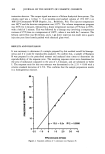
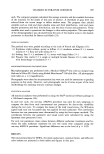
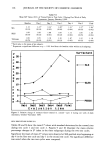
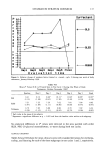
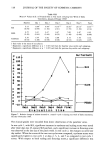
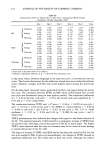
90 JOURNAL OF THE SOCIETY OF COSMETIC CHEMISTS 1.4 1.2 !- z o.• !- 0.6 • 0.4 0.2[ 0.0 0.0 n=8 _ intcpt. = 0.26 r 2 = 0.99 0.1 0.2 0.3 0.4 POLYQUATERNlUM-10 (mg) 0.5 Figure 2. Regression line used in calculation of Polyquaternium-10 equivalent weight. CALCULATION OF CATIONIC POLYMER LEVELS The amount of Polyquaternium-10 present in solution was calculated by the following equation' Amøuntcationic polymer (mg) = equiv Wtcationic polymer X f X SKPvS X (V2KPV S -- V1KPVS) [Eq. 3] where f = dilution factor [total solution wt (g)/aliquot size (g)], ViKpv s = volume KPVS needed to reach endpoint (ml), and V•Kpv s = volume KPVS needed to titrate indicator (indicator blank, ml). TREATMENT OF HAIR TRESSES Approximately one gram of bleached hair was accurately weighed and treated with Polyquaternium-10 solution. Three concentrations of Polyquaternium-10 (0.05, 0.10, and 0.20% w/v) were examined. To avoid possible problems of pipette drainage occa- sioned by introducing slightly viscous polymer treatment solutions volumetrically, each solution was added as an accurately weighed aliquot of about 20 g. Polymer

CATIONIC POLYMER ADSORPTION 91 treatments ranged from 10 to 40 mg polymer/g hair, depending on solution concen- tration. Containers were tightly covered and placed in a 40øC shaker bath for a treatment time standardized to 45 minutes, unless otherwise noted. At the end of the treatment time, solutions were decanted for analysis by titration. DETERMINATION OF CATIONIC POLYMER LEVEL ON HAIR Changes in cationic concentration following immersion of hair tresses were determined by colloid titration. Cationic polymer uptake is reported in mg cationic polymer/g hair: where Uptakecationic potymer(mg/g hair) = (mginim t - mgfin•t)/g hair [Eq. 4] mginiti• t = mg cationic polymer in solution before treatment and mgnn•t = mg cationic polymer in solution after hair treatment. RESULTS AND DISCUSSION The colloid titration method is based on a color change in the o-Toluidine blue indicator with the first excess of KPVS titrant. An anionic polymer, KPVS, is added to the analyte solution where the cationic polymer and anionic KPVS form a preferential complex. The cationic indicator remains unreacted. When all cationic analyte has complexed, the excess titrant begins to interact with the o-Toluidine blue indicator, resulting in a color change from blue to violet. The equivalence point of the titration is obtained from the titration curve and used to calculate the amount of polymer present in solution by Equation 3. Polymer uptake by the hair is inferred and calculated from differences in solution concentration before and after hair treatment by Equation 4. The colloid titration method is subject to interferences (2) including: 1) indeterminate stoichiometry between anionic titrant and cationic analyte, 2) time effects in determin- ing the endpoint, and 3) ionic contaminants including leached hair proteins and pig- ments. These difficulties are addressed in the present study. The relationship between the Polyquaternium-10 and the KPVS titrant was tested for linearity. Eight repetitions of the titration demonstrated stoichiometry of the relation- ship within the concentration range of interest (Figure 2). Pooled standard deviations of 0.05 and 0.01 are noted for the slope and intercept, respectively, of the averaged determinations. The problem of endpoint time effects is acknowledged and normalized by titrating test solutions at contant KPVS delivery rate. This minimizes kinetic effects that govern the approach toward equilibrium of colloid complexation and indicator response. In addi- tion, the colorimeter equipped with a sensor electrode is capable of an immediate response and resolves any difficulties in visual detection of titration endpoints that are often subtle. Ionic contamination was not a factor in this work, as all cationic polymer solutions were kept free of surfactants or other interfering compounds.
Purchased for the exclusive use of nofirst nolast (unknown)
From: SCC Media Library & Resource Center (library.scconline.org)