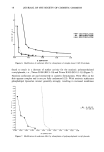
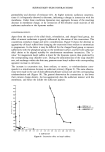
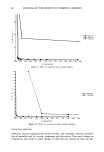
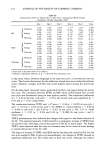
104 JOURNAL OF THE SOCIETY OF COSMETIC CHEMISTS second column of differing lot number also provided the same results, including the 7% variability in 1,4-dioxane level. In 12 of the 13 shampoos the analyses showed that no interferences were present that would impact upon the determination of the 1,4-dioxane level. However, in the case of Shampoo C, there was an unknown interference that occurred. This interference partially co-eluted with the isobutanol internal standard and provided for a variability of greater than 50%, thus eliminating the shampoo from the study. CONCLUSION An internal standard method utilizing isobutanol as the internal standard has been shown to be capable of accurately analyzing for 1,4-dioxane in a variety of commercial shampoos. The method is linear and provides recoveries between 94 and 105% over a 1,4-dioxane concentration range of 1 to 250 ppm. Thirteen shampoos were analyzed for 1,4-dioxane content. The lowest level of 1,4-dioxane was found in a shampoo containing no ethoxylated materials. The lowest concentration of 1,4-dioxane in an ethoxylate- containing shampoo was 6 ppm and the highest was 144 ppm. REFERENCES (1) C. Hoch-Legeti, M. F. Argus, and J. C. Arcos, Introduction of carcinomas in the nasal cavity of rats by dioxane, Br. J. Cancer, 24, 164-167 (1970). (2) R.J. Kociba, S. B. McCollister, C. Park, T. R. Torkelson, and P. J. Gehring, 1,4-dioxane. I. 2-Year ingestion study in rats, Toxicol. Appl. Pharmacol., 30, 275-286 (1974). (3) NIOSH, Registry of Toxic oefJ$cts of Chemical Substances, 1986 edition, NIOSH Publication No. 87-114, 3, 2082-2083 (1987). (4) D. B. Black, R. C. Lawrence, E. G. Lovering, and J. R. Watson, Gas-liquid chromatographic method for determining 1,4-dioxane in cosmetics, J. Assoc. Off. Anal. Chem., 66, 181-183 (1983). (5) T. J. Birkel, C. R. Warner, and T. Fazio, Gas chromatographic determination of 1,4-dioxane in Polysorbate 60 and Polysorbate 80, J. Assoc. Off. Anal. Chem., 62, 931-936 (1979). (6) J. J. Robinson and E. W. Ciurczak, Direct gas chromatographic determination of 1,4-dioxane in ethoxylated surfactants,J. Soc. Cosmet. Chem., 31, 329-337 (1980). (7) B. A. Waldman, Analysis of 1,4-dioxane in ethoxylated compounds by gas chromatography/mass spectrometry using selected ion monitoring, J. Soc. Cosmet. Chem., 33, 19-25 (1982). (8) S. Scalia, M. Guarneri, and E. Menegatti, Determination of 1,4-dioxane in cosmetic products by high performance liquid chromatography, Analyst, 115, 929-931 (1990). (9) S. C. Rastogi, Headspace analysis of 1,4-dioxane in products containing polyethoxylated surfactants by GC-MS, Chromatographia, 29, 441-445 (1990).

j. Soc. Cosmet. Chem., 42, 105-128 (March/April 1991) The value of multiple instrumental and clinical methods, repeated patch applications, and daily evaluations for assessing stratum corneum changes induced by surfactants j. ZHOU, R. MARK, T. STOUDEMAYER, A. SAKR, J. LEON LICHTIN, and KARL L. GABRIEL, Biosearch, Incorporated, Philadelphia, PA 19101 (J.Z., R.M., T.S., K.L.G.), and Cosmetic Science Program, College of Pharmacy, University of Cincinnati, Cincinnati, OH (J. z., A.S., J.L.L. ). Received July 5, 1990. Synopsis Biophysical, morphometric, and clinical methods were used to evaluate changes in the stratum corneum of human skin following repeated exposure to surfactants. The objectives of this study were to determine the relative efficacy and sensitivity of the various methods for assessing skin changes, particularly moisture content, water loss, and signs of irritation. The surfactants studied were sodium lauryl sulfate (SLS), sodium laureth-3 sulfate (SLES), and PEGo20 glyceryl monotallowate. The test surfactants were applied to the volar surface of the lower arm of healthy volunteer subjects twice a day for 45 minutes each for five consecutive days. The contralateral arm was similarly treated with water. Skin responses were evaluated each day after the second surfactant treatment, and a final evaluation was performed after a two-day rest. The evaluations included 1) instrumental skin moisture measurements of transepidermal water loss (TEWL), high-frequency electrical conductance and moisture factor with attenuated total reflectance Fourier transform infrared (ATR-FTIR) spectroscopy 2) morphometric methods, including determination of skin reflectance and color, macrophotography, and image analysis of skin negative replicas and 3) visual scoring of erythema, scaling, and fissuring. These objective and subjective methods provided a spectrum of data documenting the progressive changes of the stratum corneum by the surfactants. Consistent changes were observed within each treatment group of six subjects. SLS caused marked adverse changes and SLES induced slight adverse changes. PEG-20 glyceryl monotallowate treatment resulted in minimal changes in the skin. The various evaluation methods generally showed good correlation but differed in their sensitivity. Repeated studies after three to four months on the same panel showed reasonable reproducibility of all evaluation methods. Seasonal variability was observed in the SLS-treated sites. INTRODUCTION Repeated and cumulative action of weak irritant agents on the skin are well established as factors in causing various skin conditions (1-3). Surfactants play an important role in the majority of cases (2-5). Although the mechanisms of surfactant-induced skin dam- age are not fully understood, skin damage caused by repeated exposure to surfactants is demonstrated by an increase in epidermal permeability (6-8), dryness and roughness 105
Purchased for the exclusive use of nofirst nolast (unknown)
From: SCC Media Library & Resource Center (library.scconline.org)