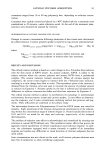
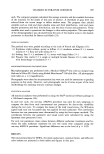
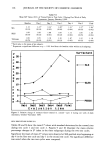
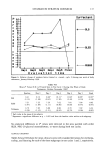
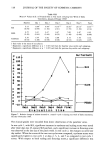
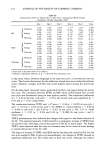
102 JOURNAL OF THE SOCIETY OF COSMETIC CHEMISTS Table II Recovery of 1,4-Dioxane Spiked Into Shampoo K and Shampoo B 1,4-Dioxane 1,4-Dioxane added (ppm) found (ppm) % Recovery Shampoo B Shampoo K 0 13.0 N.A. 9.3 22.0 98 14.4 27.2 98 21.2 33.4 94 38.9 51.1 94 0 1.5 N.A. 5.7 7.5 104 18.1 19.3 98 3O.2 33.6 105 91.9 98.1 105 164.0 173.6 105 216.3 229.6 105 spiked 1,4-dioxane from both shampoos is shown in Table II. The results indicate that the recovery of 1,4-dioxane from these shampoos is between 94 and 105%. This vari- ability is most likely due to the difficulty in accurately analyzing compounds at such trace levels. SAMPLE ANALYSIS Thirteen shampoos were purchased on the open market and analyzed for 1,4-dioxane content by this method. All but one of the shampoos indicated at least one ethoxylated compound on its list of ingredients. One shampoo (Shampoo K) was chosen due to the lack of any ethoxylates among its ingredients, and was used as a blank. The results of the analysis of these shampoos are presented in Table III. As can be seen, there is great variation in the level of 1,4-dioxane present in shampoos containing ethoxylated sur- factants. The lowest level of 1,4-dioxane found was 6 ppm, while the highest 1,4- Table III Levels of 1,4-Dioxane Found in 13 Shampoos Shampoo 1,4-Dioxane (ppm) A 6 B 13 C N.A. D 144 E 53 F 16 G 112 H 7 I 67 J 39 K 1 L 42 M 47 N.A.: Not analyzed due to chromatographic interferences.

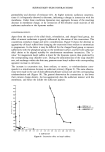
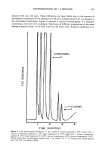
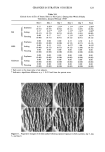
DETERMINATION OF 1,4-DIOXANE 103 dioxane level was 144 ppm. These differences are most likely due to the amount of ethoxylated components in the shampoo as well as to varying amounts of 1,4-dioxane in the ethoxylated surfactants. Figure 4 presents a typical chromatogram of a shampoo containing a low level of 1,4-dioxane. Replicates of different preparations of the same shampoo agreed within 7% of each other (in the worst case). Analyses performed on a ISOBUTANOL 1,4-DIOXANE •. I 1 2 • ,q. TIME (MINUTES) Figure 4. Gas chromatogram of Shampoo A. GC conditions: Initial temperature: 85øC initial time: 2 minutes temperature gradient A: 5øC final temperature A: 95øC final hold: ! minute temperature gradient B: 25øC final temperature B: 300øC injector temperature: 250øC detector temperature: 325øC helium carrier flow: 40 ml/minute injection size: 1 ul column: 12' X ¾8" stainless steel column packed with 15% OV-1 on Supelco WHP.
Purchased for the exclusive use of nofirst nolast (unknown)
From: SCC Media Library & Resource Center (library.scconline.org)