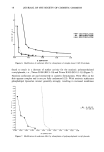
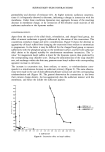
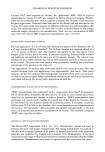
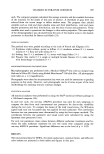
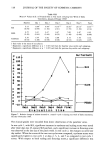
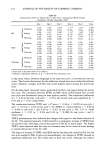
SURFACTANT-SKIN INTERACTIONS 75 species of a surfactant system (9), especially for the liposome model. Micelies may, however, be involved in producing irritation in the soap chamber test, as little is known about the actual interactions taking place between surfactant solutions and the skin during prolonged exposure (20,21). Development of a numerical irritancy index. The exponential functions obtained from the "concentration vs tV2" plots showed that the milder surfactants usually result in a curve that is less tightly bent. 'With a computerized curve-fitting program, the function y = a + b*exp (- c'x) was found to fit the available data most closely (Figure 3). The absolute value of ( - c), when placed in rank order, showed an increasing "c-value" with increasing irritancy (Table I) for a group of anionic surfactants and blends. A reasonable rank correlation was observed between most "c-values" and numerical soap chamber scores (Toxicol, U.K.) of the same surfactants (Figure 13). The correlation does not exist for nonionic surfactants. The results also demonstrate the problems associated with the assessment of irritancy by a test panel. The soap chamber data were obtained in two separate runs several months apart. ALS and SLS were the most irritating surfactant in each run. Each received the score of 4.75. This clearly demonstrates the importance of including the same standard with every batch of compounds to be tested that runs counter to the need to keep expenses low. RESULTS It was important to demonstrate that the described method is sensitive enough to rank the irritancy of most of the surfactants tested, ideally in the same order as the soap chamber tests. The rank correlation was found to be good for a series of anionic surfactants. With these surfactants, the method was found sensitive enough to respond 5. O"T : : .. :.. '"i ............. *'x .... =================================== o., l W.. ............................ • ......... ß ............ . ......... ß ..... o.o I I I --3----3-----3-- • ! •- I I -I - 0.00 0.02 0.04 0.08 0.08 O.iO 0.t2 0.t4 0.t8 0.t8 0.20 0.22 0.24 • suPfsctsnt • SLS:O.28+43.93•exp(-127.56•x) ß SLES-coco:O.6+lS.06•exp(-32.08•x) ß SLES-oxo:O.59+4.45•exp(-47.86•x) ß SLEC:O.71+13.98•exp(-21.19•x) Figure 3. Example of curve fittings If(x)= a+ b*exp(- c*x)].

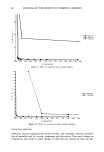
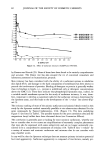
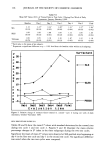
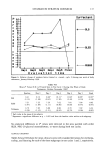
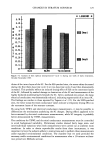
76 JOURNAL OF THE SOCIETY OF COSMETIC CHEMISTS Table I Correlation Between "C-Values" and Soap Chamber Scores (Toxicol) for Anionic Surfactants (see Figure 13) Surfactant "C-value" Soap chamber score Run 1 Proprietary formula 1 0.34 0.30 Proprietary formula 2 0.60 0.65 SLEC (3.8EO) 21.00 0.70 SLES-coco 32.00 0.89 SLES-oxo 47.83 1.36 MgLS 2.18 1.62 SLS 103.00 4.75 Run 2 ALES 11.80 2.95 Proprietary formula 3 14.70 4.14 ALS 17.74 4.75 to small changes in the chemical structure of the surfactant molecules of homologous series from the same manufacturer. In vivo data are seldom as specific. Thus we were able to describe the effects of the shape of the alkyl chain, the degree of ethoxylation, and the effect of counterions. The liposome assay was also used to test surfactant mixtures. It is important to realize, however, that we were dealing entirely with commercial grade surfactants with a dis- tribution of alkyl chain lengths and the possible presence of unreacted components and impurities. The results, therefore, apply only to the actual samples tested, and a number of unidentifiable factors may contribute to the observed effects. The same is true, of course, for samples sent for in vivo testing. For practical reasons all concentrations had to be expressed as weight percent and not as millimoles. Effects originating from changes in alkyl chain length or configuration, or the degree of ethoxylation, are common to amphipathic substances in general. These effects will, therefore, be discussed here as they pertain to all surfactant classes investigated. Counterion effects are described as they were observed for anionic surfactants. ALKYL CHAIN AND ETHOXYLATION EFFECTS Each batch of test surfactants was run against reagent grade sodium dodecyl sulfate, which was used as reference compound throughout. Commercial grade sodium lauryl sulfate with branched (oxo) alkyl chains was confirmed as more aggressive than the corresponding coco-derived product (Figure 4). Polyoxyethylene groups are frequently inserted between the alkyl chains and the charged head groups to modify surfactant irritancy. Ethoxylation of surfactants increases the hydrophilicity. In anionics this counterbalances the effect of the alkyl portion in non- ionics it is the basis for the detergent effect. Depending on the charge distribution or the hydrophilic/lipophilic balance, ethoxylation may reduce or enhance the aggressive- ness of a surfactant toward liposomes. Sodium lauryl ether sulfate (2% ethoxylation) (SLES) and lauryl ether carboxylate (3.8% ethoxylation) (SLEC) interacted less strongly with the liposomes than the lauryl sulfates (Figure 5). Figure 6 illustrates the increasing
Purchased for the exclusive use of nofirst nolast (unknown)
From: SCC Media Library & Resource Center (library.scconline.org)