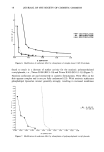
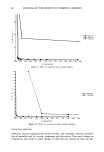
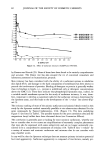
98 JOURNAL OF THE SOCIETY OF COSMETIC CHEMISTS Currently, 1,4-dioxane is most commonly analyzed by gas chromatographic methods (4-7). However, these methods require extensive sample pretreatment and have high variability and relatively poor recoveries. An HPLC method has been developed by Scalia (8), yet from the quality control aspects of time and complexity, this method suffers from the relative difficulty of using a gradient HPLC method. Additionally, Rastogi (9) has developed a headspace gas chromatographic-mass spectroscopic analysis method using mass spectral selectivity to identify and quantitate dioxane. While this method is acceptable in a research laboratory environment, it suffers in that mass spectroscopic capabilities do not exist in most quality control laboratories. This paper describes a gas chromatographic method for the analysis of 1,4-dioxane in shampoos. The method is rapid, requires no sample pretreatment, requires minimal sample preparation, and utilizes an internal standard for quantitation. EXPERIMENTAL REAGENTS AND MATERIALS HPLC grade 1,4-dioxane was purchased from Aldrich Chemical Company (Milwaukee, WI), and reagent grade (ACS certified) isobutanol was obtained from Fisher Scientific (Fairlawn, NJ). Double deionized water was distilled and deionized (Millipore, Inc., Medford, MA). Sampling vials were from Wheaton Laboratory Products (Millville, N J) and were sealed with crimp tops and teflon-lined septa. INTERNAL STANDARD DILUENT An isobutanol internal standard diluent was prepared based upon expected values of 1,4-dioxane in the shampoo products. A 2000-ppm stock solution of isobutanol in water was prepared in a crimp-top vial. This solution was further diluted to produce a final working diluent solution of 20 ppm. CALIBRATION STANDARD SOLUTION A standard calibration solution was prepared and analyzed to determine the relative response factor of the isobutanol internal standard to the 1,4-dioxane. A 1,4-dioxane stock solution was prepared at a level of 2000 ppm, and an aliquot was used to prepare an approximate 20 ppm solution. 1.0 ml of this solution was then added to 1.0 ml of the isobutanol diluent solution, resulting in a calibration standard of 10 ppm 1,4- dioxane and 10 ppm isobutanol. This calibration standard was then analyzed using the gas chromatographic program described below. SAMPLE SOLUTIONS Approximately 1 to 2 grams of shampoo sample were weighed into a sampling vial, and an equal weight of isobutanol diluent was added. The vial was crimp-sealed and shaken gently until complete dispersion of the sample was achieved. If foaming occurred, the

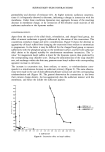
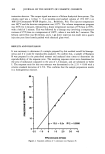
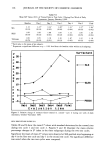
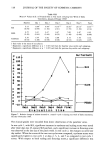
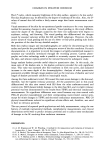
DETERMINATION OF 1,4-DIOXANE 99 Table I Reproducibility of Response Ratio Area isobutanol Area 1,4-dioxane Response ratio 147436 56600 2.60 148348 59739 2.48 156260 60161 2.60 159059 60291 2.64 164563 65101 2.53 163548 63199 2.59 159638 63356 2.52 154759 62834 2.46 Average response ratio = 2.55. Standard deviation = 0.06. Relative standard deviation = 2.5%. sample was allowed to sit until it dissipated (approximately 15 minutes). This sample solution was analyzed directly using the gas chromatographic program described below. GAS CHROMATOGRAPHIC CONDITIONS The gas chromatographic system was a Hewlett Packard 5890A equipped with a flame 1.50e+6 - 5.00e.• 0.00©+0 y = - 1.B7e+4 + 5046.gx R^2 = o.ggg8 i 50 100 150 200 250 PPM DIOXANE Figure 1. Linearity of 1,4-dioxane standards from 1 ppm to 250 ppm.
Purchased for the exclusive use of nofirst nolast (unknown)
From: SCC Media Library & Resource Center (library.scconline.org)