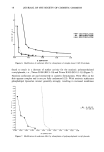
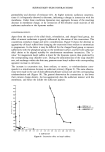
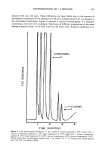
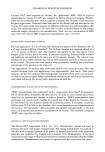
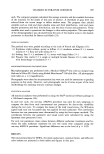
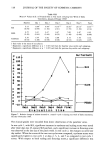
CATIONIC POLYMER ADSORPTION 89 system. A potassium polyvinylsulfate (KPVS) (Eastman-Kodak, Rochester, NY) titrant of known normality (0.52 mN) was dispensed with constant stirring. A 2-ml automatic buret (DVII, Merrier, Highstown, NY), on line with a strip chart recorder (Merrier GA12), was used to introduce the titrant into the system. The change in relative absorbance caused by indicator color change was monitored with a colorimeter (Sybron- Brinkmann, Westbury, NY) equipped with a fiberoptic sensor electrode set at a single wavelength of 620 nm. The titrant was dispensed at a rate of 0.70 ml/minute. A titration curve (Figure 1) was generated on the recorder and the endpoint calculated as the point lying midway between lines drawn tangent to the baselines. The instrumen- tation enabled the added titrant to be read to the nearest 0.025 mi. This precision was crucial to the reproducibility of the method. Plots of Polyquaternium-10 titrated with KPVS are given in Figure 2. The normality of the Polyquaternium-10 solution was calculated from the following relationship: Ncationic polymer (equiv/L) = (NKvvs X VKPvs/Vcationic polymer X slope) [Eq. 1] where slope = slope of regression line (mlKPvS/mlcationic polymer), NKpVS = normality of KPVS titrant (equiv/L), V•pvs = volume KPVS titrated to endpoint (ml), and Vcationic polymer = volume of cationic polymer aliquot (ml). The equivalent weight of the Polyquaternium-10 follows as' Equip Wtcationic polymer (g/equip) = Ccationic polymer/Ncationic polymer where Ccationic polymer ----- cationic polymer solution concentration (g/L). [Eq. 2] E 1.4 • 1.2 LLI 1.0 o z • 0.8 o 03 0.6 LLI 0.4 0.2 0 0.2 0.4 0.6 0.8 1.0 1.2 1.4 1.6 KPVS TITRANT (ml) DENOTES TITRATION ENDPOINT CALCULATED AS MIDPOINT OF DIAGONAL LINE CONNECTING BASELINE TANGENT LINES Figure 1. Sample titration curve obtained in colloid titration analysis. 1.8 2.0

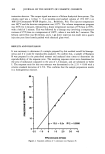
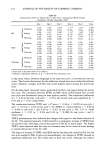
90 JOURNAL OF THE SOCIETY OF COSMETIC CHEMISTS 1.4 1.2 !- z o.• !- 0.6 • 0.4 0.2[ 0.0 0.0 n=8 _ intcpt. = 0.26 r 2 = 0.99 0.1 0.2 0.3 0.4 POLYQUATERNlUM-10 (mg) 0.5 Figure 2. Regression line used in calculation of Polyquaternium-10 equivalent weight. CALCULATION OF CATIONIC POLYMER LEVELS The amount of Polyquaternium-10 present in solution was calculated by the following equation' Amøuntcationic polymer (mg) = equiv Wtcationic polymer X f X SKPvS X (V2KPV S -- V1KPVS) [Eq. 3] where f = dilution factor [total solution wt (g)/aliquot size (g)], ViKpv s = volume KPVS needed to reach endpoint (ml), and V•Kpv s = volume KPVS needed to titrate indicator (indicator blank, ml). TREATMENT OF HAIR TRESSES Approximately one gram of bleached hair was accurately weighed and treated with Polyquaternium-10 solution. Three concentrations of Polyquaternium-10 (0.05, 0.10, and 0.20% w/v) were examined. To avoid possible problems of pipette drainage occa- sioned by introducing slightly viscous polymer treatment solutions volumetrically, each solution was added as an accurately weighed aliquot of about 20 g. Polymer
Purchased for the exclusive use of nofirst nolast (unknown)
From: SCC Media Library & Resource Center (library.scconline.org)