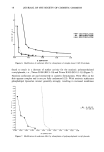
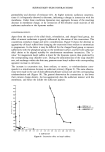
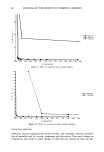
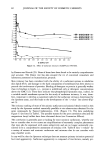
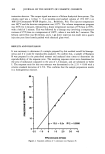
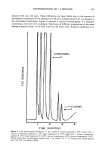
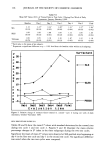
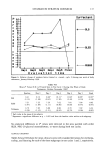
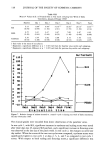
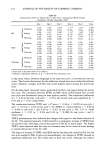
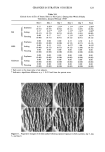
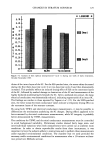
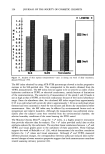
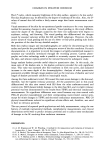
CATIONIC POLYMER ADSORPTION 93 point. Accordingly, Polyquaternium-10 levels were always kept within the linear range determined for the present work. Polyquaternium-10 treatment solutions were analyzed by removing aliquot volumes whose size depended on cationic concentration that is, for 0.10% cationic solutions, 300 Ixl was analyzed. The Polyquaternium-10 level was kept constant at 300 Ixg for all analyses, regardless of the concentrations of other components. The amount of Polyquaternium-10 present in solution as determined by colloid titration was compared to the amount determined gravimetrically and found to be within 2.7 + 0.6%. Initial determinations for Polyquaternium-10 levels gave inordinately high er- rors, which were attributed to variability in the indicator blank. To obtain consistent results, the amount of 0-Toluidine blue indicator had to be kept constant. The indicator blank was apparent in the titration endpoint, accounting for the non-zero intercept value (Figure 2). The amount of KPVS needed to titrate 1.00 ml of indicator was determined from the intercept of the regression line of the plot of KPVS titrant vs Polyquaternium- 10 (Figure 2). The intercept is the amount of KPVS needed to reach the endpoint when no cationic polymer is present, and corresponds to an indicator blank of 0.261 -+ 0.010 mi. The amount of Polyquaternium-10 adsorbed by the hair is dependent on the degree of hair damage caused by bleaching. Hair that was bleached under mild conditions (30 minutes at 32øC) exhibited an average uptake of 2.6 -+ 0.1 mg/g. This amount is much lower than that found for hair bleached under harsh conditions (four hours at 40øC). Uptake for the more severely damaged hair was 9.2 -+ 0.3 mg/g. Both determinations were performed using treatment solutions that were 0.1% in Polyquaternium-10 con- centration. These values generally agree with adsorptions reported previously for this cationic HEC (8), where uptake was measured directly by liquid scintillation of bleached hair tresses treated with radioactively tagged cationic polymer. Polyquaternium-10 uptake was examined as a function of polymer treatment time (Figure 3). Increasing the treatment time resulted in increasing adsorption of Poly- quaternium-10 by hair, with the more damaged hair again showing higher polymer levels. Extrapolation of the present colloid titration data to the longer times evaluated previously (8) showed similar results. The continued increase of Polyquaternium-10 uptake by the harshly bleached hair demonstrated the more porous nature of this hair (14): Polyquaternium-10 is adsorbed beyond the hair surface and into the fiber. In earlier work (8), bleached hair showed an uptake of up to 6% of the fiber weight with a lower molecular weight version of Polyquaternium-10. The large uptake was attrib- uted to diffusion of the cationic into the hair fiber when hair was treated with polymer solution for up to one week. The high and continuing uptake of the Polyquaternium-10 used in this experiment, while less than the 6% uptake of the lower molecular weight Polyquaternium-10, also indicates some degree of diffusion into the hair fiber. The effect of Polyquaternium-10 concentration on polymer uptake by hair was also examined with different lots of both mildly and harshly bleached hair than was used to generate the adsorption isotherms of Figure 3. Cationic adsorption was greater from a 0.20% solution in comparison to a 0.05% solution for both hair types (Figure 4). Adsorption by the mildly bleached hair from a 0.20% solution was 3.5 + 0.2 rag/g the corresponding adsorption from a 0.05% solution measured 2.8 -+ 0.1 mg/g. Poly-

94 JOURNAL OF THE SOCIETY OF COSMETIC CHEMISTS -!- 12 z o I- lO o 8 o 6 :• 4 z m 2 o i i 30 45 90 120 0 o. TREATMENT TIME (MINUTES) 180 HAIR BLEACHED HAIR BLEACHED 4 HRS/40øC 30 MINS/32 øC HAIR TREATED AT 40 øC WITH 0.10% (w/v) POLYQUATERNIUM-10 Figure 3. The effect of treatment time on Polyquaternium-10 adsorption by bleached hair. quaternium-10 uptake by harshly bleached hair measured 9.1 --- 0.3 and 8.6 --- 0.2 mg/g for 0.20% and 0.05% solutions, respectively. Similar trends in sorption of Poly- quaternium-10 as a function of concentration have been noted by Faucher and Goddard (8). This effect of concentration on Polyquaternium-10 uptake, together with bleach level and treatment time, reemphasizes the need for standardizing conditions when examining the various hair and treatment parameters that can impact adsorption. It should be noted that the treatment and analyte concentrations developed in this study are specific to Polyquaternium-10. Other cationic polymers having charge densities close to that of Polyquaternium-10 may behave similarly in their analyses, but this would require verification by application of the procedures described. Also, application of colloid titration to formulated products containing cationic polymers, such as sham- poos, can be subject to interference from other cationic, anionic, and amphoteric com- ponents. CONCLUSION The method of colloid titration was readily adaptable to measuring polymeric cationic uptake by bleached hair. Not only was quantification of sorbed cationics possible, but costly instrumentation and specially synthesized materials were avoided. The level of Polyquaternium-10 adsorption by bleached hair was in direct proportion to,
Purchased for the exclusive use of nofirst nolast (unknown)
From: SCC Media Library & Resource Center (library.scconline.org)