J. Soc. Cosmet. Chem., 42, 97-104 (March/April 1991) Gas chromatographic determination of 1,4-dioxane at the parts-per-million level in consumer shampoo products MARK P. ITALIA and MATHEWS A. NUNES, Johnson & Johnson Consumer Products Company, Grandview Road, Skillman, NJ 08558. Received November 16, 199•. Synopsis A packed-column gas chromatographic method for the determination of 1,4-dioxane in shampoo products is presented. The sample shampoo is diluted with water containing isobutanol as the internal standard and injected directly into a gas chromatograph containing a 12-foot X •/,-in stainless steel column packed with OV-1 as the stationary phase. The reproducibility of the method is better than 7% relative standard deviation, with 1,4-dioxane recoveries between 94 and 105%, and is linear over the range of 1 ppm to 250 ppm. The entire analysis can be performed in 15 minutes, allowing for fast sample turnaround. The ruggedness of the method has been demonstrated by the analysis of 13 shampoos, 12 containing ethoxylated surfactants and 1 containing no ethoxylates. All 12 products containing ethoxylated surfactants tested positive for 1,4-dioxane, with the range of 1,4-dioxane found being from 6 ppm to 144 ppm. INTRODUCTION Within the shampoo manufacturing sector of the cosmetics industry there is concern about the level of residual 1,4-dioxane present in final shampoo products. The 1,4- dioxane is introduced into the product via the use of ethoxylated fatty alcohol sulfates as cleansing agents. During the process of alcohol ethoxylation, ethylene oxide can dimerize to form 1,4-dioxane, which is subsequently carried through the shampoo manufacturing process. This compound has been shown to be carcinogenic in animals (1,2) and is listed as a carcinogen with NIOSH (3). Concern over the health risks, along with the probability that the ethoxylated surfactants in use contain a fair amount of residual 1,4-dioxane, has lead many cosmetic and toiletry companies to examine the levels of dioxane in both their raw materials and their finished products. Although many producers have begun vacuum stripping procedures in their manufacture of the fatty alcohol sulfates, there can still be high levels of 1,4-dioxane remaining in the materials that will be inadvertently added into finished product. Mark P. Italia's current address is Knoll Pharmaceuticals, Inc., 30 North Jefferson Road, Whippany, NJ 07981. 97

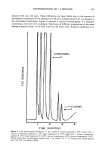
98 JOURNAL OF THE SOCIETY OF COSMETIC CHEMISTS Currently, 1,4-dioxane is most commonly analyzed by gas chromatographic methods (4-7). However, these methods require extensive sample pretreatment and have high variability and relatively poor recoveries. An HPLC method has been developed by Scalia (8), yet from the quality control aspects of time and complexity, this method suffers from the relative difficulty of using a gradient HPLC method. Additionally, Rastogi (9) has developed a headspace gas chromatographic-mass spectroscopic analysis method using mass spectral selectivity to identify and quantitate dioxane. While this method is acceptable in a research laboratory environment, it suffers in that mass spectroscopic capabilities do not exist in most quality control laboratories. This paper describes a gas chromatographic method for the analysis of 1,4-dioxane in shampoos. The method is rapid, requires no sample pretreatment, requires minimal sample preparation, and utilizes an internal standard for quantitation. EXPERIMENTAL REAGENTS AND MATERIALS HPLC grade 1,4-dioxane was purchased from Aldrich Chemical Company (Milwaukee, WI), and reagent grade (ACS certified) isobutanol was obtained from Fisher Scientific (Fairlawn, NJ). Double deionized water was distilled and deionized (Millipore, Inc., Medford, MA). Sampling vials were from Wheaton Laboratory Products (Millville, N J) and were sealed with crimp tops and teflon-lined septa. INTERNAL STANDARD DILUENT An isobutanol internal standard diluent was prepared based upon expected values of 1,4-dioxane in the shampoo products. A 2000-ppm stock solution of isobutanol in water was prepared in a crimp-top vial. This solution was further diluted to produce a final working diluent solution of 20 ppm. CALIBRATION STANDARD SOLUTION A standard calibration solution was prepared and analyzed to determine the relative response factor of the isobutanol internal standard to the 1,4-dioxane. A 1,4-dioxane stock solution was prepared at a level of 2000 ppm, and an aliquot was used to prepare an approximate 20 ppm solution. 1.0 ml of this solution was then added to 1.0 ml of the isobutanol diluent solution, resulting in a calibration standard of 10 ppm 1,4- dioxane and 10 ppm isobutanol. This calibration standard was then analyzed using the gas chromatographic program described below. SAMPLE SOLUTIONS Approximately 1 to 2 grams of shampoo sample were weighed into a sampling vial, and an equal weight of isobutanol diluent was added. The vial was crimp-sealed and shaken gently until complete dispersion of the sample was achieved. If foaming occurred, the
Purchased for the exclusive use of nofirst nolast (unknown)
From: SCC Media Library & Resource Center (library.scconline.org)