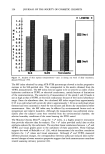
BENDING RELAXATION PROPERTIES 131 When a fibre is bent in water, not only is tension and compression developed towards the surface of the outside and inside of the bend, but shear stress is set up in both phases. Torsional data (5) suggest that the stiffness of the water-penetrable phase, M, is almost completely dependent on the presence of disulphide bonds. With the application of ammonium thioglycollate at pH 9.2, the structure of phase M would be extremely mobile due to the rate of thiol-disulphide interchange. This high rate results from the formation of a high density of charged thioIs due to the breakdown of disulphides to thioIs and the ionisation of thioIs at the high pH. A complete elimination of longitu- dinal tension and compression in the rods, C, by the distortion of the water-penetrable phase M can occur (see Figure 1). This possible mechanism of elimination of the mechanical energy stored in a bent fibre is not available to a fibre under pure extension, where the longitudinal strain of the phase C rods cannot be simply transferred to the weakened phase M. This mechanism for set in bending has been discussed in a more detail elsewhere (2) and represents a model of more universal application than that proposed by Wortmann and Kure (1), whose model, however, is certainly consistent with the behaviour of human hair in the permanent waving procedure. REFERENCES (1) F.J. Wortmann and N. Kure, Bending relaxation properties of human hair and permanent waving performance, J. Soc. Cosmet. Chem., 41, 123 (1990). (2) M. Feughelman, The mechanism of set in bending of alpha-keratin fibres, in Proceedings of the 8th International Wool Textile Research Conference, Vol. 1 (Christchurch, New Zealand, 1990), p. 517. (3) M. Feughelman, Permanent set in single wool fibres and the process of recovery of extension, in HI Congrgs International de la Recherche Textile Lainiere, Vol. 2 (Paris, 1965), p. 245. (4) M. Feughelman, A note on the water impenetrable component of alpha-keratin fibres, Textile Res. J., 59, 739 (1989). (5) M. Feughelman and T. Mitchell, The torsional properties of single wool fibres. Part III. Disulphide reduced and permanently set wool fibres, Textile Res. J., 34, 593 (1964).
Purchased for the exclusive use of nofirst nolast (unknown)
From: SCC Media Library & Resource Center (library.scconline.org)