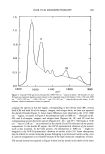
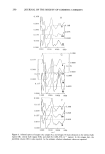
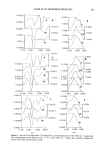
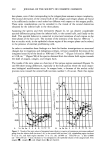
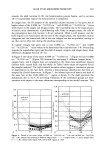
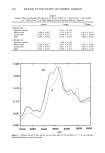
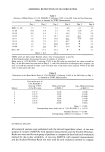
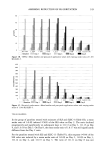
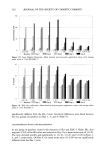
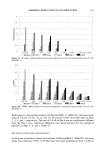
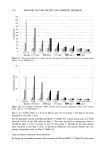
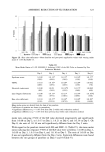
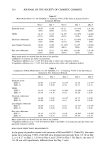
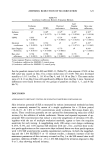
HAIR FT-IR MICROSPECTROSCOPY 295 part of the spectrum can assume significance in the examination of hairs submitted to exogenous and endogenous stresses. In previous papers regarding the infrared characterization of normal and leukemic lymphocytes and of their membrane phospholipids, it has been shown that the major contribution to the intensity of C-H stretching absorption is due to the paraffinic chains of the phospholipids. In that case, the presence of shorter segments in the phospholipids of the leukemic cells was suggested (22). On the basis of our observations, we suggest that these absorptions are mainly due to the phospholipids of the cellular membranes. Finally, it is interesting that, on the base of our experimental results (see Table I), a new method could be suggested to objectively determine the hair growth phase, using both ratios of integrated areas. Experimental work to test this possibility is in progress. CONCLUSION A reliable method of performing infrared measurements on hairs in different periods of their cycle has been developed in the present work. The A 1080 cm- •/A 1540 cm- • and the A1080 cm- •/A1238 cm- • ratios seem to offer significant, reproducible parameters in differentiating the anagen, catagen, and telogen hair phase, and in estimating the degree of hair aging. The variations of these values are related to the structural changes accompanying the cellular differentiation proceeding from the bulb matrix to the shaft and also to modifications that occur in the different periods of a hair cycle. REFERENCES (1) (2) (3) (4) (5) (6) (7) (8) (9) (10) (11) (12) C. S. Potten, Biological dosimetry of local radiation accidents of skin: Possible cytological and biochemical methods, Br. J. Radiol., 48, 349-360 (1986). M. W. A. C. Hukkelhoven, A. C. Dijkstra, and A. J. M. Vermoken, Human hair follicles and cultured hair follicle keratinocytes as indicators for individual differences in carcinogen metabolism, Arch. Toxicol. 53, 265-274 (1983). H. F. Merk, H. Mukhator, I. Kaufmann, M. Das, and D. R. Bickers, Human hair follicle ben- zo(a)pyrene and benzo(a)pyrene 7,8-diol metabolism: Effect of exposure to a coal tar-containing shampoo, J. Invest. Dermatol., 88, 71-76 (1987). J. Strong, A. Marsh, and N. Desouza, Hair analysis for drugs abuse. Lancet, 740 (March 24, 1990). J. E. Cone, Testing human hair for drugs abuse. I. Individual dose and time profiles of morphine and codeine in plasma, saliva, urine and beard compared to drug-induced effects on pupils and behavior, J. Anal. Toxicol., 14, 1-7 (1990). A. Chart and S. A. Katz, Hair Analysis: Applications in the Biomedical and Environmental Sciences (VCH Publishers Inc., New York, 1988), pp. 1-16. F. S. Parker, Biochemical applications of infrared and Raman spectroscopy, Appl. Spectr., 29, 129- 135 (1975). R. M. Gendreau, Spectroscopy in the Biomedical Sciences (CR Press, Boca Raton, Florida, 1986). J. Strassburger, Quantitative Fourier transform infrared spectroscopy of oxidised hair, J. Soc. Cosmet. Chem., 36, 61-74 (1985). E. Benedetti, F. Galleschi, A. D'Allessio, G. Ruggieri, M. Aglietto, M. Pracella, and F. Ciardelli, Microscopic FT-IR analysis of blends from functionalized polyoleofins and poly(vinyl chloride) or polystyrene, Makromol. Chem. Makromol. Symp., 23, 265-275 (1989). E. Benedetti, P. Vergamini, and G. Spremolla, FT-IR analysis of a single human leukemic cell, 6th Internat. Conf. on FT-IR Spectroscopy, Vienna, Acta A3.3, 87 (1987). E. Benedetti, P. Vergamini, M. C. Andreucci, and G. Spremolla, Chim. Ind., 69, 97 (1987).

296 JOURNAL OF THE SOCIETY OF COSMETIC CHEMISTS (13) (14) E. Benedetti, P. Vergamini, and G. Spremolla, FT-IR analysis of single human normal and leukemic lymphocytes. Mikrochim. Acta, 1, 139-141 (1988). E. Benedetti, L. Teodori, M. L. Trinca, P. Vergamini, F. Salvati, F. Mauro, and G. Spremolla, A new approach to the study of human solid tumor cells by means of FT-IR microspectroscopy, Appl. Spectr., 44, 1276-1280 (1990). (15) M. Joy and D. M. Lewis, The use of Fourier transform infrared spectroscopy in the study of the surface chemistry of hair fibres, Int. J. Cosmet. Sci., 13, 249-361 (1991). (16) E. Benedetti, F. Papineschi, R. Consolini, and G. Spremolla, Analytical infrared spectral differences between human normal and leukaemic cells (CCL)•I, Leuk. Res., 8, 483-489 (1984). (17) E. Benedetti, M.P. Palatresi, P. Vergamini, F. Papineschi, and G. Spremolla, New possibilities of research in chronic lymphatic leukaemia by means of Fourier transform-infrared spectroscopy--II, Leuk. Res., 9, 1001-1008 (1985). (18) E. Benedetti, M.P. Palatresi, P. Vergamini, F. Papineschi, M. C. Andreucci, and G. Spremolla, Infrared characterization of nuclei isolated from normal and leukaemic (B-CCL) lymphocytes: Part III, Appl. Spectr., 40, 39-43 (1986). (19) L. C. Sperling, Hair anatomy for the clinician, J. Am. Acad. Dermatol., 25, 1-17 (1991). (20) L. C. Sperling and C. P. Samlaska, Hair anatomy as seen by light microscopy, J. Assoc. Mil. Der- matol., 15, 16-28 (1989). (21) A. IV[. Kligman, The human hair cycle, J. Invest. Dermatol., 33, 307-316 (1959). (22) E. Benedetti, B. Bottici, P. Vergamini, and G. Spremolla, Comparative Fourier transform-infrared analysis of lipids extracted from human normal and leukemic lymphocytes: Part V, Chemistry Today, 6, 57-60 (1988).
Purchased for the exclusive use of nofirst nolast (unknown)
From: SCC Media Library & Resource Center (library.scconline.org)