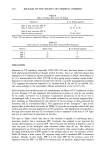
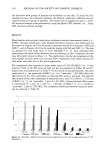
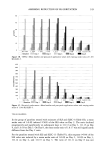
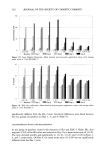
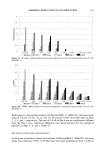
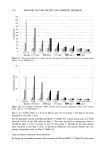
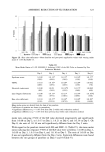
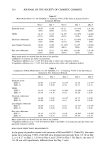
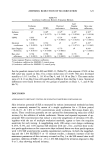
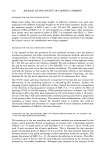
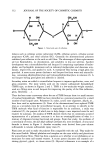
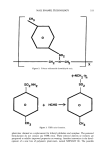
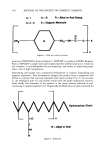
334 JOURNAL OF THE SOCIETY OF COSMETIC CHEMISTS n= 1 A = R R = Alkyl or Aryl Group n= 2 - 5 A = Organic Molecule CH 3 O S02--NH--C Figure 4. Alkyl aryl sulfonyl urethane. - A structure of NEPLAST is shown in Figure 5. NEPLAST is a product ofSNPE, Bergerac, France. NEPLAST is a high-molecular-weight polyether-urethane plasticizer. It has very low volatility, is non-flammable and non-migrating, and retains its plasticizing prop- erties, even at high temperatures. Nonsettling nail enamel was a substantial development in cosmetic formulating and pigment suspension. This development changed the product from a suspension that settled to a system that was well suspended with minor settling (10,11). As we know it, the rheological goal of a nail enamel would yield the proper application viscosity, while ideally the remainder of the product in the bottle remains relatively at rest, continuing to suspend pigments (12). Organically modified clays are used universally for ydrocarbon Chain I o I R = Alkyl or Aryl NH I R Figure 5. NEPLAST.

NAIL ENAMEL TECHNOLOGY 335 suspending nail enamel. Stearalkonium hectorite is the most widely used organophilic clay. Hectorite• is a trioctahedral hydrated silicate of a magnesium and lithium mont- morillonite group of clays. Quaternium-18 hectorite and stearalkonium bentonite have been used in some nail polish applications. The former clay is recommended for certain pearlescent applications and the latter clay has shown good results in cream-type nail enamels in reducing syneresis. Bentonite is a colloidal clay (aluminum silicate) com- posed chiefly of montmorillonite. The most alarming problem resulting from the use of these thixotropes is a curdled appearance in the bottle, over-gelatin, pigment migration, and flocculation. It was found that nail enamels in which the pigment was coated with an organo-polysiloxane exhibited greatly reduced settling and migration of the pigment (13). Other pigment treatments, such as pigments treated with Teflon ©, cyclic di- methiconol (14), and oxidized polyethylene (15), have been used in nail enamels with some success. Toluene has been questioned as an unsafe ingredient for nail enamel during the past five years. A study (14) presented in 1988 demonstrated that toluene is the main cause of nail damage. Recently, toluene was added to Proposition 65 in the State of California as a reproductive toxicant on January 1, 1991. Therefore, efforts to completely eliminate toluene formulations without any loss of the useful properties provided through their use have become very important to most cosmetic companies. Toluene is generally found to be present at about 25 percent in most colored nail enamels. Toluene is not only used because it can reduce the cost of a lacquer base and control the speed of drying, but mainly because it plays an important part when thixotropy occurs, in the case of nail enamels with suspending properties. Recent studies discuss the effects of toluene on the properties of suspension nail enamel (15,16). The findings of the aforementioned studies illustrate that it is possible to make an acceptable toluene-free suspension nail lacquer. Colorants for nail enamels are usually confined to those that have good permanence and are nonbleeding in lacquer solvents so as to avoid staining and discoloration of the nails, especially when the enamel is removed. Additionally, soluble colorants may react with the nail lacquer itself. Soluble colorants have been limited for the most part to the tinting of some colorless enamels. Another very recent innovation is in quick-drying suspension nail enamel. It is known that the solvent or solvents employed in nail enamel will influence the ease of applica- tion, its rate of drying and hardening, and also the characteristics of the applied film. Two recent patents employing acetone and halogenated hydrocarbons, respectively (17, 18), provide for reduction in drying time from 50% up to about 70% over con- ventional nail enamel compositions without adversely affecting the other desirable prop- erties of the coating. Formulations of nail enamel compositions that dry in 60 seconds, 90 seconds, and two minutes are presented. An interesting nail enamel product was manufactured by pouring nail enamel onto an adhesive-backed sheet of paper. After a period of drying at a predetermined temperature, it was packaged in semi-solid form (19). The coatings may also be provided with designs, pictures, or stripes. This invention provides a product that allows fingernails to be quickly coated with a high-gloss enamel-look without manually brushing. Uni- formity of thickness of application needed in brushing is eliminated. Nail hardeners and strengtheners represent the most significant category in the nail care
Purchased for the exclusive use of nofirst nolast (unknown)
From: SCC Media Library & Resource Center (library.scconline.org)