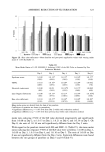
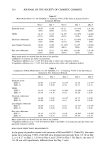
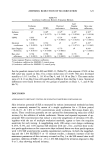
ASSESSING REDUCTION OF SLS IRRITATION 329 portion (8). A higher degree of ethoxylation also results in a higher reduction in electrostatic repulsion (6). Therefore, it is believed that SLEC-13 produced a greater reduction in the CMC of SLS and a greater lowering in the irritating SLS monomer concentration than did SLEC-5. CONCLUSIONS An in vivo method involving a two-hour occlusive patching procedure on five consecutive days together with multiple instrumental measurements was validated for its ability to assess reduction of SLS irritancy by added mild surfactants. By using this approach, both SLEC-5 and -13 exerted a mollifying effect on SLS, but SLEC-13 (the higher ethoxylated surfactant) was clearly demonstrated to be more effective in reducing the irritancy potential of SLS than SLEC-5. Because of the specificity and sensitivity of the method, valuable data for product formulation can be obtained regarding 1) the relative effec- tiveness of various added surfactants in reducing SLS irritancy, and 2) the SLS:cosur- factant proportions needed to achieve specified levels of irritancy reduction. ACKNOWLEDGMENTS The authors would like to thank Hyman Menduke, Ph.D., of Thomas Jefferson Uni- versity, Philadelphia, Pennsylvania, for his help on the data system and the statistical analyses. Appreciation is extended to Dominique Ribola, Ph.D., and Joan Day of Hoechst Celanese Corp., Charlotte, North Carolina, for supplying the test materials. The authors are also grateful to Richard Hershman, Ph.D., of Biosearch, Inc., Phila- delphia, Pennsylvania, for his comments and discussions during the course of this research. REFERENCES (8) (9) (10) (1) R. L. Goldemberg and L. Safrin, Reduction of topical irritation, J. Soc. Cosmet. Chem., 28, 667-679 (1977). (2) R. L. Goldemberg, Anti-irritants,J. Sac. Cosmet. Chem., 30, 415-427 (1979). (3) J. Garcia Dominguez, F. Balaguer, J. L. Parra, and C. M. Pelejero, The inhibitory effect of some amphoteric surfactants on the irritation potential of alkylsulphates, Int. J. Cosmet. Sci., 3, 57-68 (1981). (4) K. Miyazawa, M. Ogawa, and T. Mitsui, The physico-chemical properties and protein denaturation potential of surfactant mixtures, Int. J. Cosmet. Sci. 6, 33-46 (1984). (5) L. D. Rhein, C. R. Robbins, K. Fernee, and R. Cantore, Surfactant structure effects on swelling of isolated human stratum corneum, J. Sac. Cosmet. Chem., 37, 125-139 (1986). (6) J. C. Blake-Haskins, D. Scala, L. D. Rhein, and C. R. Robbins, Predicting surfactant irritation from the swelling response of a collagen film, J. Sac. Cosmet. Chem., 37, 199-210 (1986). (7) L. D. Rhein, F. A. Simion, R. L. Hill, R. H. Cagan, J. Mattai, and H. I. Maibach, Human cutaneous response to a mixed surfactant system: Role of solution phenomena in controlling surfactant irritation. Dermatalagica, 180, 18-23 (1990). U. K. Charaf and G. L. Hart, Phospholipid liposomes/surfactant interactions as predictors of skin irritation. J. Sac. Cosmet. Chem. 42, 71-85 (1991). J. Day, Application Chemist, Hoechst Celanese Corp., Charlotte, NC, personal communication (1991). P. J. Frosch and A.M. Kligman, The soap chamber test,J. Am. Acad. Dermatal., 1, 35-41 (1979).

330 JOURNAL OF THE SOCIETY OF COSMETIC CHEMISTS (11) (12) (13) (14) (15) (16) (17) (18) (19) (20) (21) G. E. Nilsson, Measurement of water exchange through skin, Med. Biol. Eng. Comput. 15, 209-218 (1977). J. Pinnagoda, R. A. Tupker, T. Agner, and J. Serup, Guidelines for transepidermal water loss (TEWL) measurement, Contact Dermatitis, 22, 164-178 (1990). H. Tagami, M. Ohi, K. Iwatsuki, Y. Kanamaru, M. Yamada, and B. Ichijo, Evaluation of the skin surface hydration in vivo by electrical measurement, J. Invest. Dermatol., 75, 500-507 (1980). G. E. Nilsson, U. Otto, and J. E. Wahlberg, Assessment of skin irritancy in man by laser Doppler flowmerry, Contact Dermatitis, 8, 401-406 (1982). J. C. Seitz and C. G. Whitmore, Measurement of erythema and tanning responses in human skin using a tri-stimulus colorimeter, Dermatologica, 177, 70-75 (1988). K. P. Wilhelm, C. Surber, and H. I. Maibach, Quantification of sodium lauryl sulfate irritant dermatitis in man: Comparison of four techniques: Skin color reflectance, transepidermal water loss, laser Doppler flow measurement and visual scores, Arch. Dermatol. Res., 281, 293-295 (1989). T. Agner and J. Serup, Sodium lauryl sulphate for irritant patch testing--A dose-response study using bioengineering methods for determination of skin irritation,J. Invest. Dermatol., 95, 543-547 (1990). R. A. Tupker, J. Pinnagoda, P. J. Coenraads, and J. P. Nater, The influence of repeated exposure to surfactants on the human skin as determined by transepidermal water loss and visual scoring, Contact Dermatitis, 20, 108-114 (1989). J. Zhou, R. Mark, T. Stoudemayer, A. Sakr, J. L. Lichtin, and K. L. Gabriel, The value of multiple instrumental and clinical methods, repeated patch applications, and daily evaluations for assessing stratum corneum changes induced by surfactants, J. Soc. Cosmet. Chem., 42, 105-128 (1991). S. Zehnder, R. Mark, S. Manning, A. Sakr, J. L. Lichtin, and K. L. Gabriel, Analysis of irritancy of SLS on human skin: Concentration vs. exposure duration effects, Poster presented at the Annual Scientific Meeting of the Society of Cosmetic Chemists, New York, December 5, 1991. J. A. Faucher and E. D. Goddard, Interaction of keratinous substrates with sodium lauryl sulfate: I. Sorption, J. Soc. Cosmet. Chem., 29, 323-337 (1978).
Purchased for the exclusive use of nofirst nolast (unknown)
From: SCC Media Library & Resource Center (library.scconline.org)