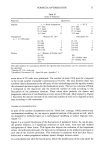
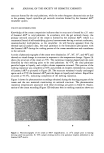
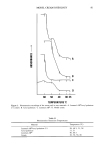
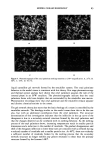
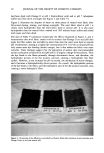
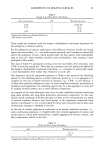
ADSORPTION TO KERATIN SURFACES 93 Table V Orange II and Wool Fabric Wettability Dye concentration pH Wetting time (sec) 0.5% 1 2500.00 a 0.5% 7 29.6 -- 7 35.0 b 5.0% 7 12.6 a Significantly different by Kruskal Wallis test. SLS-washed control fabric. These results are consistent with the charge to hydrophobic continuum hypothesis for the adsorption to keratin surfaces. For the adsorption of cationic surfactants to hair fibers as a function of pH, one would expect the reverse effect, i.e., one would expect primarily ionic bonding at neutral pH (above the isoelectric of hair), which would render the hair surface more hydrophobic than at acid pH, where bonding would be more hydrophobic, thus creating a more hydrophilic fiber surface. The data of Table VI summarizes wetting times for wool fabric after treatment with CTAC at acid and neutral pH. These data are consistent with the predictions offered by the charge to hydrophobic continuum hypothesis, i.e., treatment at neutral pH creates a more hydrophobic fiber surface than treatment at acidic pH. One important and still unanswered question is: What is the nature of the adsorbing species? Is the adsorbing species a simple molecular species or is it an aggregate or a complex? In the case of simple solutions of cationics, e.g., CTAC, at low dilution, it is likely that molecular adsorption occurs. In more complicated systems, particularly in emulsions and suspensions, the adsorbing species may be a self-aggregate or some sort of complex formed between two or more different components. An example of the latter adsorption may occur in some conditioner systems containing long-chain alcohols and long-chain quaternary ammonium compounds. In this case, liquid crystals consisting of alcohol and quat can form at low concentrations as a result of reduced repulsion between ionic head groups in the quaternary compound when alcohol is interposed (11, 12). It seems likely for these types of systems that at least some alcohol-quat complex is adsorbed to the hair. In the case of cationic polymers or surfactants in an anionic surfactant medium, i.e., some conditioning shampoos, it is highly likely that complex aggregates of cationic and anionic species, and in some formulations, complex aggregates of cationic, anionic, and lipid components, adsorb to the hair. Table VI CTAC and Wool Fabric Wettability pH Wetting time (sec) 1 107.4 • 7 720 • Significantly different by Mann Whitney U test (p = 0.01 level).

94 JOURNAL OF THE SOCIETY OF COSMETIC CHEMISTS SUMMARY AND CONCLUSIONS A hypothesis is presented that explains a wide variety of experimental observations regarding the adsorption of conditioning agents to keratin fiber surfaces. This hypoth- esis suggests that the adsorption of conditioning agents to hair should be considered as a continuum between a charge-driven process and a hydrophobically driven process. The exact nature of the reaction depends primarily on the structure of the adsorbing species and the pH of the system. The adsorption of species and systems to hair can all be explained on the basis of this hypothesis: increasing adsorption with increasing alkyl chain length for cationic surfac- rants (at acid pH) increasing adsorption of lipid/cationic with increasing lipid to cationic in formulated hair conditioners increasing adsorption with decreasing charge density for amodimethicones in an anionic surfactant medium and hydrocarbon adsorp- tion in an anionic medium. Changes in the wettability of keratin surfaces by an anionic dye (Orange II) and a cationic surfactant (CTAC) caused by pH changes above and below the isoelectric point of hair are also explained by this same hypothesis. REFERENCES (1) G. V. Scott, C. R. Robbins, and J. D. Barnhurst, Sorption of quaternary ammonium surfactants by human hair, J. Soc. Cosmet. Chem., 20, 135-152 (1969). (2) J. Steinhardt and E. M. Zaiser, Combination of wool protein with cations and hydroxyl ions, J. Biol. Chem., 183, 789-802 (1950). (3) G. Reese, Adsorption of amines on hair keratin, Fette Seifen Anstrichmittel, 68, 763-765 (1966). (4) R. Y. Lockhead, Conditioning shampoos, Soap Cosmetics Chemical Specialties, 42-49 (October 1992). (5) J. Steinhardt, C. H. Fugitt, and M. Harris, Further investigations of the affinities of anions of strong acids for wool protein, J. Res. Natl. Bur. Stand., 28, 201-216 (1942). (6) C. Robbins, Mechanisms for adsorption to keratins, Proceedings of the 8th Int. Hair Sci. Syrup., Kiel, Germany, September 1992. (7) C. R. Robbins, in Chemical and Physical Behavior of Human Hair, 2nd ed. (Springer-Verlag, New York, Berlin, 1988), p. 157. (8) C. R. Robbins, C. Reich, and J. Clarke, Dyestaining and the removal of cationics from keratin: The structure and the influence of the washing anion, J. Soc. Cosmet. Chem., 40, 205-214 (1989). (9) G. Kohl and E. G. Gooch, Method to determine silicones on human hair by atomic absorption spectroscopy, J. Soc. Cosmet. Chem., 39, 383-392 (1988). (10) T. Vickerstaff, in The Physical Chemistry ofDyeing, 2nd ed. (Interscience, New York, 1954), p. 413. (11) B. W. Barry and G. M. Saunders, The self-bodying action of the mixed emulsifier cetrimide/ cetostearyl alcohol, J. Colloid Interface Sci., 34, 300-315 (1970). (12) B. W. Barry and G. M. Saunders, The influence of temperature on the theology of systems containing alkyltrimethylammonium bromides/cetostearyl alcohol: Variation with quaternary chain length, J. ColloidInterface Sci., 36, 130-138 (1971).
Purchased for the exclusive use of nofirst nolast (unknown)
From: SCC Media Library & Resource Center (library.scconline.org)