j. Soc. Cosmet. Chem., 45, 95-107 (March/April 1994) The concept of sensory quality JO-ANN CLOSE, Close Associates, Route 5, Box 445, Rutherfordton, NC 28139. Received September 3, 1993. Presented at the Annual Scientific Seminar of the Society of Cosmetic Chemists, Baltimore, May 6-7, 1993. Synopsis Sensory evaluation is a growing discipline in the cosmetics and personal care products industry today. Having its roots in the food industry where most of the original methodology was developed, there are new challenges facing sensory scientists in applying these principles to skin care, hair care, fragrance, etc. Sensory analysis has been used successfully in new product development, product reformulation, stability, claims support, and competitive surveillance. It is critical that it now be applied to product quality. With the concept of total quality in the forefront thanks to the lessons Japan has taught us, it is essential that product sensory quality be monitored to fall within acceptable ranges based on consumer perceptions of product quality. Consumers, in fact, buy sensory quality and consistency. The first signals of product identity and performance are sensory signals--how the product they are about to purchase looks, feels, smells, etc. In companies where sensory performance is critical to product acceptance and efficacy, the margin of error for sensory quality is very small. As with all product development and support programs, sensory quality programs should be built upon consumer understanding--understanding how consumers define quality and what specific product parameters comprise it. INTRODUCTION In general business terms, a simple definition of quality is customer satisfaction. The concept of product quality is currently evolving from being expert-driven to being consumer-driven because a single expert opinion can rarely, if ever, consistently predict consumer acceptability in today's highly segmented marketplace. Yet many companies continue to rely on the N of 1! (1). Quality has also been described as the combination of attributes or characteristics of a product that has significance in determining the degree of acceptability of the product to the user (2). This necessarily means building in quality instead of putting it in after the fact. It means meeting consumers' expectations for a product consistently before shipment . . . every time. It means understanding how much deviation is tolerable before the product's sensory profile changes negatively in the eyes of the consumer. It means knowing how far to go given that the next batch of product will not always be identical to the last because raw materials and processes introduce unpredictable vari- ability. 95

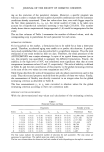
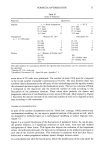
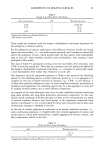
96 JOURNAL OF THE SOCIETY OF COSMETIC CHEMISTS Practically speaking, the issue is one of degree--what degree of difference will be acceptable to the consumer. Based on these considerations of total quality, the following points are critical to the installment of a useful and valid sensory quality function. BACKGROUND Companies in the United States have become very involved with quality control and quality assurance, and have developed elaborate methods to assay many properties of the products that they manufacture. The food and beverage industries have conducted quality surveillance on their products' sensory attributes--flavor, color, texture, etc.-- for many years because they realized early on that what they are selling is sensory satisfaction. Cosmetics and personal care companies have traditionally controlled things like water content, pH, viscosity, and active ingredient levels, and some have even paid cursory attention to color, fragrance, odor, skinfeel, etc. In fact, a skin care product's sensory characteristics are much more important and are worthy of much more attention at the QC level than they are usually given. Companies often set specifications for raw materials and finished products as "charac- teristic" or "typical" rather than establishing specific reference standards and ranges of variability. Table I displays the specifications for a raw material known to be odorous by nature. Note that an odor description is not provided for the analyst but that the notation of "characteristic" is found in the "Results" column for both odor and color. Specifications like these are crises waiting to happen at the most inopportune moment because they provide a huge margin of error in interpretation from one analyst to another. Further, they do not specify a range of acceptability within which to operate. In these situations it is very possible to produce a batch with several slightly "atypical" raw materials that when added together produce a large deviation from a "typical" finished product. In fact, such specifications offer no guidance at all, and in the hands of a new, inexperienced, or inadequately trained analyst, they are meaningless. The analyst has to know an apple from an orange before he or she can determine that the test sample is similar to either the apple or the orange. This demonstrates the need for sensory odor quality control even in products in which Table I Manufacturing Specification Sheet Sunscreen raw material: A clear, viscous liquid having a characteristic odor and color Specification/test Result Solubility/70% alcohol Conforms to NF Specific gravity 1.80-1.85 Optical rotation 1.5 ø Refractive index 1.26-1.29 Viscosity 5,000 cps Color Characteristic Odor Characteristic
Purchased for the exclusive use of nofirst nolast (unknown)
From: SCC Media Library & Resource Center (library.scconline.org)