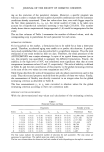
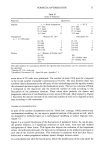
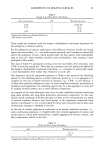
SENSORY QUALITY 97 it is not the primary product characteristic. It is also possible that in a product in which odor is the primary attribute, other product attribute deviations such as color or clarity might signal that the product itself has changed even though, in fact, it hasn't (3). Simply stated, these examples lead to the conclusion that the manufacturer must know the profile of the product, establish reasonable ranges of deviation from its characteristic profile, and install a mechanism to control it. The manufacturer can then measure deviations from the predetermined standard. CONSUMER PERSPECTIVE It is extremely important to understand what the consumer has to say about quality--or how he or she defines it in the particular product in question--or what are his or her expectations. It is also helpful to understand that the perceivable characteristics of a product are multidimensional in nature. The components of quality that make it multidimensional are the product attributes that help to differentiate items from one another in the marketplace. Table II lists the dimensions of quality and defines them (4). Included are performance, conformance, features, reliability, durability, serviceability, response, rep- utation, and aesthetics. It is this last very critical component that provides the product's identity. This aesthetic element is particularly important in the skin care and personal care categories in which we work. For example, a woman might describe the moisturizer she is using to a friend who is going to the market to look for it by saying, "It's a non-greasy, easy to spread, quickly absorbing white cream with a light floral fragrance." All sensory characteristics--every one! She doesn't say "It's a viscous oil-in-water emulsion with a pH of 6.5, a particle size of 0.1 Ix, a specific gravity of 1.5-1.59, and a viscosity of 20,000 to 28,000 cps." She employs her senses to identify and describe the product she uses. The product through its manufacturer must have the capability to deliver the same level of quality consis- tently. Therefore, another definition of quality is conformance to customers' expecta- tions. In many instances, people buy products, and in fact, differentiate among them in a crowded marketplace based on the differences in the sensory characteristics between brands. In other words, all other things being equal, for example, in a moisturizer, the fragrance probably plays a key role in the consumer experience and level of satisfaction. Table II The Dimensions of Quality Performance Features Conformance Reliability Durability Service Response Reputation Aesthetics Primary product characteristics Secondary product characteristics Meets specifications or standards Consistent performance Continued performance over time Product service and support Human interface characteristics Past performance and good will Product sensory characteristics

98 JOURNAL OF THE SOCIETY OF COSMETIC CHEMISTS However, how closely monitored is the fragrance or odor quality of this moisturizer, or of the raw materials composing it? The motivation for purchasing a specific cosmetic or personal care product is influenced by the senses and what these senses tell the consumer about the product he or she is about to purchase. Color, fragrance, and texture are key elements stimulating the desire to buy (5). The sensory properties of skin care products are the first signals consumers receive regarding product performance, and they are often the most important reason for purchase. Once a consumer has purchased a product and made the decision to buy it again, the brand has a sensory identity in his or her eyes and any change in the future will not be well received unless it is understood and the reasons for the change are accepted. This is true even when the product attribute is not particularly important by itself, such as the fragrance in a moisturizer or bar of soap. The role of the fragrance in signaling product quality and consistency is strong in such cases. A slight odor change could cause a consumer to conclude that the product has been changed, even though he may not be aware that he used the fragrance signal to draw his conclusion. Quality control seeks to maintain product integrity despite numerous raw material and processing variables that may alter the sensory characteristics of a product and subsequently erode consumer loyalty (6). HYPOTHESIS This paper suggests that sensory quality is an intregral part of overall product quality and is critical to its success. It further suggests that there are simple and relatively foolproof sensory methods to monitor the sensory quality of product characteristics that are or may be important to consumers. It also states that it is now essential to control the key sensory parameters that identify the product for the consumer in a meaningful way. The consistent evaluation of the sensory quality of the raw materials, intermediates, and finished product is necessary because many of the raw materials themselves have odor and texture characteristics critical to the acceptance of the end product. For example, a raw material odor may be strong and unpleasant inherently and need to be "damage controlled" out of the end product. Or the product's perfume may be so superior that it offers the manufacturer a strong competitive advantage. In either case, it is imperative that the desired optimal overall odor impression be maintained in order to insure consumer confidence and satisfaction. DISCUSSION Sensory methods offer several advantages when incorporated into quality control pro- grams. Of the greatest significance is the fact that at times sensory evaluations are the only methods that directly measure perceived product characteristics. They often provide information that aids in consumer understanding. Further, they can measure interactive or "Gestalt" effects, yielding integrated responses rather than the discrete measurements provided by instrumentation. Sensory measurements are obtained using
Purchased for the exclusive use of nofirst nolast (unknown)
From: SCC Media Library & Resource Center (library.scconline.org)