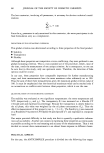
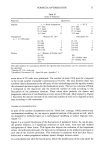
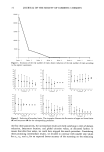
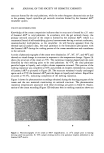
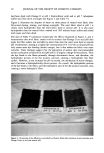
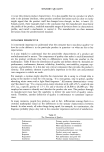
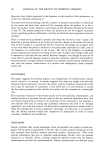
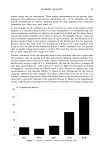
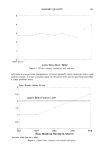
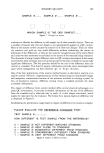
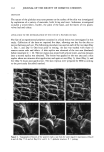
112 JOURNAL OF THE SOCIETY OF COSMETIC CHEMISTS ARTIFACTS The nature of the globular structures present on the surface of the skin was investigated by replication of a variety of materials, both living and inert. Substrates investigated included a woven fabric, leather, the palm of the hand, and the leaves of two plants: velvet leaf and coleus. APPLICATION TO THE DETERMINATION OF THE FATE OF A POLYMER ON SKIN The fate of an experimental polymer contained in a facial lotion was investigated in this study. Collection of the data set required five days, allowing one day for the skin to recover between each set. The following procedure was used on each of the test days (Day 1, Day 3, and Day 5): One hour prior to testing, the face was washed with water to remove excess salts and debris. A skin replica was obtained of the test area (forehead) before treatment (t = 0). The test region was wiped with a facial toner, and ten minutes later a second replica was obtained. The lotion was applied to the test area and a skin replica taken ten minutes after application and again at one (Day 1), three (Day 3), and five (Day 5) hours post-application. The skin replicas were prepared for SEM accoMing to the previously described method. 88075• 10FV X50.0 600um Figure 2. Topographical features of the positive replica cast from the same negative impression at Day 0 (a and d) Day 77 (b and e) Day 81 (c and f). G = globular structure P = pitting.

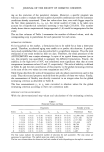
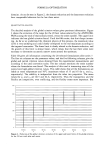
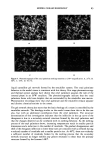
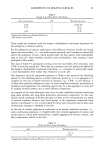
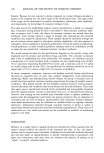
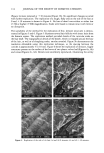
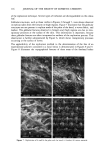
REPLICATION OF SKIN 113 RESULTS AND DISCUSSION The effects of casting the positive replica from the same Reprosil mold at 0, 77, and 81 days are shown in Figure 2. The overall surface topography was not observed to be affected at either low (x 50) or higher magnification (x 250) at 77 days after the sample was taken (Figure 2a,b,d,e). The effect of repeated use of the same Reprosil mold is illustrated in Figures 2c and 2f. Surface pitting (P) was evident with repeated use however, in practice the Reprosil molds are only used once. The globular structures (G) were reproduced accurately, except in Figure 2d, where one of the structures was absent. The globular structures are fragile and may easily be lost either during removal of the Reprosil negative from the epoxy or during the final mounting of the sample. Figure 3 shows the effects of replicating the skin at 30-minute intervals at a magnifi- cation of x 150. Several loose flakes of skin that were present in the initial replica / 881469 10KV X150 •00u• 8-5)8 Figure 3. Replication of the same area of the forearm at 30-minute intervals: (a) 0 minutes (b) + 30 minutes (c) + 60 minutes (d) + 90 minutes.
Purchased for the exclusive use of nofirst nolast (unknown)
From: SCC Media Library & Resource Center (library.scconline.org)