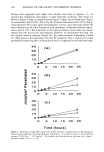
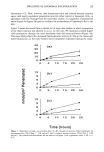
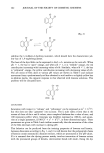
150 JOURNAL OF THE SOCIETY OF COSMETIC CHEMISTS human hair fibers from which the influence of the cuticle on the permanent wave set is deduced. METHODS Descaled fibers were prepared by abrading the cuticle layers from a hair using fine grade emery paper. The principle of this method is based on the procedures described by Chamberlain (8) and Snaith (9). An electrical laboratory motor was fixed to a burette stand by a clamp with the motor shaft down. A single hair fiber of approximately 20-cm length was connected to the head of the motor shaft through an adapter. A weight of 500 mg was suspended from the free end of the fiber, which was rotated at a speed of approximately 200 rev/min. A small piece of fine emery paper was bent, carefully contacted with the rotating hair fiber, and by exerting a small normal force slowly moved up and down along the fiber. The progress of the cuticle removal was checked discontinuously and continued until the anisotropic friction of the fiber, detected by rubbing the fiber between thumb and index finger, was removed. The electron microscopic examination of the surface of the treated fibers showed for fibers that had passed this check that the cuticle had largely been removed without any significant damage to the cortex. All experiments were carried out on chemically untreated Japanese hair taken from the head of one of the authors (N.K.) just prior to the experiments. Virtually straight, normal, and descaled hairs, whose tips were clipped off for 2 cm, were rinsed in methylene chloride and then in distilled water. After drying in air, the hairs were cut into halves, each of which was subjected to one of two tests, either for the determination of fiber bending set or for the measurement of bending stiffness. To determine bending set, a hair fiber was wound around a PVC cylinder (12 mm diameter), keeping the fiber perpendicular to the cylinder axis and finally fixing both ends with small drops of nail polish. The cylinder was then suspended in a beaker and treated in sequence with the following reagents at room temperature: 1. Distilled water for 30 min 2. Reduction by thioglycolic acid for 20 min 3. Rinse in distilled water for 20 min 4. Reoxidation by 2.3% hydrogen peroxide for 20 min 5. Rinse in distilled water for 20 min The concentrations of thioglycolic acid (TGA) used in Step 2 were varied from 0.1 to 0.8 M. The initial pH of the TGA solution was adjusted to 9.0 by an appropriate amount of 25 % ammonia solution. After the final rinse (Step 5), the fiber loops were cut and dropped into distilled water, followed by the immediate measurement of their diameters. The set acquired by the fiber loops is given by (3,7): S e = dc/d• (1) where S e is the experimental loop set, d c the cylinder diameter, and d• the mean diameter of the circles defined by the partially opened fiber loops. The bending stiffness of a hair fiber was measured by the balanced fiber method

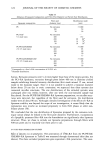
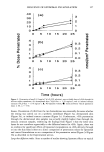
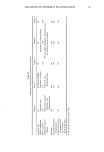
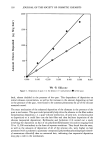
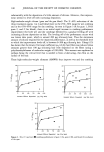
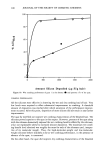
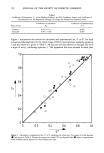
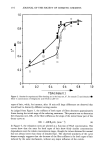
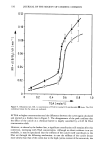
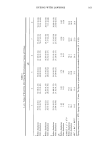
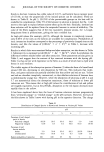
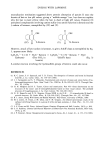
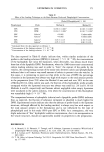
THE CUTICLE AND PERMANENT WAVE SET 151 described by Scott and Robbins (10). This method essentially consists of measuring the distance between the ends of a single fiber bent over a thin hook under appropriate loads attached to the fiber ends. The procedure for the measurements is described in detail in reference 7. After equilibration in distilled water for 20 min in the undeformed state, the fiber was draped over the hook of the bending device and placed in a beaker filled with distilled water. The change of the distance between the fiber ends with time was followed during the above-described treatment sequence. The exchange of the treatment agents was carried out by sucking off the solution in the beaker in parallel with an inflow of new treatment solution (7). THEORY AND RESULTS On the basis of Denby's equation (11) for the interrelation of bending stiffness and a cohesive set of wool fibers, an analogous description was developed for permanent set (7): S c= 1 - Bre/Bro (2) where the calculated set is given by the ratio of the residual stiffness of the fiber after the treatment sequence, Bre, and the inherent stiffness, Bro , that is restored to the fiber through reoxidation. Since Bro is not determined in the balanced fiber test, a coefficient of restoration, C, is defined (7) that relates the stiffness of the reoxidized fiber to the initial stiffness B o of the untreated fiber, so that: S c --- 1 - Bre/(C B o) (3) Bre was obtained by determining the bending stiffness remaining at the end of the final rinsing process, and B o was estimated graphically by extrapolating the curve for the bending relaxation in water (Step 1) to t = 0 (see Figure 3). Rewriting equation 3 as: and accepting the equality (7): Bre/B o = C (1 -S c) (4) allows us to determine C by fitting a linear regression through the origin to pairs of experimentally obtained data for Bre/B o and 1 - S e for the paired halves of normal and descaled fibers, where C is the slope of the related regression line. Pairs of data with low values of Br/B o, and hence large values of set, were omitted, since in the balanced fiber test for these cases bending strains are imposed that are beyond 1%, which is the limit of linear viscoelasticity for wool and most likely also for hair fibers (12,13). The values of C thus obtained are summarized in Table I, together with their 95% confidence limits and with the coefficients of determination r 2 of the regression. The values of C are comparable for normal and descaled hairs and in good agreement with previous results on normal hairs for various treatment conditions (7). They show that on reoxidation (Step 4) the bending stiffness, which is drastically lowered during reduction, is restored within about 5 % of its original value. S c = S e (5)
Purchased for the exclusive use of nofirst nolast (unknown)
From: SCC Media Library & Resource Center (library.scconline.org)