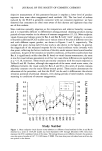
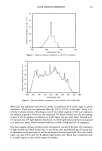
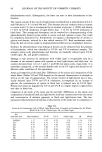
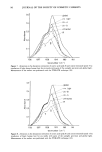
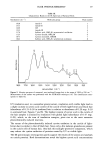
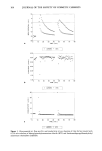
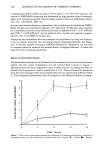
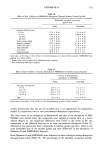
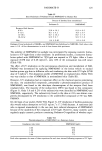
112 JOURNAL OF THE SOCIETY OF COSMETIC CHEMISTS tains silicone emulsion Q2-7224. Reduced level of conditioning for this system may also be related to a lower concentration of active ingredients in the formulation. CONDITIONERS BASED ON ELECTRICALLY NEUTRAL INGREDIENTS Three examples of the systems that deposit relatively thick layers of a conditioning agent but produce small changes in the surface charge are shown in Figure 6. Conditioners F and G are based on an electrically neutral complex linoleamidopropyl dimethylamine dilinoleate, also containing positively charged conditioning agents such as linole- amidopropyl dimethylamine (Conditioner F) or a combination of linoleamidopropyl di- methylamine with the silicone emulsion Q2-7224 (Conditioner G). In both cases, owing to the presence of positively charged materials, the zeta potential of treated hair becomes less negative. Conditioner G is a little more substantive, as reflected by both the zeta potential and permeability data, as a result of the use of higher concentrations of active ingredients. Conditioner H contains no positively charged surfactants or polymers, and its conditioning ability relies on petrolatum. Although, in general, the uncharged or negatively charged oils in the form of stable emulsions have little affinity towards unmodified hair surface (6), a composition such as Conditioner H, containing significant amount of alcohol, may precipitate the conditioning agent by destabilization as a result of dilution with water during the use of the product. As expected, the zeta potential of hair is little changed after the application of this composition, especially after prolonged rinsing with the test solution. Initial, transient adsorption, immediately following the treatment cycle, increases the measured zeta potential by probably screening the surface charges, but gradual desorption restores the original value of the surface potential. The changes in the electrokinetic parameters are paralleled by the variations in the plug permeability, which becomes significantly reduced following the treatment and in- creases during rinsing with the test solution. This may be explained by desorption of initially adsorbed oil droplets before their spreading and coalescence into a surface film (6). REMOVABILITY OF CONDITIONER RESIDUES BY SHAMPOOS Frequent use of conditioners that leave surfactant or polymer residues on hair dictates the need for shampoos capable of removing them. The effectiveness of a post-conditioning shampooing and the evaluation of build-up parameters can be tested in DEPA experi- ments by consecutive treatment of hair with conditioners and shampoos. Figure 7 presents the results of an experiment in which the hair plug was first exposed to a 1% solution of Conditioner I, and then, after the measurement cycle, flushed for five minutes with a 5 % solution of Shampoo A. This whole process was repeated twice in order to evaluate build-up parameters after conditioning and after shampooing. Conditioner I contains substantive components such as BTC and silicone emulsion DC 929, and thus its use results in a significant modi- fication of hair as reflected in the high positive values of zeta potential and a thick (3.56 •m) layer of the conditioning agent. Subsequent treatment with a solution of Shampoo A, which is based on SLES-SLS-betaine as a primary surfactant system, strips away most of the adsorbed species, lowering the zeta potentials to relatively high negative values, and significantly reducing the thickness of the conditioning layer. Note that the zeta

DYNAMIC ELECTROKINETIC AND PERMEABILITY ANALYSIS 113 15 •' 10- E _ z • o • -10- N 0 10 2b 3b 4b 5b 6b 7b 80 TIME ( rain ) o CONDITIONER F + CONDITIONER G • CONDITIONER H ] 4.50 4 00- 3.50- • 3.00- v 250 • 2 00- O• 1.50 J 1.00 0 50- o oo 1 04 .urn 2.08 Hm -•"-.•++H++-.-•+:::::: :• + 354 .um 0 10 20 30 40 50 60 70 80 b TIME ( mln ) CONDITIONER F + C•ONDITIONER G :• CONDITIONER H I 3O 25- •5- lO- o o 10 2b 3b 4b 5'0 60 7o 80 C TIME ( mln ) D CONDITIONER F + CONDITIONER G ß CONDITIONER H Figure 6. Zeta potential (a), flow rate (b), and conductivity (c) as a function of time for hair treated with 1.0% w/w solutions of conditioners F, G, and H.
Purchased for the exclusive use of nofirst nolast (unknown)
From: SCC Media Library & Resource Center (library.scconline.org)