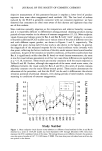
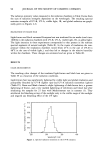
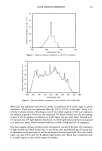
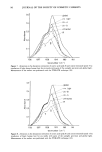
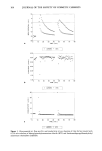
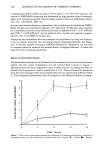
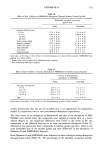
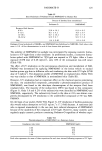
110 JOURNAL OF THE SOCIETY OF COSMETIC CHEMISTS Considering the deposition of cationic surfactants from conditioner formulations such as those represented by formulas A and B, one has to keep in mind the fact that these systems contain several nonionic amphiphiles that can form a variety of complex struc- tures with active ingredients. For example, fatty-chain alcohols can form liquid-crystal mesophases as well as a gel phase that consists of double layers of surfactants separated by layers of water (16-18). This arrangement imparts high viscosity to the formulation. Furthermore, it was shown that cationic surfactants interact with fatty alcohols to form mixed lamellar liquid crystals as well as gel networks (17). If an oil phase is present, the structure of an emulsion (cream) consists of a continuous ternary phase of cationic surfactant/fatty alcohol/water in which oil droplets are dispersed. The deposition exper- iments are performed on 1% dilutions of these compositions, and the gel structure characteristic of the original, undiluted formula is probably disintegrated under these conditions. It is possible that it is transformed into a dispersion of pure and mixed crystals or liquid crystals of a cationic surfactant, fatty alcohols, and other emulsifiers. These are the structural elements of the formulation that are adsorbed and deposited on the surface of hair. While pure cationic surfactants such as linoleoamidopropyldimeth- ylethyl ammonium ethylsulfate or behenyltrimethylammonium chloride deposit on hair without the formation of the thick layers (Figure lb), the interaction of conditioners with hair leads to a significant reduction in permeability. This is probably related to the precipitation of large-size fragments of crystalline or liquid crystalline phase containing both an active ingredient and the emulsifying agents, and swollen by water. The size of these surface deposits is reduced on drying by probably a factor of 10 to 100 (considering the fact that the total concentration of actives and emulsifiers is usually in the range from 2% to 10%), and consequently the deposited layer cannot be usually visualized even at high magnifications in SEM micrographs. CONDITIONERS FOR DIFFERENT TYPES OF HAIR Graduated conditioning effect can be achieved by combining several types of condition- ing agents, as shown in Figure 5, presenting the data for three conditioner formulations for damage/dyed, regular, and fine hair. Judging from the hair type designation, the extent of hair surface modification was expected to be the highest for Conditioner C and the lowest for Conditioner E. In agreement with this, the most significant surface modification resulted from the use of Conditioner C, which contains BTC and silicone emulsion DC 929. This system precipitates a thick layer of conditioning agents on hair, as evidenced by the permeability measurements, and also changes the character of the surface from negative to positive. The surface charge modification is durable and is not affected by a prolonged rinsing with the test solution. The permeability data for Conditioner C also suggest that the thickness of the adsorbed layer contracts during 30-minute rinsing with the test solution. This may be related to the rearrangement of the morphological structure of the conditioning phase or partial desorption of the surfactants. The formulation based on dicetyldimmonium chloride, stearamidopropyl dimethylamine, and cyclomethicone (Conditioner D) also precipitates a relatively thick conditioning layer, although according to zeta potential data, the cationic charge grad- ually disappears form the fiber surface during the 30-minute rinsing with the test solution. The least extent of the surface modification is evident for Conditioner E, which in addition to dicetyldimmonium chloride and stearamidopropyl dimethylamine con-

DYNAMIC ELECTROKINETIC AND PERMEABILITY ANALYSIS 111 10- -2O 0 1'0 2•0 3'0 4'0 5'0 6•0 70 80 TIME ( rain ) [] CONDITIONER C + CONDITIONER D ß CONDITIONER E 4.00 3.50- • 300- • 2.50 O 2.00 _.1 1.50 1.00 0 ß 058pm 0 71 pm 3 12 240pm 2 90 •-• 3 22 pm _ 10 20 3'0 4'0 5'0 60 70 80 TIME ( rain ) [] CONDITIONER C + CONDITIONER D ß CONDITIONER E ] 20- 0 0 1'0 2'0 3'0 4'0 5'0 6•0 7'0 80 TIME ( rain ) [] CONDITIONER C + CONDITIONER D ß CONDITIONER E Figure 5. Zeta potential (a), flow rate (b), and conductivity (c) as a function of time for hair treated with 1.0% w/w solutions of conditioners C, D, and E.
Purchased for the exclusive use of nofirst nolast (unknown)
From: SCC Media Library & Resource Center (library.scconline.org)