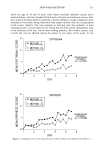
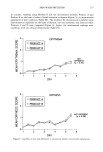
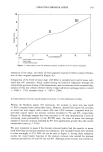
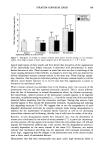
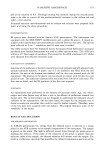
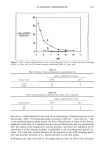
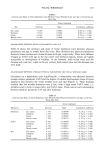
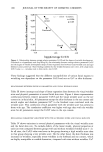
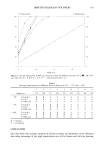
STRATUM CORNEUM LIPIDS 145 10 II 0 2 4 6 8 10 Region_ % EXTENSION I Hookean Region. GMF •z % extension II Plateau Region III Increased Sbffemng Region Figure 1. Stress-strain curve for stratum corneum incubated at 97% relative humidity. relaxation of the tissue, and many of them appeared ruptured without proper reforma- tion of their original organization (Figure 4c). Comparison of the levels of intact dsgl (160 kDa) in extended and control tissue indi- cated that 8% extension, which caused tearing and physical separation through the extracellular portions of some of the desmosomes, was not associated with increased deg- radation of this key cohesive element (levels of dsg 1-arbitrary units/pog protein: control = 9500 -+-- 1750 extended tissue = 7500 -+-- 2500). WATER BARRIER FUNCTION MEASUREMENTS DURING IN VITRO EXTENSION STUDIES Within the Hookean region (2% extension), the increase in water loss was small ( 10%) compared with unstretched tissue. However, beyond this region the increases in water loss were larger, with a mean 44% and 130% increase, compared with un- stretched control tissue, for stratum corneum extended to 5% and 8%, respectively (Figure 5). Although samples that were extended to 5% only demonstrated a trend of increasing water permeability in the WVTR assay, the rates of water loss through samples of stratum corneum extended by 8% were significantly greater than the control unstretched tissue (p 0.05). We were interested to assess if the stratum corneum barrier had the capacity to repair itself following mechanical extension and relaxation. The extended tissues were allowed to relax overnight at 97% RH. As can be seen in Figure 5, during these relaxation studies the water barrier function of the stratum corneum was normal for stratum corneum extended by 2% and 5% but not 8%. Although some recovery was evident for

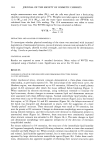
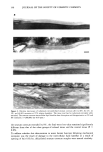
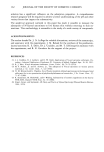
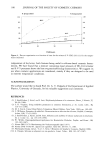
146 JOURNAL OF THE SOCIETY OF COSMETIC CHEMISTS .o Figure 2. Electron microscopy of ruthenium tetroxide-fixed stratum corneum after (a) 0%, (b) 2%, (c) 5%, and (d) 8% extension at 97% relative humidity. The tissue was fixed in ruthenium tetroxide while extended. The stratum corneum intercellular lipid lamellae show disruption and disorganization at 5% and 8% extension. (x200,000 bar 0.05 }xm.) the stratum corneum extended by 8%, the final water loss value remained significantly different from that of the other groups of relaxed tissue and the control tissue (P 0.05). To address whether this deterioration in water barrier function following mechanical extension was the result of damage to the intercellular lipid lamellae or a result of opening of hair follicles, delipidated stratum corneum samples were treated similarly.
Purchased for the exclusive use of nofirst nolast (unknown)
From: SCC Media Library & Resource Center (library.scconline.org)