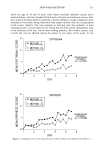
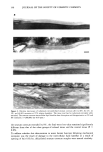
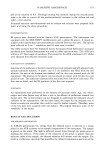
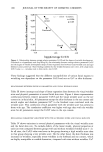
DIMETHYLSILOXANE POLYMERS 177 4O % Evaporated % Evaporated 4O 30 20 20 lO b lo 5 20 35 50 TIME (rain) Figure 1. Percent vaporization at iSøC as a function of time for different silicones: S.V-2-1-, DC-244- -zS•-, DC-344 3( , A.K-4-43--, S.V-5--o•, and deionized water •--•.. 15 minutes, and all tetramers took between 20 and 30 minutes to reach 100% evap- oration. The pentamer, on the other hand, did not go over 90% even after 60 minutes. The different evaporation rates observed for the tetramers might be due to the presence of impurities in the commercial products. Most probable impurities are cyclomethicone pentamers, hexamers, etc. Our data show that pentamers evaporate at a significantly slower rate than tetramers it is thus to be expected that tetramers evaporating more slowly contain larger amounts of silicone pentamers or hexamers. For the same reason DC-244 is probably the purest cyclomethicone tetramer among those studied in this work. FREEZING TESTS The results obtained in evaporation tests made it interesting to study mixtures of the tetramers S.V-2, A.K-4, and DC-244 with the pentamer S.V-5, with the aim of finding the combination showing good volatilization and freezing behavior simultaneously. It must be taken into account that the freezing point of the tetramers is close to 15øC, whereas S.V-5 freezes at -40øC. The freezing tests are of interest since, for instance, some cyclomethicone-based formu- lations are photoprotectors that must be designed to be used in high mountains during winter (10). The procedure followed consisted of mixing different amounts of both types of silicone

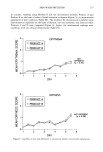
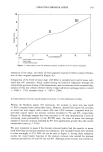
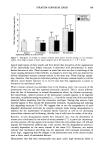
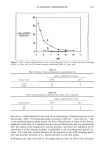
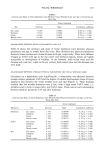
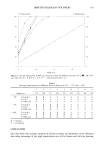
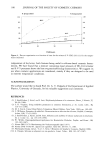
178 JOURNAL OF THE SOCIETY OF COSMETIC CHEMISTS % Evaporated % Evaporated 100 _ 80 lOO -60 -2o 5 20 35 50 TIME (rain) Figure 2. Percent vaporization at 40øC as a function of time for different silicones: S.V-2-1-, DC-244- -•'-, DC-344--5•-, A.K-4--CY-, S.V-5--•--, and deionized water-•-•-. •-. to a final volume of 10 mi. The test tubes were kept at different temperatures (4 ø, - 7 ø, and - 10øC) for 24 hours, and afterwards we examined them to detect whether freezing had occurred or not. Table I shows the results obtained. Note that mixtures consisting of 30% S.V-2 and 70% S.V-5, or 40% A.K-4 and 60% S.V-5 fulfilled the condition of not freezing at temperatures as low as -10øC. The most suitable behavior, however, is shown by mixtures S.V-5 and DC-244 equal amounts of these silicones gave an almost ideal formulation as to the freezing behavior, since that blend remained liquid at moderately low temperatures, unlike pure tetramers. In order to further check the characteristics of that formulation, we performed an evaporation test on it, as described in the previous paragraph. Thus, Figure 4 shows the amount evaporated as a function of time, at three temperatures: 15 ø, 40 ø, and 80øC. When these results are compared to those shown in Figures 1-3 for the pure tetramers and pentamer, it can be seen that the evanescent power of the S.V-5 pentamer is significantly improved and that the mixture evaporates at a rate comparable to some pure tetramers. The proposed blend shows proper evaporation behavior with no cold feeling upon evaporation (due to the low heat of vaporization of the silicone tetramer). These tests thus confirm the overall good behavior of the 1:1 S.V-5/DC-244 silicone mixture.
Purchased for the exclusive use of nofirst nolast (unknown)
From: SCC Media Library & Resource Center (library.scconline.org)