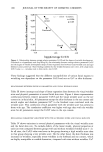
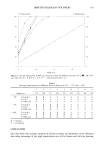
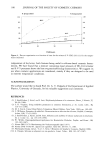
172 JOURNAL OF THE SOCIETY OF COSMETIC CHEMISTS between the forehead and eye corners showed that susceptibility to wrinkle formation is associated with either a low initial value or an acute slope despite a high initial value. It is generally accepted that wrinkle formation is marked in the face skin exposed frequently to the sun. However, in this study, no marked relationship was confirmed between the wrinkle formation rate and Ue*, a parameter reflecting the influence of exposure to the sun. Rather, a marked correlation was observed with Ur/Uf, a parameter reflecting aging. These results suggest that another important UV-related factor is involved, in addition to changes in physical properties, in the progression of wrinkles. Recently, we observed wrinkle formation in an unusual direction after temporary fixa- tion of the skin in hairless mice, suggesting the importance of both temporary fixation and UV in wrinkle formation (19). Considering these findings, sites in the face that are susceptible to wrinkle formation seem to be those susceptible to temporary wrinkle formation. Therefore, temporary fixation after UV irradiation together with Ur/Uf changes may be an important factor in wrinkle formation in humans. Based on these findings, we speculated the following mechanism of wrinkle formation and progression: Ur/Uf in the skin decreases with intrinsic aging and/or chronic aging. When Ur/Uf decreases below a certain level, many temporary wrinkles form in the areas of the face that move frequently, and constant exposure to UV causes gradual fixation of these wrinkles. As a result, large wrinkles form, and the skin surrounding the wrinkles becomes thickened. There may be different mechanisms of wrinkle formation and progression, and further studies are needed to characterize each mechanism fully. REFERENCES (1) A.M. Kligman, P. Zheng, and R. M. Lavker, The anatomy and pathogenesis of wrinkles, Br. J. Dermatol., 113, 37-42 (1985). (2) T. Tuji, T. Yorifuji, Y. Hayashi, and T. Hamada, Light and scanning electron microscopic studies on wrinkles in aged person's skin, Br. J. Dermatol., 114, 329-335 (1986). (3) G. E. Pierad and C. M. Lapiere, The microanatomical basis of facial frown lines, Arch. Dermatol., 125, 1090-1092 (1989). (4) H. M. Daniell, A study in the epidemiology of"crow's feet," Ann. Intern. Med., 75, 873-880 (1971). (5) G. L. Grove, M. J. Grove, and J. J. Leyden, Optical profflometry: An objective method for quan- tiffcation of facial wrinkles, J. Am. Acad. Dermatol., 21, 631-637 (1989). (6) C. E. Griffiths, T. S. Wang, T. A. Hamilton, and J. J. Voorhees, A photonumeric scale for the assessment of cutaneous photodamage, Arch. Dermatol., 128, 347-351 (1992). (7) P. Corcuff, J. de Rigal, and J. L. Leveque, Skin relief and aging,J. Soc. Cosmet. Chem., 34, 177-190 (1983). (8) R. Graham and P. J. L. Holt, The influence of aging on the in vivo elasticity of human skin, Gerontologica, 15, 121-139 (1969). (9) C. H. Daly and G. F. Odland, Age-related changes in the mechanical properties of human skin, J. Invest. Dermatol., 73, 84-87 (1979). 10) P. G. Agache, C. Monneur, J. L. Leveque, and J. De Rigal, Mechanical properties and Young's modulus of human skin in vivo, Arch. Dermatol. Res., 269, 221-232 (1980). 11) C. Escoffier, M. Pharm, J. De Rigal, A. Rochefort, R. Vasselet, J. L. Leveque, and P. G. Agache, Age-related mechanical properties of human skin: An in vivo study, J. Invest. Dermatol., 93, 353-357 (1989). 12) J. L. Leveque, L. de Rigal, P. G. Agache, and C. Monneur, Influence of aging on the in vivo extensibility of human skin at a low stress, Arch. Dermatol. Res., 269, 127-135 (1980). 13) P. Elsher, D. Wilhelm, and H. I. Maibach, Mechanical properties of human forearm and vulvar skin, Br. J. Dermatol., 122, 607-614 (1990).

FACIAL WRINKLES 17 3 (14) (15) (16) (17) (18) (19) (20) (21) (22) A. B. Cua, K. P. Wilhelm, and H. I. Maibach, Elastic properties of human skin: Relation to age, sex, and anatomical region, Arch. Der,zatol. Res., 282, 283-288 (1990). M. Nisimura and T. Tuji, Measurement of skin elasticity with a new suction device, Jpn. J. Dermatol., 102, 1111-1117 (1992). Y. Takema, Y. Yorimoto, M. Kawai, and G. Imokawa, Age-related changes in the elastic properties and thickness of human facial skin, Br. J. Dermatol., 131, 641-648 (1994). F. Morikawa and M. Nakamura, "Face Muscle and Wrinkle," in Cutaneous Aging, Y. Takase et al., Eds. (Maruzen, Tokyo, 1986), pp. 229-244. S. Hayashi, K. Mimura, and Y. Nishijima, Changes in surface configuration of the skin caused by aging and application of cosmetics: Three-dimensional analysis according to a new system based on image analysis and Fourier transformation, Int. J. Cosmet. Sci., 11, 67-85 (1989). Y. Takema, Unusual wrinkle formation after temporary skin fixation followed by UVB irradiation in the hairless mouse skin (submitted). R. Warren, V. Gartstein, A.M. Kligman, W. Montagna, A. Allendorf, and G. M. Ridder, Age, sunlight, and facial skin: A histologic and quantitative study, J. Am. Acad. Dermatol., 25, 751-760 (1991). G. L. Grove and M. J. Grove, "Objective Methods for Assessing Skin Surface Topography Nonin- vasively," in Cutaneous Investigation in Health and Disease, J. L. Leveque, Ed. (Marcel Dekker, New York, 1989), pp. 1-32. J. de Rigal and J. L. Leveque, "Influence of Aging on the Mechanical Properties of Skin," in Aging Skin: Properties and Functional Changes, J. L. Leveque, and P. G. Agache, Eds. (Marcel Dekker, New York, 1993), pp. 15-27.
Purchased for the exclusive use of nofirst nolast (unknown)
From: SCC Media Library & Resource Center (library.scconline.org)