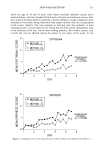
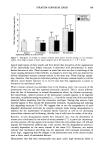
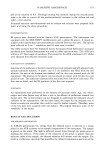
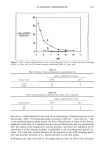
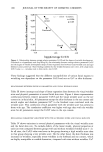
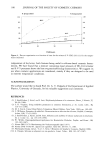
ARM WASH METHODS 135 W Z SIGNIFICANTLY DIFFERENT (p = 0.0003) DAY w z 3 - DRYNESS "PRODUCT C PRODUCT D 2- ..-A 0 • m m r m 1 2 5 4 5 DAY SIGNIFICANTLY DIFFERENT (p = 0.0002) Figure 4. Capability of arm wash Method I to discriminate between two personal washing liquids. method was used to treat the termination values for instrument readings in a manner identical to the clinical scores. STATISTICAL ANALYSIS Statistical analysis was performed on the termination values. The nonparametric Wilcoxon sign rank test was used to compare clinical data a parametric paired "t" test

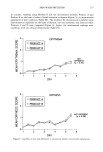
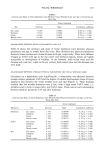
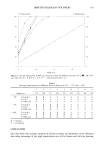
136 JOURNAL OF THE SOCIETY OF COSMETIC CHEMISTS Table IV Relative Sensitivity of Arm Wash Methods to Discriminate Between Personal Washing Products: Instrumental Evaluation Method I Method II Instrument Parameter Product C Product D p Product C Product D Evaporimeter Barrier function TEWL (g/m2/hr) Chroma meter Redness a* Skicon Hydration conductance (•mhos) Dermal Extensibility Torque Ue Meter Ur Uf 8.5 + 0.7 5.7 + 0.4 0.0002 5.5 + 0.4 5.6 + 0.7 0.1 7.2 + 0.3 6.4 + 0.3 0.0034 5.8 + 0.3 5.8 + 0.3 0.1 2.7 + 0.6 6.9 + 1.6 0.0012 10.5 + 1.8 1.4 ----- 0.1 2.7 + 0.2 0.1 0.6 ñ 0.3 1.6 ----- 0.1 0.1 3.2 ----- 0.1 3.3 + 0.1 0.1 14.7 ----- 3.1 0.05 1.7 ñ 0.1 1.9 ----- 0.1 0.1 0.7 + 0.1 0.7 + 0.1 0.1 3.8 + 0.01 4.0 ----- 0.2 0.1 was used to evaluate the instrumental data. Differences at p -- 0.05 were considered to be statistically significant. RESULTS COMPARISON OF METHODOLOGIES Washing with Product A and Method I produced significantly greater clinical irritation and skin dryness compared to that produced by the same product when using Method II (Figure 2). The skin treated with Product A using Method I exhibited increased barrier disruption and redness, and decreased hydration (skin conductance) and exten- sibility, compared to the skin treated with the same product using Method II (Table II). RELATIVE SENSITIVITY OF METHODOLOGIES Washing using Method I discriminated between Product A and Product B on the basis of clinical irritation (Figure 3). Instrumental assessment of skin condition was consistent with clinical observations (Table III). The forearms washed with Product A and Method I exhibited increased transepidermal water loss (an indicator of greater barrier disrup- tion) and increased redness (Chroma meter "a") compared to Product B. Skin hydration levels for the tissues treated with Product A were also reduced compared to the other test product. Washing using Method I also discriminated between Products C and D Product C induced a significantly greater degree of erythema and skin dryness (Figure 4). Again, the instrumental readings were consistent with the clinical observations (Table IV) and reflected the greater harshness potential of Product C as evidenced by increased trans- epidermal water loss, increased redness, and decreased skin hydration levels.
Purchased for the exclusive use of nofirst nolast (unknown)
From: SCC Media Library & Resource Center (library.scconline.org)