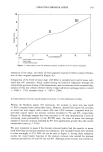
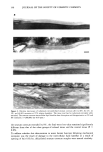
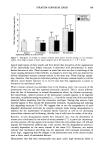
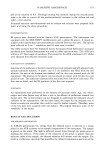
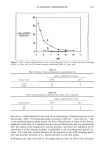
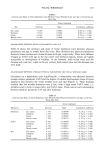
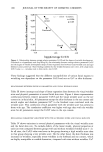
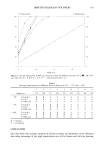
168 JOURNAL OF THE SOCIETY OF COSMETIC CHEMISTS ,• -1.06 •x • ] • ß y: - 1.3314 - 0.68282x • / • Eye r=-0.906 • -1.081 N•er p0 05 •1 . m -1.10' ß% O 1 12 Forehead • • -1.14 • •1• -1.16 Cheek • Mouth '• -1.18 -0.4 -0.3 -0.2 10g10(average Ur/Uf) Figure 3. Relationship between average relative parameter Ur/Uf and the degree of wrinkle development. Calculated on a logarithmic scale (log 10/log 10), the relationship between average relative parameter Ur/Uf and the degree of wrinkle development (slope of linear regression line between visual wrinkle score and age) followed a strict power law. These findings confirm that the wrinkle formation rate is low, with a high mean Ur/Uf value i.e., wrinkles tend to form with a low Ur/Uf. These findings suggested that the different susceptibilities of various facial regions to wrinkling was dependent on the parameter Ur/Uf and not on Ue* or skin thickness. RELATIONSHIP BETWEEN PHYSICAL PARAMETERS AND VISUAL WRINKLE SCORE Table III shows intercept and slope of linear regression lines between the visual wrinkle score and physical parameters at several facial skin sites. Figure 4 shows representative correlations between relative parameter Ur/Uf and the visual wrinkle score on the eye corner site in facial skin. All parameters except the skin thickness in the eye corners and mouth angles and absolute parameter Ue* in the forehead were correlated with the wrinkle score. This correlation of each parameter with the wrinkle score was similar to those with age. The correlation coefficient was higher with age than with the wrinkle score for all parameters except the Ur/Uf value in the eye corners. MECHANICAL PARAMETER VARIATIONS WITH VISUAL WRINKLE SCORE AND FACIAL SKIN SITE Table IV shows variations in several physical parameters with the visual wrinkle score and the facial skin site. To exclude defects of the linear model, physical properties at each site were compared between groups with and without wrinkles (wrinkle score 1-2). At all sites, the Ur/Uf value was lower in the group showing a high wrinkle score than in that group showing a low wrinkle score. On the other hand, the skin thickness was increased in wrinkles, especially severe wrinkles in the forehead and eye corners, which are highly susceptible to wrinkle formation, compared with sites without wrinkles. Ue*

FACIAL WRINKLES 169 Table III Intercept and Slope of Linear Regression Line Between Visual Wrinkle Score and Skin Physical Parameters on Several Facial Skin Sites Linear regression Parameter Site Intercept Slope Correlation coefficient Thickness Eye corner 1. 508 0.0177 Forehead 1.490 0.0318 Cheek 1.640 0.0430 Mouth corner 1.621 0.0293 Ur/Uf Eye corner 0.672 - 0.0691 Forehead 0.511 - 0.0228 Cheek 0.620 - 0.0412 Mouth corner 0.745 - 0.0561 Ue* Eye corner 0.312 - 0.0312 Forehead 0.231 - 0.0090 Cheek 0.247 - 0.0123 Mouth corner 0.209 - 0.0223 0.122 0.216 p 0.05 0.212 p 0.05 0.000 -0.728 - 0.266 -O.452 -O.529 -0.327 - 0.109 -0.148 -0.282 p 0.001 p 0.01 p 0.001 p 0.001 p 0.001 p 0.05 p 0.01 1'0 t o y -- 0.67256 - 0.06911-0.728= 0.8 ß ß r : . 0.4 0.2' O0 . 0 1 2 3 4 5 6 Visual wrinkle score Figure 4. Correlation between relative parameter Ur/Uf and visual wrinkle score at the eye corner. There was a high degree of correlation between visual wrinkle score and age. was decreased significantly in wrinkles of the eye corners and mouth angles compared with the group without wrinkles (wrinkle score 1-2). MECHANICAL PARAMETER VARIATION WITH WRINKLE SCORE AT SEVERAL FACIAL SITES Table V shows mean physical parameter variations with the wrinkle score at several facial skin sites. To exclude age-related factors, physical properties in the primary regression line at each site were compared between groups with and without wrinkles in the age range showing a wrinkle score of 2-3. Only Ur/Uf and Ue* at the eye corners differed
Purchased for the exclusive use of nofirst nolast (unknown)
From: SCC Media Library & Resource Center (library.scconline.org)