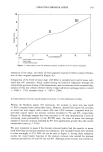
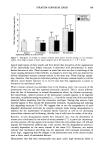
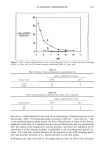
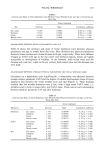
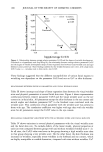
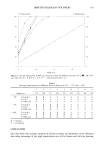
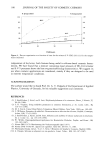
160 JOURNAL OF THE SOCIETY OF COSMETIC CHEMISTS examined by repeating the substantivity measurement on the same individual under the same experimental conditions. Table I lists the results of tests with 2% solution of surfactant at pH 5.5 for a two-minute contact time. The relative standard deviation of the experiment is 10%. The pH of the surfactant solution has a remarkable influence on the substantivity (Figure 6, Scan a). The surfactant is most substantive at pH 5.2. No experiments were con- ducted at a pH lower than 5.2, since deuterolauroyl sarcosine has limited solubility under those conditions. The deuterolauroyl sarcosine used in the study contained residual deuterolauric acid. A solution of the deutero surfactant at 2% would contain 0.08% deuterolauric acid sodium salt. This raises the question as to whether the IR spectral output (C-D bands) of surfactant-treated skin is due to the adsorbed lauroyl sarcosine or to adsorbed lauric acid. In order to understand this, the following experiment was conducted: A 2% solution of (H23) lauroyl sarcosinate was spiked with perdeuterolauric acid at 0.08% concentration. Substantivity results at pH 6, 7, 8, 9, and 10 were generated with this solution. Figure 6 compares the substantivity of deuterolauroyl sarcosine to that of spiked (H23) lauroyl sarcosine. Both solutions contained 0.08% perdeuterolauric acid. The intensity of the C - D bands in the skin spectra after surfactant contact is much lower in the case of (d23) lauric acid-spiked (H23) lauroyl sarcosine. It is, therefore, concluded that the adsorbed deuterolauroyl sarcosine is largely responsible for the C-D bands in the spectra of deuterosurfactant-treated skin. Table II represents the effect of contact time on the substantivity at pH 6 and pH 7. Increasing the contact time beyond two minutes does not have any significant impact on the amount of surfactant sorbed on the skin. This suggests that the adsorption of the surfactant is fast on the time scale we have examined. The substantivity of perdeuterolauroyl sarcosine at 2% and 4% concentrations at pH 6 and pH 7 was tested. The contact time chosen was two minutes. The results are in Table III. There is no significant difference between the amounts of sorption. Substantivity tests with solutions at concentrations less than 2% are in progress. CONCLUSIONS The experimental approach described in the paper uses deutero-labeled surfactant as the model and ATR-IR spectroscopy as the analytical tool. The results have demonstrated Table I Repeatability of Substantivity Measurements (2% d23-1auroyl sarcosinate, pH 5.5, contact time 2 minutes) •g/cm 2 19.7 22.3 25.1 24.1 Average = 22.8 % RSD = 10.5

N-LAUROYL SARCOSINATE 161 •tg d23 surfactant Sq.cm. skin 4O 3O 2O 10 ß i ß 'r ß i ß i ß i 5 6 7 8 9 10 11 pH Figure 6. Effect ofpH on the substantivity of d23 lauroyl sarcosine: (a) 2% d2• lauroyl sarcosine containing 0.08% d2• lauric acid (b) 2% lauroyl sarcosine containing 0.08% d23 lauric acid. Table II Effect of Contact Time on Substantivity (concentration 2%) p•g d23 surfactant/cm 2 of skin Contact time pH 6 pH 7 2 min 12 6 4 min 12 5 Table III Effect of Concentration on Substantivity (contact time 2 minutes) p,g d2• surfactant/cm 2 of skin Concentration pH 6 pH 7 2% 12 6 4% 11 4 that this is a viable method for the study of the substantivity of lauroyl sarcosine to live human skin. The C - D vibrational bands occurring at 2090 cm- • and 2196 cm- • due to the perdeuterolauroyl group permit the direct identification of traces of the deutero surfactant on the skin. It is assumed that the isotopic substitution does not significantly alter the surface-active properties of lauroyl safcosine, and hence the validation of the substantivity of the deutero analogue is applicable to the non-deuterated lauroyl sat- cosine. The band ratio method balances the discrepancies in the ATR sampling proce- dure and provides estimates of d23 lauroyl safcosine on the skin surface. Preliminary test data described in this paper indicate that the pH of the surfactant
Purchased for the exclusive use of nofirst nolast (unknown)
From: SCC Media Library & Resource Center (library.scconline.org)