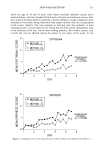
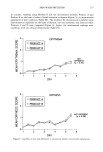
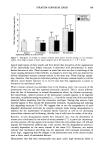
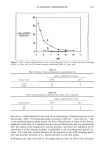
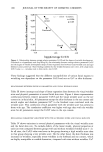
ARM WASH METHODS 133 four times daily for four consecutive days and twice on the fifth day, for a total of 18 wash cycles or until reaching a termination score (erythema or dryness --3), whichever came first. Method II was conducted according to the procedure described by Doughty et al. (5). Lather was generated by rubbing the bar (or working the liquid) for six seconds with a wet Webril pad. The lathered pad was applied to the volar surface of the forearm and moved from the elbow to the wrist and back with moderate pressure once per second for ten seconds. The lather was allowed to remain on the skin for an additional 90 seconds, Z 1 1 ER Y THEM A SIGN I FI CANTLY i.i.I..i,,.I'I DIFFERENT ß PRODUCT A / (p: o.ooo0 .I-I ß PRODUCT B i., 'I' /t-t •' ' ,m•// 0 -m •m-"m 1 2 3 4 5 6 DAY i,i z .- g 1 I ß PRODUCT A ß PRODUCT B DRYNESS 1 2 $ 4 5 6 DAY NOT DIFFERENT (p o.1) Figure 3. Capability of arm wash Method I to discriminate between two personal washing bars.

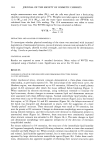
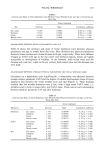
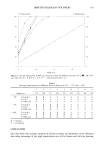
134 JOURNAL OF THE SOCIETY OF COSMETIC CHEMISTS Table III Capability of Arm Wash Methods to Discriminate Between Personal Washing Products: Instrumental Evaluation Instrument Method I Method II Parameter Product A Product B p Product A Product B p Evaporimeter Barrier function TEWL (g/m2/hr) Chroma meter Skicon Dermal Torque Meter Redness a* Hydration conductance (p•mhos) Extensibility Ue Ur Uf 18.9 + 1.0 14.7 + 0.9 0.0001 13.5 + 2.0 13.9 + 1.9 0.10 8.5 -+ 0.3 7.4 -+ 0.4 0.0013 7.2 - 0.5 7.3 -+ 0.4 0.10 20.2 + 3.6 25.6-+ 3.7 0.0001 17.0 + 1.8 20.1 + 3.0 0.06 2.7 -+ 0.2 2.7 -+ 0.2 0.10 2.2 - 0.1 2.3 -+ 0.1 0.10 1.6 -+ 0.2 1.6 - 0.1 0.10 1.0 -+ 0.1 1.1 - 0.1 0.08 NT a NT a 5.1 - 0.2 5.3 -+ 0.2 0.10 • NT = not tested. and then the arm was rinsed and dried. Two minutes after drying, the washing proce- dure was repeated. Two of these cycles, entailing four washes, were conducted daily for four consecutive days, with one cycle on the fifth day, thus providing the same number of total washes (treatments = 18) as in Method I. EXPERT EVALUATION The forearms were evaluated by an expert clinical evaluator for dryness and erythema immediately prior to each wash and three hours following the final wash [0 (none) to 4 (severe) scale for each parameter (4)]. Half-grade scores were allowed, and ties were broken using a forced-choice procedure in which 0.1 point was added to the clinical score of the side judged to be worse. Once a termination score of 3.0 or greater for either erythema or dryness was reached for at least one arm, washing was discontinued for both arms, and the termination scores carried through for the remainder of the study (re- placement method). INSTRUMENTAL EVALUATION Barrier function was assessed by an Evaporimeter (Servo-Med EP-1), erythema by a Chroma meter (Minolta CR-200), the degree of hydration by a Skicon 200 (I.B.S.), and skin flexibility by a Diastron dermal torque meter (4). All instrumental evaluations were conducted following a 15-60 minute (Study 1,2,3, = 60 minutes Study 4,5 = 15 minutes) acclimation period in a controlled environment (40% --- 5% RH 70 ø --- 2OF). Instrumental evaluations of skin condition were conducted three hours after the final wash session or three hours after reaching a termination score. The replacement
Purchased for the exclusive use of nofirst nolast (unknown)
From: SCC Media Library & Resource Center (library.scconline.org)