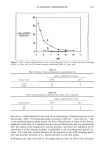
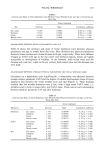
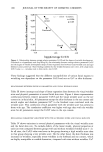
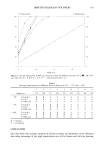
DIMETHYLSILOXANE POLYMERS 179 loo 6o 40 % Evaporated % Evaporated i lO0 0 ! - 0 8O --4O --20 5 20 35 50 TIME (min) Figure 3. Percent vaporization at 80øC as a function of time for different silicones: S.V-2-1-, DC-244- -•--, DC-344 5C , A.K-4•3--, S.V-5-•o•, and deionized water•--. Table I Freezing Characteristics for Different Silicone Mixtures at 4øC, -7øC, and - 10øC 1 2 3 4 5 6 7 8 9 Sample no. 1/9 2/8 3/7 4/6 5/5 6/4 7/3 8/2 9/1 4øC - 7øC - 10øC V-5/A.K-4 X X 0 0 0 0 0 0 0 V-5/V-2 X X 0 0 0 0 0 0 0 V-5/DC-244 0 0 0 0 0 0 0 0 0 V-5/A. K-4 X X X X 0 0 0 0 0 V-5/V-2 X X X X X 0 0 0 0 V-5/DC-244 X X X 0 0 0 0 0 0 V-5/A.K-4 X X X X X 0 0 0 0 V-5/V-2 X X X X X X 0 0 0 V-5/DC-244 X X X X 0 0 0 0 0 X = freezing. 0 = no freezing. CONCLUSION Our data show that a proper mixture of silicone tetramer and pentamer can be obtained that takes advantage of the high vaporization rate of the former and the low freezing

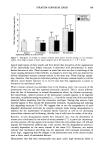
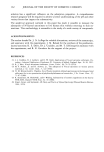
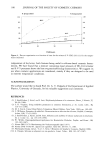
180 JOURNAL OF THE SOCIETY OF COSMETIC CHEMISTS lOO 8o 6o o-- 5 % Evaporated % Evaporated 80,C lOO 2o TIME (min) Figure 4. Percent vaporization as a function of time for the mixture S.V-5/DC-244 (1' 1) for the temper- atures indicated. temperature of the latter, both features being useful in silicone-based cosmetic formu- lations. We have found that a mixture containing equal amounts of DC-244 tetramer and S.V-5 pentamer shows the best evaporation/freezing characteristics. We suggest its use when cosmetic applications are considered, mainly if they are designed to be used in extreme temperature conditions. ACKNOWLEDGMENTS The authors would like to thank Prof. Dr. A. V. Delgado of the Department of Applied Physics, University of Granada, for his valuable suggestions and comments. REFERENCES (1) J. Smid-Korbar, J. Kristl, and S. Srcic, Polydimethylsiloxane oil in ointments, Pharm. J. Slovenia, 37, 86-90 (1986). (2) C. D. Vaughan, Using solubility parameters in cosmetics formulation, J. Soc. Cosmet. Chem., 36, 319-333 (1985). (3) M. S. Starch, Topical Drug Delivery Formulations (Marcel Dekker, New York, 1990), pp. 389-409. (4) C. Willemin, Param&re de soluNlit& Characterisation et s•lection des silicones, Parfums, Cosmetiques, Ar•mes, 102, 57-63 (1992). (5) J. Smid-Korbar, J. Kristl, and M. Stare, Efficiency and usability of silicone surfactants in emulsions. Int. J. Cosmet. Sci., 12, 135-139 (1990). (6) W. Wolfes, Organopolysiloxan-Copolymere fur Kosmetische Produkte, Parfilm. und Kosmet., 68, 195-202 (1987). Norma DIN 53170. Bestimmung der Verdunstungszahl (April 1977). Norma UNE 55-902-85. Agentes de superficie. CDU 661.187:543.71, 1985. Pharmacopea Europea 2nd ed., V. 4.5.5, Parte I. Ministerio de Sanidad y Consumo, Madrid (1988). A. Disapio, Silicones as adjuvants on sun products, Cosmet. Toiletr., 102, 102-107 (1987). (7) (8) (9) (10)
Purchased for the exclusive use of nofirst nolast (unknown)
From: SCC Media Library & Resource Center (library.scconline.org)