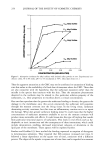
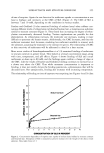
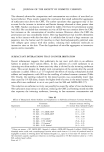
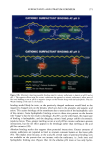
SURFACTANT-SKIN INTERACTIONS 233 surface is rarely flat and signal variations from neighboring (-100 pm) regions may also contribute to significant intensity variations in the image. Therefore, extraction of fine structural changes (in individual comeocytes) from gross intensity variations requires a careful analysis of the micrographs. The accuracy of TEWL measurement is dependent upon the amount of water loss. Measurements are highly reproducible for low-water-loss conditions such as those that exist in normal unperturbed skin. If the water loss is about 20 g/m 2 hr, the measurement error could be about 10%. However, when losses approach 80 g/m2hr, the error could exceed 50% (14). TEWL in surfactant-treated tissue may be as high as 60 g/m • hr, as was seen for soap bar-treated tissue. However, the exact TEWL value is not significant for the current discussion, as the dependence of structural damage on TEWL values was fairly consistent. The high degree of water loss encountered in soap bar-treated tissue may be due to the combined effect of damage incurred to lipids and to the intracellular environment. This could also affect the water-retaining mechanisms involving the role of molecules re- sponsible for providing natural moisturizing factor (15). Leaching of such molecules from surfactant-damaged corneocytes may aggravate dry skin condition. This study showed that the presence or absence of outer layers of disjunctum, which have minimal surrounding lipid, is not critical for water loss. Water loss depended upon the preservation and integrity of lipids and proteins belonging to the lower layers of cor- neocytes. No severe water loss was observed in cases where the lipids in compactum appeared ordered and structured. Inordinately high water loss (for the soap bar) was due to damage that extended from the surface to multiple strata of underlying lipids and comeocytes. REFERENCES (1) P.M. Elias, Epidermal lipids: Barrier function and desquamation,J. Invest. DermatoL, 80 (Suppl), 44- 49 (1983). (2) A. V. Rawlings, A. Watkinson, J. Rogers, A. Mayo, J. Hope, and I. R. Scott, Abnormalities in stratum corneum structure, lipid composition, and desmosome degradation in soap-induced winter xerosis, J. Soc. Cosmet. Chem., 45, 203-220 (1994). (3) S.J. Chapman and A. Walsh, Desmosomes, corneosomes and desquamation. An ultrastructural study of adult pig epidemis, Arch. Dermatol. Res., 282, 304-310 (1990). (4) P. Bowsen and R.J. White, Isolation, barrier properties and lipid analysis of stratum compacturn, a discrete region of the stratum corneum, Br. J. Dermatol., 112, 1-14 (1985). (5) G. Imokawa, K. Sumura, and M. Katsumi, Study on skin roughness caused by surfactants. I. A new method in vivo for evaluation of skin roughness,J. Am. Oil Chem. Soc., 8, 92-108 (1975). (6) G. Imokawa, Evaluation for alteration of the stratum corneum, J. Jpn. Cosmet. $ci. $oc., 8, 92-108 (1984). (7) G. Imokawa, S. Akasaki, Y. Minematsu, and M. Kawai, Importance of intercellular lipids in water retention properties of the stratum comeum: Induction and recovery study of surfactant dry skin, Arch. Dermatol. Res, 281, 45-51 (1989). (8) G. Imokawa, S. Akasaki, M. Hattori, and N. Yoshizuka, Selective recovery of deranged water-holding properties of the stratum corneum lipids,J. Invest. Dermatol., 187, 758-761 (1986). (9) A. W. Fulmer and G. J. Kramer, Stratum corneum lipid abnormalities in surfactant induced dry skin, J. Invest. Dermatol., 86, 598-602 (1986). (10) M. Fartasch, T.L. Diegpan, O. P. Hornstein, Morphological changes of epidermal lipid layers of stratum corneum in sodium lauryl sulfate induced dry skin, J. Invest. Dermatol., 96, 617A (1991). (11) K. P. Ananthapadmanabhan, S. Prowell, K. Hoyberg, M. Misra, S. Spaltro, S. Mukherjee, and M.

234 JOURNAL OF THE SOCIETY OF COSMETIC CHEMISTS (12) (13) (14) (15) Aronson, Cleanser induced structural changes in human stratum corneum, Proceedings of the 4th Congress of the European Academy of Dermatology and Venereology, Brussels (Elsevier, Amsterdam, 1995), p. 143. K. C. Madison, D.C. Schwartzendruber, P. W. Wertz, and D. T. Downing, Presence of intact inter- cellular lipid lamellae in the upper layers of the stratum corneum, J. Invest. DermatoL, 88, 714-718 (1987). L. D. Rhein, C. R. Robbins, K. Fernee, and R. Cantore, Surfactant structure effects on swelling of isolated human stratum corneum,J. Soc. Cosmet. Chem., 125-139 (1985). P. Elsner, E. Berardesca, and H. I. Mailbach (Eds.), Bioengineering of the Skin: Water and the Stratum Corneum (CRC, Ann Arbor, MI, 1994), Chapter 5. A. V. Rawlings, I. R. Scott, C. R. Harding, and P. A. Bowser, Stratum corneum moisturization at the molecular level, Prog. Dermatol., 28, 1-12 (1994).
Purchased for the exclusive use of nofirst nolast (unknown)
From: SCC Media Library & Resource Center (library.scconline.org)