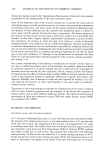
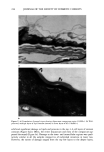
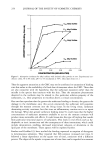
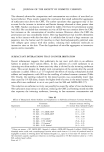
260 JOURNAL OF THE SOCIETY OF COSMETIC CHEMISTS monomer rather than the micelie is the species that interacts with the proteins and that the surfactant solution properties probably control the reaction. Systematic structural studies of the surfactant-induced swelling reaction also verify that stratum corneum swelling parallels the known irritation potential of structurally related surfactants. Maxi- mum swelling was induced by surfactants with C12 or C14 alkyl chain lengths in homologous series of several anionic surfactants--for example, alkyl benzene sulfonates, alphaolefin sulfonates, alkyl sulfates, and paraffin sulfonates (see Figure 7). This parallels their known in vivo clinical irritation, which is maximal at C12 (see review, ref. 20). As E 20 E E lO Alkyl Benzene Sulfonates 1•0 1•2 14 t'6 40- 30 ÷ 20, t0' ß , 0 18 8 Alpha Olefin Sulfonates Alkyl Chain Length Alkyl Chain Length 30 20 10 0 . i 8 10 Paraffin Sulfonates 40- 30- 20 1 hr. Alkyl Sulfates 2 6 hr. , i i i i i 6 i o i i i i i 12 t4 1 18 8 10 12 14 16 18 Alkyl Chain Length Alkyl Chain Length Figure 7. Dependence of swelling of human stratum corneum on alkyl chain length for various surfactants. Studies were all run at 1% (w/w) surfactant. Time periods shown are incubation time of treatments. Swelling values are precent increases from hydrated lengths. Means differing by greater than 2% are significantly different (p 0.05). Note that swelling results for one homologous series cannot be compared to another because they were run in separate experiments. Data taken from ref. 5.

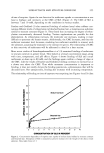
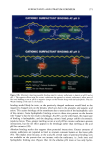
SURFACTANTS AND STRATUM CORNEUM 261 with surfactant binding, ethoxylation of alkyl sulfates reduces the swelling response (see Table I and ref. 17), which also parallels the known reduced irritation of these ethox- ylated variants (18,19). The presence of divalent cations reduces or inhibits the swelling response to anionic surfactants. In vivo clinical results (21) suggest that magnesium laurly sulfate is also clinically less irritating than the sodium salt. Cationic surfactants have an even more interesting effect. Alkyl trimethylammonium bromides, which along with other alkyl ammonium halides may be clinically irritating (ref. 22 and Table 1), inhibit stratum corneum (17) and collagen (19) swelling (at neutral pH). Positive charges obviously change the nature of the interaction of the surfactants with the skin surface. This will be discussed later. The reason for the maximum activity (whether quantified as swelling, protein denatur- ing potency, induction of skin roughness, or clinical irritation) usually occurring for the C12 or C14 homologue of a series for various surfactants has been the subject of much speculation. Robbins and Fernee (23) explained the phenomenon, based on Breuer's model (24), as indicating the importance of hydrophobic interactions to the swelling and/or adsorption mechanism. In essence, the shorter alkyl chains do not interact as efficiently as C12 with the hydrophobic regions on the proteins. As chain length increases above C12, penetration into the keratin matrix would be more difficult. However, Cooper and Berner (25) did not fully agree with this model. They observed that Imokawa eta/. (26) reported a C12 maximum activity for surfactant effects on optical rotation of bovine serum albumin (BSA). Thus these authors searched for a mechanism other than inhibition of matrix penetration to explain the reduced swelling and adsorption for the higher alkyl chain lengths. They proposed a mathematical model to explain this effect, based on binding, critical micelie concentration, solubility, and partitioning into the stratum corneum. Hydrophobic sites on the keratin might opti- mally bind a specific hydrophobic alkyl chain length of C 12 (in the case of alkyl sulfates). Beyond this chain length there may be no thermodynamic advantage to binding of longer alkyl chains. As the alkyl chain length is increased, the CMC is reduced, resulting in less monomer available to interact with the keratin protein. Thus the reduced activity of the longer chains probably results form the lower overall CMC (reducing the available monomer) and reduced solubility of the surfactant in the aqueous phase. ROLE OF THE CRITICAL MICELLE CONCENTRATION In 1986, at the 14th IFSCC Conference, Lang and Spengler (27) showed results that compared skin reactivity of surfactants with their CMC (Table II). They found a sig- nificant correlation of the CMC of these anionic surfactants with irritancy values and swelling of pig skin. While it is likely that the monomer level, and hence the CMC, is one important parameter controlling irritation/skin reactivity, other factors must be considered. For example, in the homologous series of surfactants discussed in the pre- vious section, the CMC and monomer level decrease as alkyl chain length increases, as pointed out previously. But skin reactivity showed a maximum for the C 12 homologue. Such maxima are also dictated by molecular size, hydrophobicity, and solubility in the vehicle. An excellent discussion of these interdependencies is found in an article by Cooper and Berner in the first edition of Surfactants in Cosmetics (25). During their dose-dependent studies of skin reactivity of a single surfactant like sodium
Purchased for the exclusive use of nofirst nolast (unknown)
From: SCC Media Library & Resource Center (library.scconline.org)