266 JOURNAL OF THE SOCIETY OF COSMETIC CHEMISTS Table IV CMC and Monomer Concentration for Various SLS/AEOS-7EO Mixtures Tested for Irritation Potential SLS • in AEOS • in CMC of Total SLS Total AEOS monomers monomers mixture Irritation (mM) (mM) (mM) (mM) (raM) potential 8.7 0 5.4 0 7.9 9.1 8.7 2.6 3.4 0.1 3.1 8.0 8.7 5.7 2.6 0.3 1.0 5.4 8.7 8.7 2.1 0.4 0.9 4.8 34.7 0 7.9 0 7.9 12.6 34.7 10.4 5.1 0.2 3.1 17.2 34.7 23.3 3.7 0.4 1.0 7.6 34.7 34.7 2.7 0.6 0.9 6.0 (water) 0 0 0 0 0.9 • The 2000 MW cutoff membrane was used to separate micelles from monomers and small micellar aggregates. AEOS-7EO, laureth-7 sulfate SLS, sodium lauryl sulfate. From ref. 29. We (29,33) also separated the monomers from the micelles using the ultrafiltration methods described in the previous section and quantified the monomers (Table IV). What we found was that the CMC did decrease as the mole fraction of AEOS-6EO increased, typical of any such mixture of high and low CMC surfactants. However, when one examines the concentration of each monomer, one finds more monomeric SLS present in the mixtures than expected (29,33). For example, in a 1:1 mixture of SLS and AEOS (8.7 mM SLS plus 8.7 mM AEOS), one finds about a 5:1 ratio of SLS monomers to AEOS monomers (2.1 mM SLS plus 0.4 mM AEOS). Thus, even though the absolute monomeric concentration is reduced when AEOS is present, there is relativity more SLS in the monomer than AEOS. Future strategies to produce even milder compositions need to explore ways to manipulate the free energy and/or thermodynamics of the system to shift more SLS into the micelie or alternatively to tie up the monomeric species so as to block its action. Perhaps counter ions or cationic polymers should be considered. EFFECT OF pH ON SURFACTANT-INDUCED SWELLING AND IRRITATION Robbins and Fernee (23) and Zeidler (38) examined the effect of pH on surfactant- induced swelling of isolated epidermis. Robbins and Fernee studied the anionics: SLS and dodecyl benzene sulfonate (LAS) and the cationic: dodecyl trimethyl ammonium bromide (DTAB). Results in Table V show that for the anionic surfactants, swelling decreased as the pH was reduced from pH 9 to pH 3. On the other hand, for the cationic surfactant, swelling increased as the pH dropped. This can be explained by the change in types of bonds formed between protein and surfactant (illustrated later in Figure 10). Two types of binding are most likely to occur--hydrophobic and ionic. Most importantly, hydrophobic binding is pH- insensitive and ionic binding is pH-sensitive, i.e., binding will change depending on the pH. At the basic pH, anionic surfactants bind primarily by hydrophobic bonds to hydrophobic sites on the keratin. This can be concluded because there is substantial swelling caused by anionic surfactants at the basic pH, and since the net charge on the

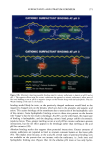
SURFACTANTS AND STRATUM CORNEUM 267 Table V Effect of pH on Surfactant-Induced Swelling of Stratum Corneum • Surfactant (0.069 M) pH SLS LAS DTAB 3 3.09 b 2.84 b 2.77 • 6 3.24 3.00 • 2.70 9 3.24 2.95 • 2.69 • Values are actual membrane lengths (cm) after 1-h incubation time and are average of five membranes for each measurement. SLS, sodium lauryl sulfate LAS, dodecyl benzene sulfonate DTAB, dodecyl trimethyl ammonium bromide. • Significantly different from other column responses at p -- 0.05 level. From ref. 23. keratin substrate is negative, anionic surfactants must bind to hydrophobic sites on the keratin, as they would be repelled at the negatively charged sites. Binding of the surfactant hydrophobic "tails" to hydrophobic sites exposes the negatively charged "dangling" head groups, leading to repulsive forces between chains, followed by hydra- tion and swelling (see Figure 10 at end). For the cationic surfactants, the major bonding at higher (basic) pH is ionic bonding to the negatively charged surfaces, exposing their hydrophobic tails these attach to each other via Van der Waals forces and shrink the membrane. As the pH is dropped, the surfactant binding becomes hydrophobic and swelling increases due to repulsion between cationic head groups (see Figure 10 at end). Zeidler (38) performed studies to assess pH effects for a variety of surfactants. His findings were similar to those of Robbins and Fernee (23). Zeidler reported interesting findings for an amphoteric surfactant (cocoamphodiacetate). Swelling of epidermal membrane was high on both the extreme acidic and extreme basic side. However, it was minimal at pH 6.0. At this pH, charge of the amphoteric is neutralized, and one is observing essentially nonionic/hydrophobic binding, which produces little swelling due to lack of charged head groups and therefore lack of repulsive forces between these charges. Zeidler (38) also investigated the pH effect on swelling of different anionically charged head groups (see Figure 9). Replacing the sulfate with phosphate reduces swelling over the entire range of pH. The increase in swelling begins at pH 1.0 for the sulfate, at pH 4.5 for the phosphate, and at pH 5.5 for the soap. This corresponds to the decreased acidity of the anionic groups. Increased swelling is first observed when a sufficiently large proportion of the surfactant is present in the ionized form. For the soaps, results show a more dramatic increase in swelling. The ionized form of the carboxylate thus causes as much swelling as the sulfate, while the unionized form causes little swelling. Zeidler has a slightly different explanation for the swelling behavior of epidermis when exposed to surfactants. The strong dependence on anionic structure suggests an osmotic process. The volume of water that can flow is controlled by the osmotic pressure and is limited by the structural resistance of the membrane. The changes in swelling at different pHs are controlled by the colloid-osmotic pressure of the amphoteric protein matrix. According to the Donnan equilibrium conditions, the formation of excess posi- tive or negative charges elicits excess swelling. Likewise, their elimination causes re- duced swelling. The concentration of freely mobile counter ions, and thus the osmotic
Purchased for the exclusive use of nofirst nolast (unknown)
From: SCC Media Library & Resource Center (library.scconline.org)