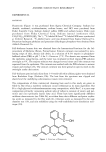
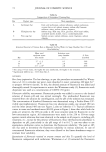
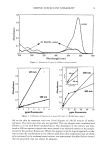
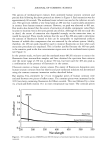
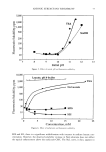
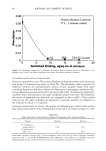
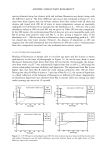
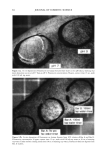
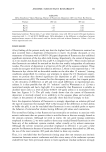
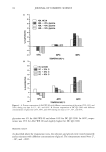
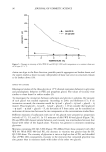
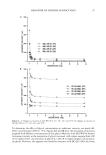
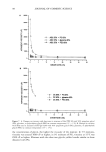
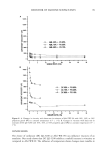
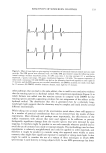
ANIONIC SURFACTANT RINSABILITY 87 not partition into micelies, it also cannot track the location of surfactants. Thus, the assay actually measures the way fluorescein, applied to skin from water or a cleansing bar slurry, is rinsed under highly unrealistic conditions using a limited amount of cool water with no mechanical agitation, i.e., it is a fluorescein rinsing assay! Not only do differ- ences in fluorescein retention disappear under more realistic rinsing conditions, the differences between products primarily arise from differences in pH because of fluores- cein's solubility characteristics. Thus, the conclusions by Wortzman et aL (2) on the superior finsability of the TEA-soap bar over the isethionate bar are derived from an artifact of their test method, and has little to do with surfactant rinsability, let alone mildness. In fact, the test is actually misleading since soaps leaves more aurfact•nta bound to skin than do isethionate-based bars because of soap's stronger interaction with stratum comeurn proteins. ACKNOWLEDGMENTS The authors thank Ms. Marion Margosiak for the photographs, Ms. Patricia Liberati for supplying habits information, and Dr. Paul Sharko for useful discussions. REFERENCES (1) S. Mukherjee, M. Margosiak, K. P. Ananthapadmanabhan, K. K. Yu, and M.P. Aronson, Interactions of cleansing bars with stratum corneum proteins: An in vitro fluorescent spectroscopic study, J. Soc. Cosmet. Chem., 46, 301-320 (1995). (2) M. S. Wortzman, R.A. Scott, P.S. Wong, N.J. Lowe, and J. Breeding, Soap and detergent bar rinsability, J. Soc. Cosmet. Chem., 37, 89-97 (1986). (3) K.P. Ananthapadmanabhan, K. K. Yu, C.L. Meyers, and M. Aronson, Binding of surfactants to stratum corneum, J. Soc. Cosmet. Chem., 47, 185-200 (1996). (4) D. D. Strube, S. W. Koontz, R. I. Murahata, and R. F. Theiler, The flex wash test: A test method for evaluating the mildness of personal washing products, J. Soc. Cosmet. Chem., 40, 297-306 (1989). (5) J. K. Thomas, Radiation-induced reactions in organized assemblies, J. Soc. Cosmet. Chem., 80(4), 283-299 (1980). (6) R. Zana, Ed., Surfactant Solutions, Surfactant Science Series, Vol. 22 (Marcel Dekker, New York, 1987). (7) K. Kalyanasundaram and J. K. Thomas, Environmental effects of vibronic band intensities in pyrene toohomer fluorescence and their application in studies of miceliar systems,J. Soc. Cosmet. Chem., 99(7), 2O39 (1977). (8) K.P. Ananthapadmanabhan, E. D. Goddard, N.J. Turro, and P.L. Kuo, Fluorescence probes for critical micelie concentration, Langmuir, 1(13), 352 (1985). (9) N.J. Turro, M. Aikawa, and A. Yekta, A comparison of intermolecular and intramolecular excimer formation in detergent solutions, J. Am. Chem. Soc., 101,772 (1979). (10) P. Chandar, P. Somasundaran, and N.J. Turro, Fluorescence probe studies on the structure of the adsorbed layer of dodecyl sulfate at the alumina-water interface. J. Colloid. Interface Sci., 117(1), 31 (1987). (11) P. Chandar, P. Somasundaran, K. C. Waterman, and N.J. Turro, Variation in nitroxide chain flex- ibility within sodium dodecyl sulfate hemimicelles, J. Phys. Chem., 91, 150 (1987). (12) P. Mukerjee and K.J. Mysels, A re-evaluation of spectral change method of determining critical micelle concentration,J. Phys. Chem., 77, 2937 (1955). (13) P. Mukerjee and K.J. Mysels, Critical micelle concentration of aqueous surfactant systems, National Bureau of Standards, NSRDS-NBS, 36 (1971). (14) J. Slavik, Anilinonaphthalene sulfonate as a probe of membrane composition and function, Blochim. Biophys. Acta, 694, 1-25 (1982). (15) D. A. Kolb and G. Weber, Cooperativity of binding of anilinonaphthalene sulfonate to serum albumin induced by a second ligand, Biochemistry, 14, 4476•,499 (1980).

88 JOURNAL OF COSMETIC SCIENCE (16) (17) (18) (19) (20) (21) (22) (23) (24) L. Stryer, The interaction of a naphthalene dye with apomyogloein and apohemoglobin: A fluorescent probe of non-polar binding sites, J. Mo/. Bio/., 13, 482-495 (1965). R. P. Haughland, Handbook of F/aorescent Probes and Research Chemicals, 5th ed. (Molecular Probes Inc., Eugene OR, 1992), p. 134. M. L. Graber, Characteristics of fluoroprobes for measuring intracellular pH, AnM. Blochem., 156, 202 (1986). P.J. Frosch and A.M. Kligman, The soap chamber test,J. Am. Acad. Dermato/. 1(10), 35 (1979). E. Gotte, Skin compatibility of tensides measured by their capacity for dissolving zein, Proc. of the 4th Int. Cong. on S•rface Active S•bstances, Brussels, Vol. 3, 83-90 (1964). J.A. Faucher and E. D. Goddard, Interaction of keratinous substrates with sodium dodecyl sulfate: Sorption, J. Soc. Carmet. Chem., 29, 323 (1978). Z. Piso and C. Winder, "Soap, Syndet, and Soap Syndet Bar Formulations," in Soaps Technology for the Nineties (AOCS monograph, 1990), p. 209. P. Liberati, Unpublished Unilever Results, 1993. M. Davies, M. Hogan, K. P. Ananthapadmanabhan, K. Yu, and M. Aronson, Rinsability of cleansers using IR spectroscopy. Manuscript in preparation, 1998.
Purchased for the exclusive use of nofirst nolast (unknown)
From: SCC Media Library & Resource Center (library.scconline.org)