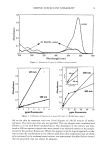
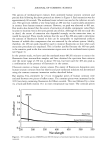
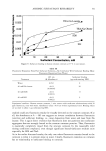
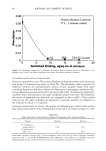
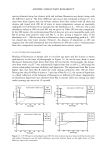
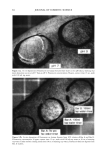
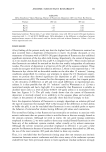
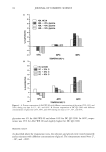
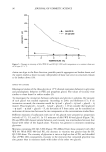
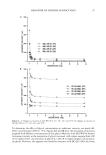
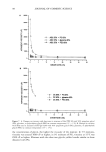
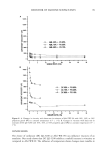
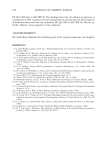
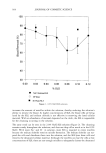
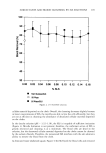
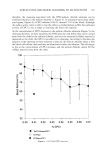
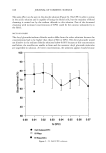
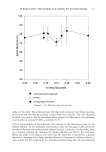
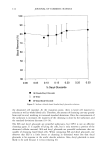
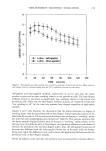
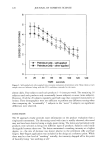
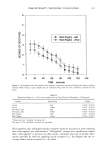
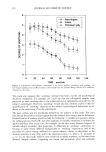
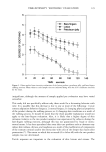
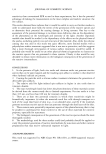
BEHAVIOR OF SILICONE SURFACTANTS 95 After 24 hours at 2 ø and -10øC, none of the samples had frozen except PEG 400 alone, which froze after two hours at 2øC and after 30 minutes at - 10øC. At -28øC, all samples froze within five minutes. These results show that the type of glycol used in the mixture and the concentration of glycol had little effect on the freezing point of the two silicones tested here. RHEOLOGICAL STUDY Influence of temperature on viscosity. In a given fluid, shear stress (force per unit surface area required to produce sharing action, F = F/S) is related to shear rate • = dy/dt, a measure of the speed at which the intermediate layers move with respect to each other). New- tonian fluids are those in which shear rate (7) is directly proportional to shear stress (F), and its proportionality constant is defined as viscosity (qq). The reciprocal term (1/qq) is designated fluidity. The resulting rheogram is a straight line (10-13). •1 = F/• The viscosity of simple (i.e., pure) liquids (molecular solutions) is influenced by com- position, temperature, and pressure, increasing slowly with pressure and decreasing rapidly with temperature. The changes in viscosity with temperature are described by an equation similar to the Arrhenius formula: qq = Ae E/RT where A -- molecular weight-dependent constant, T = absolute temperature, E -- acti- vation energy for flow between molecules, and R = gas constant. At high temperature, hydrogen bonds break down, and E and qq decrease significantly (14). Our analyses showed that both surfactants apparently display newtonian behavior: vis- cosity remained constant across a relatively large range of values of shear stress (I') up to a point at which flow changed from laminar to turbulent. In both cases viscosity decreased as temperature increased (Figure 5). This was particularly evident in DC Q2-5200, in which "dynamic" (i.e., apparent) viscosity ranged from 4000 cP at 15øC to 850 cP at 50øC. In Abil WE 09 the effect of temperature was weaker: viscosity was 315 cP at 15øC and 125 cP at 50øC. At low shear rates viscosity was greater at higher temperatures (Figure 6A not so in Figure 6B). The difference in chemical composition in the two surfactants probably accounted for the difference in rheological behavior. At very low shear rates the behavior of both silicones, however, was not newtonian, as can be seen in Figure 6. This effect has been reported for a number of other compounds for example, the behavior of blood (15) at low shear rates is non-newtonian, whereas at high shear rates behavior becomes newtonian. The dependence of apparent viscosity on shear rate is shown in the absence (Figures 6A, 6B) and in the presence (Figures 7A, 7B) of added glycols. As observed, a newtonian behavior (constant viscosity) is found for shear rates above 0.85 s -1. However, for lower shear rates values a non-newtonian behavior is observed, and viscosity decreases when the shear rate is increased, reflecting the resistance of chemical groups to flow under shear stresses these groups are larger in DC Q2-5200 than in Abil WE 09, hence the larger viscosities found in the former case. When the shear rate is sufficiently high, the polymer

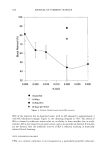
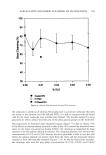
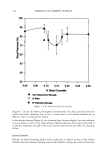
96 JOURNAL OF COSMETIC SCIENCE % % % ß 0 ' I ' I ' I ' I ' 10 20 30 40 50 TEMPERATURE (øC) Figure 5. Changes in viscosity of Abi! WE 90 and DC Q2-5200 with temperature at a constant shear rate of 50 rpm (17 s •). chains can align in the flow direction, possible particle aggregates are broken down, and the system reaches a lower viscosity independent of shear rate since no structures remain to be broken down (16). EFFECT OF GLYCOLS Rheological studies of the three glycols at 15 øC showed newtonJan behavior in glycerine and pseudoplastic behavior in PEG and propylene glycol. The values of viscosity were similar to those found in earlier studies (9). To investigate the interaction between surfactants and glycols in solution, the viscosity of each glycol was studied separately. According to Lewis and Robinson (17), if no interaction occurred, the situation would be: qr I (surf + glycol) = qr I (surf + glycol) - qr I (water). Thus qr I (glycol) + qr I (surf) - qr I (surf + glycol) = 1. If we consider that qr I (glycol) + qr I (surf) - qr I (surf + glycol) = F, the deviation of F from unity can be considered an indication of interaction between the two components at the concentrations studied here. Different mixtures of surfactants with one of the glycols were prepared at proportions (vol:vol) of 7/3, 5/5, and 9/1. In 5/5 mixtures of Abil WE 09 and glycol (Figure 7A), PG and PEG 400 showed similar behavior, and viscosity was intermediate between that found with either of the liquids alone. Viscosity was greatest in mixtures containing glycerine. Mixtures containing DC Q2-5200 (Figure 7B) differed from those prepared with Abil WE 09. With PEG 400 and PG, the decrease in viscosity was greater than for DC Q2-5200 alone. The viscosity of glycerine is twice as high as that of PG, and threefold that of PEG 400 consequently, viscosity in the mixtures that contained glycerine was also greater than in mixtures made with either of the other two glycols.
Purchased for the exclusive use of nofirst nolast (unknown)
From: SCC Media Library & Resource Center (library.scconline.org)