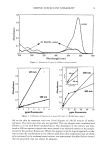
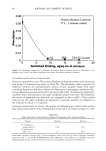
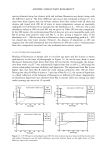
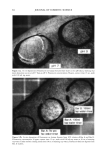
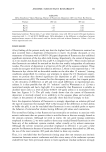
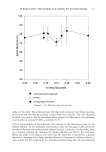
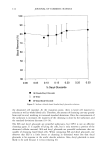
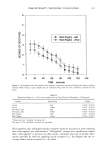
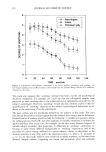
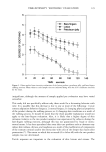
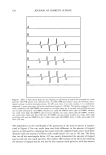
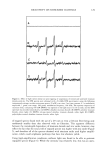
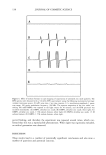
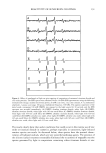
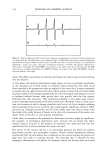
134 JOURNAL OF COSMETIC SCIENCE sensitivity than conventional EPR as used in these experiments, but it has the potential advantage of making the measurements in the most complex and realistic situation: the live subject. The results obtained here indicate that it would be useful to carry out further studies in order to understand more fully the extent of the generation of the reactive species and to determine their potential for causing damage in living systems. One key to the assessment of the potential damage is to obtain more definitive data on the dependency of the phenomena on the wavelength and intensity of the light. Another important variable that should be studied is the dependency of the effects on the physical form of the oxides, including particle size and structure of the material. Also, while the silicone coating that was used in this study was quite effective, more limited studies with a polyethylene surface treatment suggested that it was not as protective, and this suggests that a more thorough investigation of various surface treatments would be useful. It probably also would be useful to use other physical-chemical approaches to characterize the reactive species that are generated in these systems. Clearly it also would be very desirable to obtain more information on the biological consequences of the generation of the reactive intermediates. CONCLUSIONS 1. In the presence of light, both zinc oxide and titanium oxide can generate reactive species that can be spin trapped, and the resulting spin adduct is similar to that observed when hydroxyl radicals are present. 2. Coating the particles with a silicone surface treatment eliminates the generation of detectable spin adducts. 3. The relative yield for light-induced spin adducts in higher in zinc oxide than in titanium dioxide. 4. The exact wavelength band that drives the photochemistry of these materials cannot be derived from the current study due to limited experiments. For zinc oxide it is less than 435 nm, and less than 620 nm for titanium dioxide. 5. There are at least two potential scenarios in which these reactivities might be biomedically important: (a) when the materials reach live cells through transport or a lack of the usual dead layer of skin (e.g., in an abraded area), and (b) if the materials generate secondary reactive species that can penetrate through the dead layers of the skin. 6. There remain some potentially important aspects of this photochemistry that it may be prudent to understand for those involved in the use of these materials for cosmetic purposes, especially for sunscreens. 7. The biological consequences of the generation of the reactive species should be more thoroughly studied. 8. The methodology used for these studies could (and probably should) be applied to study the potential generation of reactive intermediates by sunscreens and other cosmetic preparations that may receive substantial exposure to light. ACKNOXWLEDGMENT This work was supported by NIH Grant P41 RR11601, an NIH-supported resource center.

REACTIVITY OF SUNSCREEN COATINGS 135 REFERENCES (1) J. C. Ireland, P. Klostermann, E. W. Rice, and R. M. Clark, Inactivation of Escherichia coli by titanium dioxide photocatalytic oxidation, App/. E,v. MicrobioL, 59, 1668-1670 (1993). (2) H. Matsubara, M. Takada, S. Koyama, K. Hashimoto, and A. Fujishima, Photoactive TiO 2 containing paper: Preparation and its photocatalytic activity under weak UV light illumination, Chem. Lett., 767-768 (1995). (3) M. Biguzzi and G. Shama, Effect of titanium dioxide concentration on the surviving of Pseudotoo,as stutzeri during irradiation with near ultraviolet light, Lett. AppL Microbial., 19, 458-460 (1994). (4) M. Kobayashi and W. Kalriess, Photocatalytic activity of titanium dioxide and zinc oxide, Cosmet. Toiletr., 112, 83-86 (1997). (5) E.G. Janzen, Spin trapping, Acc. Chem. Res., 4, 31-40 (1971). (6) K.T. Knecht and R. P. Mason, In vivo spin trapping of xenobiotic free radical metabolites, Arch. Biochem. Biophys., 303, 185-194 (1993). (7) X. Shi, Generation of SO•' and OH radicals in SO32- reactions with inorganic environmental pollutants and its implications to SO32- toxicity, J. Inorg. Biochem., 56, 155-165 (1994). (8) H. M. Swartz, and T. Walczak, In Vivo EPR: Prospects for the '90's, Phys. Med., 9, 41-48 (1993). (9) H. M. Swartz and T. Walczak, An overview of considerations and approaches for developing in vivo EPR for clinical applications, Res. Chem. Interreed., 22, 511-523 (1996).
Purchased for the exclusive use of nofirst nolast (unknown)
From: SCC Media Library & Resource Center (library.scconline.org)