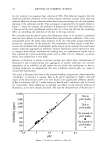
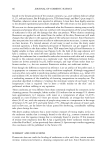
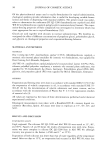
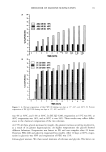
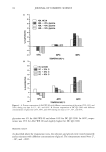
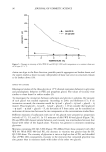
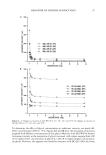
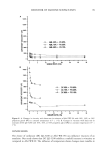
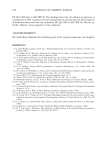
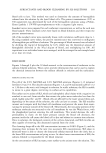
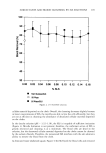
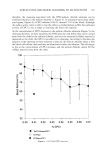
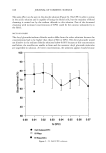
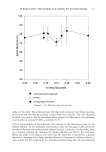
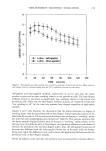
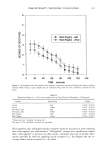
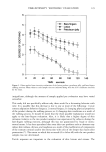
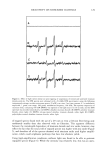
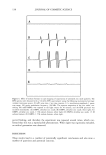
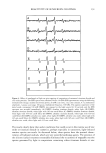
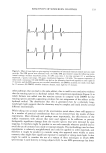
SURFACTANTS AND BLOOD CLEANSING BY SLS SOLUTIONS 107 therefore, the cleansing associated with the CPC1/sodium chloride solutions can be attributed mainly to the sodium chloride (7, Figure 5). In deionized water alone (dark- ened square, Figure 4), a CPC1 solution (0.01%) cleansed 57% of the blood. Although the surface-active cation is able to lyse the cells in a similar fashion as SLS, the surfactant activity of CPC1 is not as adept at cleansing the lysed cell material. As the concentration of CPC1 increases in the sodium chloride solutions (Figure 5), the cleansing decreases. In these situations the CPC1 tyses the cells before they can be carried away from the cloth by the sodium chloride, and once the denatured cellular material is deposited on the cloth, the CPC1 is less effective in cleansing. According to the data, the majority of the cleansing in these solutions is done by the sodium chloride where it lifts the blood cells off the cloth and they are distributed within the solution. The cells begin to lyse as the concentration of CPC1 increases, and the sodium chloride cannot lift the cellular material away from the cloth. "øø t o o o 9O 8O 7O 6O 5O 4O 3O 0.00 0.01 0.02 0.03 0.04 0.05 0.06 0.07 % CpCl ß NaC1 Solution/CPCl ¸ DI Water ß DI Water/CPC1 Figure 4. 0.9% NaC1/CPC1 solutions.

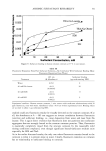
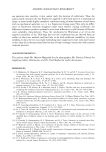
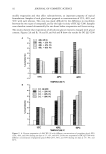
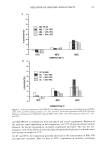
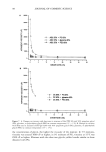
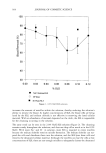
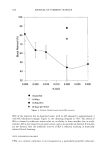
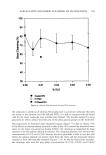
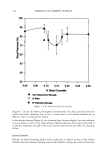
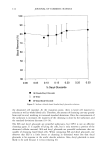
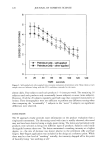
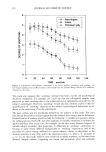
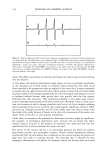
108 JOURNAL OF COSMETIC SCIENCE The same effect can be seen in the douche solution (Figure 6). The CPC1 is able to ionize in the acidic solution and is capable of lysing the blood cells, but the majority of blood cleansing is carried out by the sodium chloride in this solution. Part of the decreased cleansing with increased concentrations of CPCI could be the cationic substantivity to the fabric. DECYL GLUCOSIDE The decyl glucoside/sodium chloride results differ from the other solutions because the concentrations had to be higher than those of SLS or CPC1. The decyl glucoside would not dissolve in the sodium chloride solutions below 0.09% because at this concentration and below, the micelies are unable to form and the nonionic decyl glucoside molecules are suspended in solution. At lower concentrations, the solutions appear cloudy because lOO 80-- 70 60 - 50- 40 30 0.00 0.01 0.02 0.03 0.04 0.05 0.06 0.07 % CPCl ß NaCI Solution/CPCl O DI Water ß DI Water/CPCl Figure 5. 2% NaC1/CPC1 solutions.
Purchased for the exclusive use of nofirst nolast (unknown)
From: SCC Media Library & Resource Center (library.scconline.org)