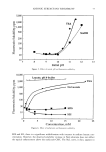
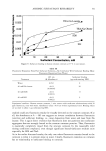
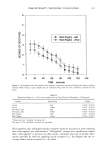
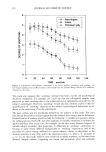
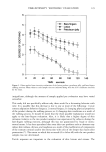
Cosmet. Sci., 49, 101-113 (March/April 1998) Evaluation of the effect of surfactants on the blood-cleansing ability of sodium chloride solutions MARTIN E. CHANDLER, JUDY BATEMAN, and THOMAS G. WOOD, Research and Development Department, C. B. Fleet Co. Inc., 4615 Murray Place, Lynchburg, VA 24506. Received for publication March 23, 1998. Synopsis This study investigated the effect of three different surfactants on the blood-cleansing ability of sodium chloride solutions. Three surfactants, sodium lauryl sulfate (SLS), cetyl pyridinium chloride (CPC1), and decyl glucoside, and three sodium chloride solutions, 0.9% sodium chloride, 2.0% sodium chloride, and a sodium chloride-based douche solution, were used. The cleansing was based on the percent blood removal from a cloth. In all three sodium chloride solutions, the surfactant interacts, altering the blood-cleansing ability of the sodium chloride solutions. SLS, CPC1, and decyl glucoside lowered the blood cleansing ability of the sodium chloride solutions, although the decyl glucoside can be used effectively, in lower concentra- tions, with sodium chloride solutions. INTRODUCTION Physiological saline is used as a biological cleanser and irrigant because its isotonic nature makes it compatible with body fluids and tissues therefore, red blood cells can be suspended in it without being lysed (1). Surfactants are also effective cleansing agents for both biological and non-biological substances because they separate particles from surfaces and allow them to be washed away by the solution (2). Theoretically, if sodium chloride solutions and the ideal surfactant could be combined in the proper proportion, a powerful all-purpose cleanser could be produced. Research has shown that salt inhibits a surfactant's cleansing ability, but there is little information on how surfactants affect the biological cleansing of sodium chloride solutions (3). By studying the influence of several surfactants on sodium chloride solutions, the interaction between the two substances when used to remove blood and other biological materials can be observed. If properly controlled, a solution could use both sodium chloride and surfactant to provide a biological and non-biological cleansing. The ulti- mate goal of this research is to demonstrate how surfactants affect the cleansing abilities of sodium chloride solutions. Sodium lauryl sulfate, CH3(CH2)•oCH2OSO3Na, in aqueous solution, carries its surface- active properties as anions therefore it is referred to as an anionic surfactant. It is a lol

102 JOURNAL OF COSMETIC SCIENCE common ingredient in detergents and toothpaste (4). SLS is known to be incompatible in acids (pH 2.5), where the SLS is in a non-ionized form, which is highly inactive in solution. Cetyl pyridinium chloride, a quaternary ammonium compound, is a cationic surfactant, with the following formula: /NCH2(CHz) 14CH3CL CPC1 is not a very effective detergent, although it is popularly used as a preservative (5). The third surfactant, decyl glucoside, is a nonionic surfactant that does not dissociate into ions when in solution. Decyl glucoside is an alkyl polyglycoside, a surfactant consisting of numerous alkyl chains lengths. Decyl glucoside is a hydrocarbon with an average chain length of 12 carbon atoms (6) and is an effective cleanser because it contains polar glucose groups, with a typical molecule containing an average of two polar glucose groups. By providing powerful cleansing ability with little or no irritation to the skin and mucous membranes, alkyl polyglycosides have become an exciting alternative in surfactant technology. The three sodium chloride solutions were tested against surfactants that represent three of the main classes of surfactants. Each of the surfactants was tested at various concen- trations around the critical micelle concentration. EXPERIMENTAL MATERIALS The SLS was obtained from the Stepan Company, Northfield, Illinois CPC1 from Penta Manufacturing, Fairfield, New Jersey and decyl glucoside (Plantaren 2000 ©) from Henkel Corporation, Hoboken, New Jersey. The douche solution with sodium chloride was Summer's Eve Extra Cleansing Vinegar and Water ©, supplied by C. B. Fleet Co. Inc., Lynchburg, Virginia. All materials were used without further purification. CLEANSING PROCEDURE All blood samples were collected in Vacutainer © tubes with EDTA as an anticoagulant. The plasma was removed, and the cells were rinsed and adjusted to a 40% hematocrit with the 0.9% sodium chloride and stored at 4øC. Three-inch-diameter Veratec Flexilon (70% rayon/30% polyester) cloth pads were cut into eight pie-shaped pieces along the diagonal. A 50-•fi aliquot of blood was expelled onto the tip of the cloth using an Eppendorf pipettor. After one minute, the cloth was picked up with forceps and placed into an 80-ml beaker containing 8 ml of the solution under study, and placed on a Fisher clinical rotator at 100 rpm. After swirling for 15 seconds, the rotator was stopped and the cloth removed. Excess liquid was drained by gently touching the cloth along the inside wall of the beaker. Potassium cyanide reagent was added to the beaker as necessary. The reagent bound to the hemoglobin, changing the osmotic pressure around the cell, which caused the red
Purchased for the exclusive use of nofirst nolast (unknown)
From: SCC Media Library & Resource Center (library.scconline.org)