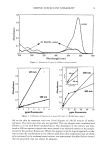
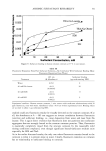
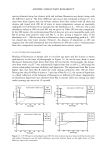
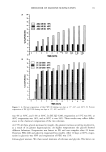
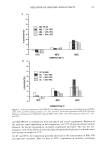
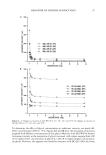
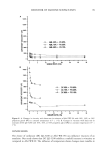
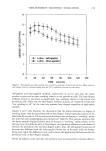
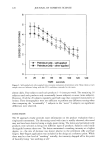
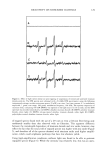
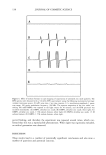
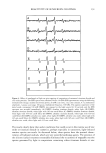
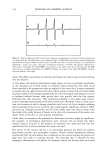
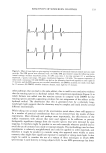
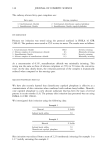
BEHAVIOR OF SILICONE SURFACTANTS 99 A 14003 12t•0 --El-- ABIL50% + PG50% --e-- ABIL70% + PG30% --A-- ABIL90% + PG10% I • I ' I ' I ' I 0 5 10 15 20 SHEAR RATE d/S) ' I ' I' 25 30 A G I I I G --m-- DCS(Y'• + PG50% --e-- DC70% + PG30% --A-- DC90% + PG10% I ' I ' I ' I ' I ' I ' I ' I 0 5 10 15 20 25 30 35 SHEAR RATE (1/S) Figure 8. A. Changes in viscosity with shear rate in mixtures of Abil WE 90 with 10%, 30%, or 50% propylene glycol (PG) at constant temperature (1• ø _+ 1øC). B. Changes in viscosity with shear rate in mixtures of DC Q2-5200 with 10%, 30%, or 50% propylene glycol (PG) at constant temperature (15 ø _+ 1 øC). CONCLUSIONS The choice of surfactant (DC Q2-5200 or Abil 'WE 09) can influence viscosity of an emulsion. Our study shows that DC Q2-5200 exhibits a tenfold increase in viscosity as compared to Abil 'WE 09. The influence of temperature shows changes more notable in

100 JOURNAL OF COSMETIC SCIENCE DC Q2-5200 than in Abil WE 09. Our findings show that the addition of glycerine at a proportion of 50% or greater increases substantiveness and provides the best properties of hydration when used with the surfactants DC Q2-5200 or Abil WE 09. Glycols can further influence these properties of the surfactant. ACKNOWLEDGMENTS We thank Karen Shashok for translating parts of the original manuscript into English. REFERENCES (1) j. Smid-Korbar, J. Krist, and S. Srcic, Polydimethylsiloxane oil in ointments, Pharm. J. Slovenia, 37, 86-90 (1986). (2) D. Schiifer and P. Hameyer, Evolucidn de la Qu/mica de la Silicona y Su Aplicaci•n Cosmgtica (T. H. Goldschmidt, S. A. Jornada T•cnica, Madrid, 1990). (3) A. Nieto Garcfa-Valdecasas, A. del Pozo Carrascosa, and A. Roda, Nuevas Tendencias de formulaci6n de preparados t6picos: Emulsiones A/S, Acofar, 331, 40•i2 (1995). (4) C. O. F. Bizkaia, Formulacidn Magistral de Medicamentos (Colegio Oficial de Farmac•uticos, Bizkaia, 1993). (5) C.D. Vaughan, Using solubility parameters in cosmetics formulation, J. Soc. Cosmet. Chem., 36, 319-333 (1985). (6) M. A. Ruiz, A. Hernandez, A. Parera, and V. Gallardo, Dimethylsiloxane polymers: Vaporization rate test/freezing temperatures, J. Soc. Cosmet. Chem., 46, 175-180 (1995). (7) Norma DIN 53170, Bestimmung der Verdunstungszahl (April 1977). (8) Norma UNE 55-902-85, Agentes de superficie. CDU 661.187:543.71 (1985). (9) Pharmacopea Europea, 2nd ed., V.4.5.5, Parte I (Ministerio de Sanidad y Consumo, Madrid, 1988). (10) R. Voigt and M. Bornschein, Tratado de Tecnolog/a Farmacgutica, Emulsiones (Editorial Acribia, Zara- goza, 1982). (11) F. Puisieux and M. Seiller, Agents de Surface et Emulsions (Les Systgmes Dispersgs). Technique et Documentation (Lavoisier, 1973). P. Sherman and T. Wall (& Sons), Rheology of Emulsions (Pergamon Press, 1963). A. R. Gennaro et al., Remington Farmacia, 17th ed., Vol 1 (Medica Panamericana, Buenos Aires, 1987). W. Liang, Th. F. Tadros, and P. F. Luckham, Rheological properties of concentrated sterically stabi- lized latex dispersions in the presence of hydroxyethyl cellulose,J. Colloid. Interface Sci., 160, 183-189 (1993). L. L. Berga et al., Hemorreolog/a. Bases Tegricas y Aplicaciones Cloenicas (Editorial Salvat S. A., Barcelona, 1983). Introduccidn a la Viscosimetr/a Prdctica (Gebrtider Haake GmbH, Karlsruhe, Germany, 1984). K. E. Lewis and C. Robinson, The interaction of dodecylsulfate with methylcellulose and polyvinyl alcohol, J. Colloid. Interface Sci., 32, 539-546 (1970). (12) (13) 04) (15) (16) (17)
Purchased for the exclusive use of nofirst nolast (unknown)
From: SCC Media Library & Resource Center (library.scconline.org)