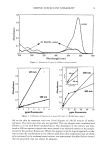
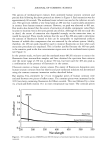
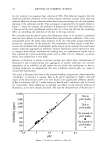
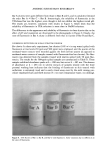
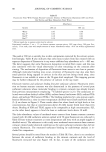
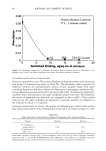
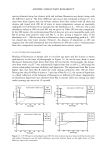
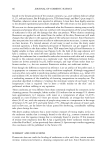
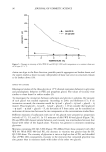
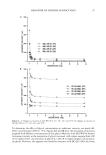
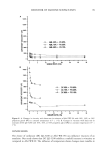
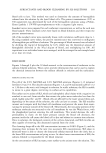
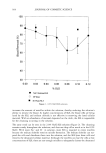
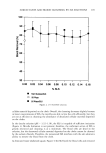
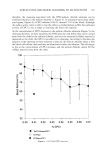
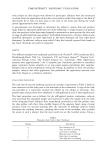
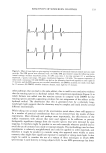
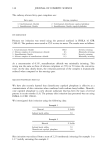
ANIONIC SURFACTANT RINSABILITY 73 0.5 0.4 0.3 0.1 0 250 4:1 MeOH: water 300 350 !\ • • water : ß ! . ß 4OO 45O 5OO 55O Wavelength (nm) Figure 2. Fluorescein (2 ppm) in different solvent systems. 1 1.4 ß 0.8 1.2 1 0.6 • 0.8 0.4 • 0.6 0.2 . , , • ,• 0.4 0.2 0 0 0 1 2 3 4 5 6 0 ppm fluorescein • •j 280 nm,/ 10 20 30 40 50 ppmfluorescein Figure 3. Calibration of fluorescein in water (left) and 4:1 MeOH:water (right). left on the skin by treatment with two 10-ml aliquots of a 80:20 mixture of metha- nol:water. The extraction time was not specified. The two aliquots were combined and diluted to 25 ml with 80:20 methanol:water. The absorbance of the extracts was mea- sured at 280 nm against controls that were treated in an identical manner to the sample, except for the presence fluorescein. While this appears to be the logical approach to take into account the contributions to the 280-nm peak from skin components that are likely to be extracted by the methanol:water solvent, our experiments described below showed that the procedure may not always be adequate.

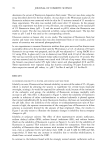
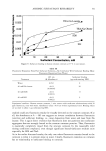
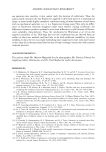
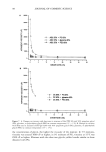
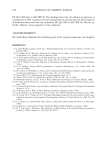
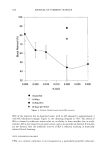
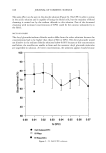
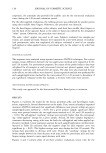
74 JOURNAL OF COSMETIC SCIENCE The spectra of methanol:water extracts from untreated human stratum corneum and porcine skin following the above protocol are shown in Figure 4. Each extraction was for approximately 60 seconds. The methanol:water solvent was used as the reference in each case. The spectrum exhibits a very broad peak at 280 nm that is particularly prominent in extracts from human stratum corneum. However, no peak was observed at 485 nm. Our results also showed that the extent of extraction of soluble components varied from location to location even in the same general area of skin. Although we did not study this in detail, the extent of extraction also depended strongly on the extraction time, as would be expected. These results indicate that the use of the 280-nm peak to determine the amount of fluorescein bound to skin can be susceptible to experimental artifacts because of soluble skin components that are extracted by the solvent system. Ideally, therefore, the 485-nm peak should be used to monitor fluorescein on skin when such extraction procedures are employed. This is further justified because the 485-nm peak is the sensitive peak in the low-concentration region even in the methanol:water system (see Figure 3). In the present study, we have used the methanol:water (80:20) mixture to extract the fluorescein from stratum/skin samples and have obtained the spectrum from extracts over the entire range of 250 nm to about 550 nm, but have used the 485-nm peak as a confirmation of the presence of fluorescein in the extract. Fh/orescein retention on hz/man stratz/m cornez/m. The extent of fluorescein deposition onto human stratum comeurn from bar slurties and pure surfactant solutions was determined using the stratum comeurn immersion studies described below. Bar slurries. Two-centimeter by 1.5-cm rectangular pieces of human comeurn were enclosed between two pieces of teflon screen. The corneum pieces were immersed in the 10% bar slurry containing fluorescein for fifteen seconds. This was followed by a rinse via a back-and-forth motion (5x) in room temperature tap water. The comeurn pieces 0.8 0.6 0.2 280 nm Porcine Skin Human Stratum Comeurn -0.2 250 300 350 400 450 500 550 Wavelength Figure 4. UV-visible spectra of MeOH:water (80:20) extracts of untreated porcine skin and human stratum corneum.
Purchased for the exclusive use of nofirst nolast (unknown)
From: SCC Media Library & Resource Center (library.scconline.org)