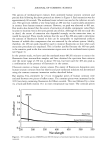
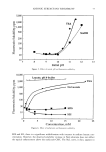
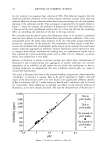
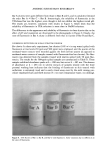
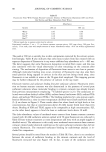
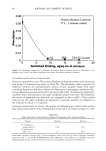
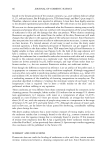
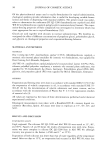
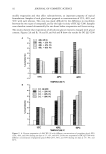
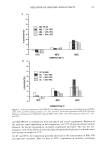
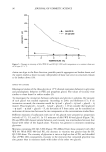
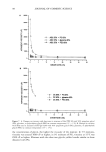
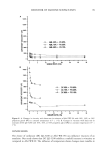
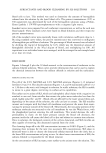
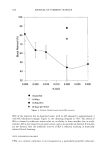
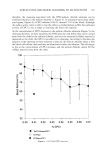
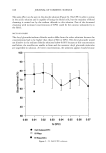
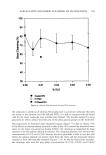
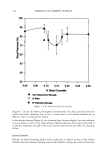
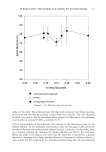
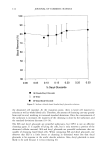
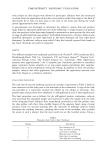
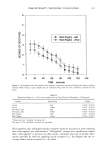
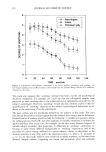
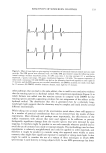
96 JOURNAL OF COSMETIC SCIENCE % % % ß 0 ' I ' I ' I ' I ' 10 20 30 40 50 TEMPERATURE (øC) Figure 5. Changes in viscosity of Abi! WE 90 and DC Q2-5200 with temperature at a constant shear rate of 50 rpm (17 s •). chains can align in the flow direction, possible particle aggregates are broken down, and the system reaches a lower viscosity independent of shear rate since no structures remain to be broken down (16). EFFECT OF GLYCOLS Rheological studies of the three glycols at 15 øC showed newtonJan behavior in glycerine and pseudoplastic behavior in PEG and propylene glycol. The values of viscosity were similar to those found in earlier studies (9). To investigate the interaction between surfactants and glycols in solution, the viscosity of each glycol was studied separately. According to Lewis and Robinson (17), if no interaction occurred, the situation would be: qr I (surf + glycol) = qr I (surf + glycol) - qr I (water). Thus qr I (glycol) + qr I (surf) - qr I (surf + glycol) = 1. If we consider that qr I (glycol) + qr I (surf) - qr I (surf + glycol) = F, the deviation of F from unity can be considered an indication of interaction between the two components at the concentrations studied here. Different mixtures of surfactants with one of the glycols were prepared at proportions (vol:vol) of 7/3, 5/5, and 9/1. In 5/5 mixtures of Abil WE 09 and glycol (Figure 7A), PG and PEG 400 showed similar behavior, and viscosity was intermediate between that found with either of the liquids alone. Viscosity was greatest in mixtures containing glycerine. Mixtures containing DC Q2-5200 (Figure 7B) differed from those prepared with Abil WE 09. With PEG 400 and PG, the decrease in viscosity was greater than for DC Q2-5200 alone. The viscosity of glycerine is twice as high as that of PG, and threefold that of PEG 400 consequently, viscosity in the mixtures that contained glycerine was also greater than in mixtures made with either of the other two glycols.

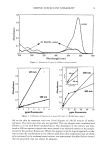
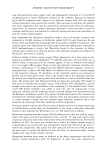
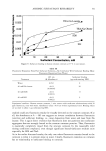
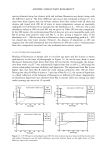
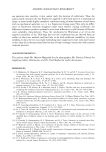
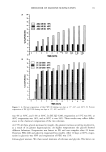
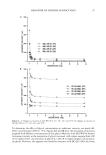
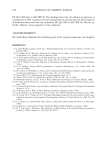
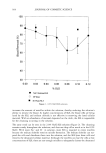
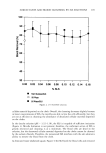
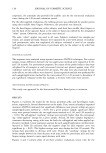
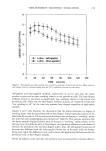
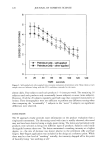
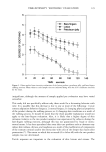
BEHAVIOR OF SILICONE SURFACTANTS 97 A 5000 •o -- I.LI n 4000. --n-- ABILWE0• 1•'C --o-- ABIL WE 0• ,,,, --A-- ABIL WE 0• 40ø(3 ,.•. - -V -• ABIL WE 0• i I I I ' I i i , 0 5 10 15 20 25 30 SHEAR RATE (1/S) ,, %' H':I .... FI- [] i ,, ,, o ,, A• .... o.-- o .............. '.'•- -V .... V .............. V ........................ --El-- DC Q2-5200 15"C --O-- DC Q2-5200 30"C --A-- DC Q2-5200 40øC --V-' DC Q2-5200 50"C I '"" • ' I' ' I ' I ' I ' I ' I 0 5 10 15 20 25 30 35 SHEAR RATE (1/S) Figure 6. a. Changes in viscosity of Abil WE 90 at 15 ø, 30 ø, 40 ø, and 50øC. B. Changes in viscosity of DC Q2-5200 at 15 ø, 30 ø, 40 ø, and 50øC. To determine the effect of glycol concentration on surfactant viscosity, we tested dif- ferent concentrations of PG at 15 øC. Figures 8A and 8B show the rheograms of mixtures prepared with different concentrations of this glycol. Mixtures with Abil WE 09 showed increasing viscosity as the proportion of glycol increased, with values ranging from 400 cP or higher (lower concentration of glycol) to 1200 cP or higher (higher concentration of glycol). However, the opposite was found for mixtures with DC Q2-5200: the lower
Purchased for the exclusive use of nofirst nolast (unknown)
From: SCC Media Library & Resource Center (library.scconline.org)