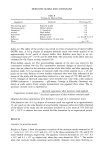
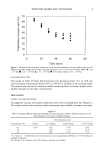
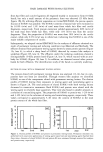
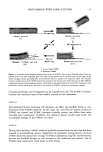
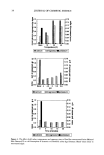
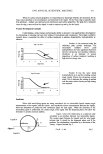
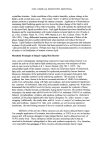
46 JOURNAL OF COSMETIC SCIENCE TOWARDS BETTER SUN PROTECTION THROUGH MOLECULAR PHOTOCHEMISTRY Craig Bonda, Peter Marinelli, Yin Hessefort, Jagdish Trived and Gary Wentworth The C.P. Hall Company I. Introduction The purpose of this paper is twofold: to provide cosmetic formulators, especially those involved in formulating sun protection products, with a basic introduction to photochemistry and to introduce to them a new compound that has a profound effect on the photo stability of many UV filter combinations and, therefore, on the performance of the sunscreens that contain them. Our work grows out of our belief that we stand on the threshhold of a new era in sun protection. In this new era, sunscreens will not only protect against the full spectrum of UV radiation, they will also efficiently and safely dispose of its energy. Formulators of the new sunscreens will combine their mastery of the cosmetic art with a greater appreciation for the physics of sun protection and its chemical and biological consequences. II. Basic Photochemistry Concepts To begin at the beginning: a photon is a quantum or "packet" of electromagnetic energy with an energy equal to Planck's Constant (h) times its frequency (v). The absorption of a photon by an organic molecule causes the excitation of one of a pair of electrons in a low energy orbital to a higher energy unoccupied orbital I (Figure 1). Before absorption, the orbital configuration of the electrons is the "ground" state. Upon absorption, two sm0et Triplet Figure 1: Schematic representation of photon absorption resulting in the excitation of an electron to the singlet state, the decay to the triplet state, and the emission of a photon before returning to the ground state. electronic states are possible. In one, the spins of the two electrons remain paired and, as in the ground state, the net spin of the pair is zero. This is called the "singlet" excited state. In the other, the spins of the two electrons are unpaired, and there is a net spin. This is called a "triplet" excited state because three states can be resolved in a magnetic field. 2 The energy of both excited states is eventually dissipated as heat (vibration, including both bond stretching and nuclear motion), or heat and light (emission of a photon of lower energy/longer wavelength). Emission of a photon from the singlet state is called "fluorescence." Photon emission from the triplet state is called "phosphorescence." The singlet state may return to the ground state directly, or it may decay to the triplet state. • The singlet state is often short-lived, typically 10 '9 - 10 '8 seconds. Therefore, reactions that proceed from it must be quite rapid. Of more importance to the sunscreen formulator are reactions that proceed from the (usually) much longer-lived triplet state, which may last 10 -4 seconds or longertl During the triplet state lifetime, the excited molecule looks and behaves as a diradical, 5 from

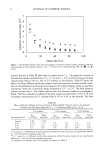
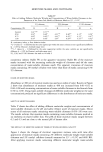
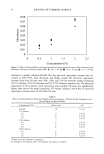
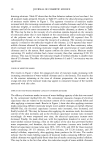
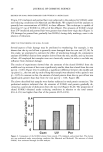
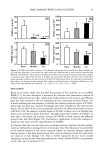
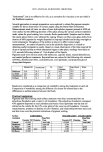
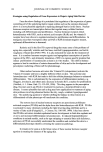
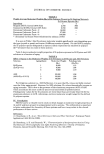
1999 ANNUAL SCIENTIFIC MEETING 47 which many chemical reactions are possible. In general, these reactions can be grouped into four categories: photoaddition/substitution6 cycloaddition7 isomerization* and photofragmentation? Any of these reactions may alter or destroy the UV absorption of the sunscreen formulation. Many factors determine the pathway an excited molecule will take including its triplet energy (Table 1). Under certain conditions, the excited molecule may return to the ground state (and its original form) by transferring its energy to a nearby molecule. The excited molecule becomes a "donor" (D*) and the nearby molecule becomes an "acceptor" (A). Upon the transfer of energy, the donor returns to ground state (D) and the acceptor is elevated to the excited state (A*). n Molecules that accept the triplet energy of excited molecules are called "triplet quenchers." Table 1: Triplet Energies of Some Common Sunscreen Actives tø Aminobenzoic acid 75 kcal/mol Oxybenzone 66 kcal/mole Avobenzone 59.5 kcal/mol Octocrylene 55-60 kcal/mole Octyl methoxycinnamate 57 kcal/mole III. A new sunscreen photostabilizer Figure 2: Diethylhexyl naphthalate (Trade name.' HallBrite TQ). MW-'-440. Avobenzone Photostability as Function of Stabilizer ConcentTation: 5 MED Exposure 1 0.9 0.8 0.7 0.6 0.5 0.3 0.2 •0.1 0 4% 8% Concenlyation Figure 3: Diethylhexyl naphthalate stabilizes Avobenzone (Parsol 1789, Roche) in the concentration- related manner indicative of triplet quenching. Recently, we have developed a new triplet quencher: Diethylhexyl naphthalate (Trade name: HallBrite TQ) (Figure 2). In our laboratory studies, Diethylhexyl naphthalate has proven to be a powerful photostabilizer of Avobenzone. It exhibits the classic relationship of photostability to quencher concentration indicative of triplet quenching: a rapid rise followed by an increasingly gradual rise (Figure 3). In a side-by-side comparison, the new compounds demonstrated a photostabilizing effect on Avobenzone comparable to that of Octocrylene. Model broad spectrum sunscreens made with the new compounds show virtually no loss of absorbance at any point in the spectrum even after exposure to five hours of direct sunlight. Sunscreens with enhanced stability exhibit and maintain in vitro Sun Protection Factors far above those with much higher levels of active ingredients (Table 2). Diethylhexyl naphthalate*is a superior solvent for sunscreen actives: 20%(w/w) for Avobenzone 17%(w/w) for Benzophenone-3 20%(w/w) for Octyl triazone. It has a unique,
Purchased for the exclusive use of nofirst nolast (unknown)
From: SCC Media Library & Resource Center (library.scconline.org)