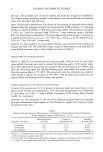
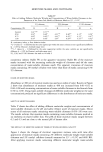
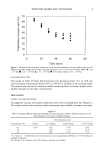
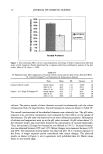
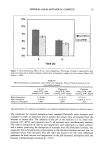
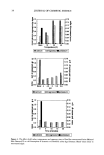
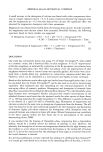
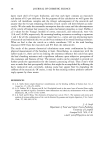
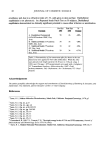
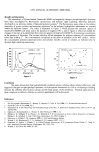
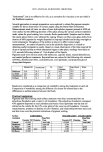
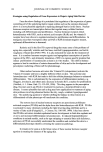
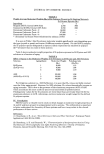
48 JOURNAL OF COSMETIC SCIENCE emolliency and, due to a refractive index of 1.53, adds gloss to skin and hair. Diethylhexyl naphthalate is not phototoxic. In a Repeated Insult Patch Test on 50 subjects, Diethylhexyl naphthalate demonstrated no clinically significant potential to cause either irritation or sensitization. Pre-Sun Post-Sun % Formula SPF SPF Chan!•e A. Unstabilized Commercial 50 26 -48% (16%-18% actives: OMC, Oxy, Avo) B. Stabilized Model (11% actives: 50 36 -28% OMC, Oxy, Avo) C. Stabilized Model (7% actives: 39 42 +8% OT, Oxy, Avo) D. Stabilized Model (7% actives: 29 34 +17% Oxy, Avo) Table 2: Photostability of four sunscreens after five hours in the sun. Sunscreens were applied to Vitro-skin (7MS) slides. When dry, they were placed in the bright sunJ•om 10:30 a.m. to 3:30p. m. (Aug. 3, 1999, near Chicago). SPF measurements were made with a Labat•here UV Transmittance Analyzer. Abbreviation key: OMC=Octyl methoxycinnamate Oxy=Oxybenzone Avo=Avobenzone OT=Octyl triazone Acknowledgements The author gratefully acknowledge the support and contributions of David Steinberg of Steinberg & Associates, and Mark Miller, Pete Marinel!i, and Yin Hessefort of The C.P. Hall Company. References • Turro, N.J., Modem Molecular Photochemistry, Menlo Park, California: Benjamin/Cummings, 1978. p.3 2 Turro, N.J., Op. cit., p.23 3 Turro, N.J., Op. cit.,. pp. 4-6 4 Turro, N.J., Op. cit., p.90,105,352 s Turro, N.J., Op. cit., pp. 364-365 6 Turro, N. J., Op. cit., Ch. 10 7 Turro, N. J., Op. cit., Ch. 11 8 Turro, N. J., Op. cit., Ch. 12 9 Turro, N.J., Op. cit., Ch. 13 •0 Gonzenbach, H., Hill, T.J., Truscott, T.G., The triplet energy levels of UVA and UVB sunscreens, Journal of Photochemistry and Photobiology. B: 16 377-379 (1992) • Turro, N.J., Modern Molecular Photochemistry, Menlo Park, California: Benjamin/Cummings, 1978. Ch. 9

1999 ANNUAL SCIENTIFIC MEETING 49 POLYMER-SURFACTANT INTERACTIONS STRUCTURE• RHEOLOGY• AND REACTION TEMPLATING Robert K. Prud'homme Princeton University, Princeton, NJ 08544 Mixtures of polymers and surfactants occur ubiquitously in consumer products applications. Polymers are often added to surfactant formulations to control rheology - sometimes with disastrous effects. While both the polymer and surfactant are water soluble their interactions can cause phase separation, gelation, or precipitation depending of the nature of the interactions, interaction strengths, and concentrations. We will begin by presenting the data on unmodified, or uniform polymers with surfactants. For repulsive interactions phase separation is the norm, and for attractive interactions again 'phase separation is the norm. But the equilibrium rules for both systems will be different. The rules for surfactants interacting with hydrophobically modified polymers are significantly different. The presence of hydrophobes on the polymer creates specific interaction sites with the surfactant micelles or mesophases. We will present three problems involving the interactions between surfactant structures and hydrophobically modified polymers. The first two involve association complexes between hydrophobically modified polymers in dilute and concentrated surfactant phases and the second involves polymerizations in surfactant mesophases. In several applications involving surfactant formulations it is desirable to have a fluid with tunable rheology. Adding polymers alone often results in phase separation and unstable formulation. Recently considerable work has gone into understanding hydrophobically modified polymers and their influence on formulation rheology. In the talk we will discuss how the control of surfactant morphology can be used to tune rheology. Neutron scattering under shear is used to clarify the structure of the association fluid in the case of hydrophobically modified polymers interacting with rod-like surfactant micelies. The second problem involves the miscibilization of polymers in concentrated surfactant phases. Polymers do not mix with surfactant lameliar or hexagonal phases because the polymer suffers too great a loss of configurational entropy if it were to be confined into the lameliar bilayers. However, with hydrophobically modified polymers it is possible to balance the entropy loss with the gain of hydrophobic interaction energy and, thereby, produce miscibile systems. Using neutron scattering we show the effect on the surfactant membrane stiffness of the interacting hydrophobically modified polymers. And we will show preliminary results on the use of these polymers to create stable multilamellar vesicles. For several oil/water/surfactant systems "cubic phases" can be obtained which are periodic, oil and water hi-continuous structures. We have successfully polymerized monomers in the aqueous phase to produce regular micro-porous gels with periodicity of 5 to 800 nm. These materials offer interesting opportunities for new classes of separation media, and media for controlled release and as separation media. ABSTRACTS abs.poly/surf SCS 12/99 RKP 7/99
Purchased for the exclusive use of nofirst nolast (unknown)
From: SCC Media Library & Resource Center (library.scconline.org)