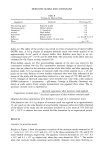
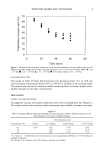
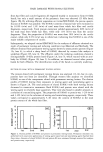
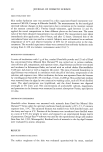
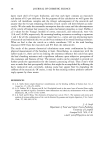
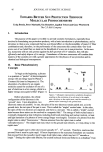
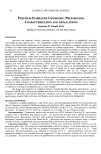
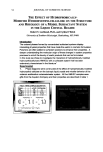
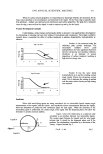
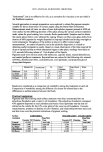
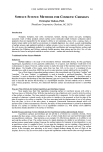
54 JOURNAL OF COSMETIC SCIENCE THE EFFECT OF HYDROPHOBICALLY- MODWIED HYDROXYETHYLCELLULOSE ON THE STRUCTURE AND RHEOLOGY OF A MODEL SURFACTANT SYSTEM IN THE LIQUID CRYSTAL REGIME Robert Y. Lochhead, Ph.D., and Cythia E Welch University of Southern Mississippi, Hattiesburg, MS 39406 Introduction The ordered phases formed by concentrated surfactant systems display interesting physical properties that have made the useful in cosmetic formulation. Polymers are often added to surfactant solutions to enhance their properties. A deeper understanding the molecular origin of these changes in system properties promises to enrich the bounty of useful products that can be formulated. In this study we chose to investigate the interaction of hydrophobically modified hydroxyethylcellulose (HMHEC) with a surfactant system that has been extensively characterized in the literature 1 Experimental: 1. Phase diagrams were constructed of the effect of hydrophobically-modified hydroxyethyl cellulose on the lyotropic liquid crystal and miceliar behavior of the octanoic acid/sodium octanoate/water system. All five HMHEC samples were gifts from the Aqualon Company and their properties are described in table 1. TABLE1: HMHEC •S DESCRIPTION ' Pdymsr x • %I',F' # t, lo per chain • -- 0.0 0 I-IV•EC-1 0 O. 54 5- 8 I-M-•C-2 0 O. 85 8 - 13 •C-3 0 1.91 19- 28 PlVtHEC4 9 0.72 7 - 11 CI"•O(CI'•C•O)4 - R CH20(CH2CH,zO)4H ([ [ OH OH a • --CH•CH=CH=O).---O---(C-•)•C• x=0or9 Oc amoic Acid / Sod'u• Oc aroate[KololdLMandellPEk•,'all Octanolc Acid Mi r lOO H a•lonal • J, 40 g r o q •o co eo lOO no. e

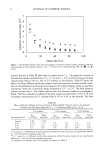
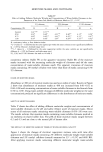
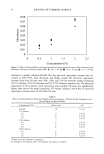
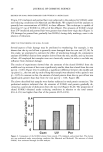
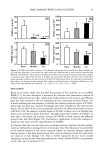
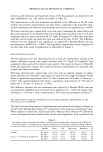
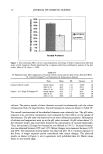
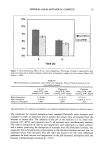
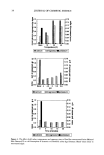
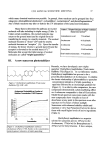
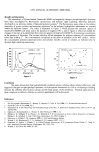
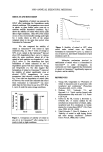
1999 ANNUAL SCIENTIFIC MEETING 55 The thickness of the water layer in the lameliar phase was analyzed using the quadrupolar splitting in deuterium NMR. Controlled stress rheology was measured on a Bohlin CVO rheometer with a couette measuring system. Results Addition of hydrophobically modified hydroxyethylcellulose (HMHEC) to the surfactant system octanoic acid / sodium octanoate / water dramatically alters its properties. Lying at the interface between surfactant aggregates and water molecules, HMHEC changes the packing of surfactant molecules in miceliar and liquid crystal aggregates. Such behavior results in miceliar-to-hexagonal (L•--E) and micellar-to-lamellar (L•--D) phase transitions. As the number of hydrophobic side chains per polymer is increased, these transitions are more pronounced. In the lameliar mesophases, HMHEC causes a slightly decreased width for the water layer (d,,), as shown by 2H NMR. This effect is stronger than the confinement imposed on the HMHEC by a d,, which is much less than HMHEC's estimated hydrodynamic radius (Rh). The confinement effect may be responsible for creating more defects in the bilayer structures, thereby imparting a D--E transition which may not represent a thermodynamically equilibrated state. All of these activities intensify as the % hydrophobe or the spacer length is increased. When placed under the magnitude of steady shear conditions that might be expected in skin applications, the D phase of this system undergoes a phase transition to a vesicular structure after passing through a mixed phase state. As the aqueous content (or d,,) is decreased, this phase transition occurs at a higher shear rate. Surprisingly, HMHEC has practically no effect on this shear-induced phase transition. For the D phase, then, the plane of slippage must be within the surfactant bilayer under steady shear conditions. We find the opposite to be true for the other lameliar phase of this system (B), previously believed to be composed of either vesicles or Helfrich-type planar bilayers. Our data support the idea that the B phase is a Helfrich lameliar phase and indicate that HMHEC acts to bridge the surfactant bilayers such that higher shear rates are required to cause a phase transition. In this case, then, the plane of slippage must be in the water layer, where the HMHEC resides. • Ekwall, P. Mandell, L. Kolloidz ioo 3% HEC HEC Polymere 1969, 233, 938.
Purchased for the exclusive use of nofirst nolast (unknown)
From: SCC Media Library & Resource Center (library.scconline.org)